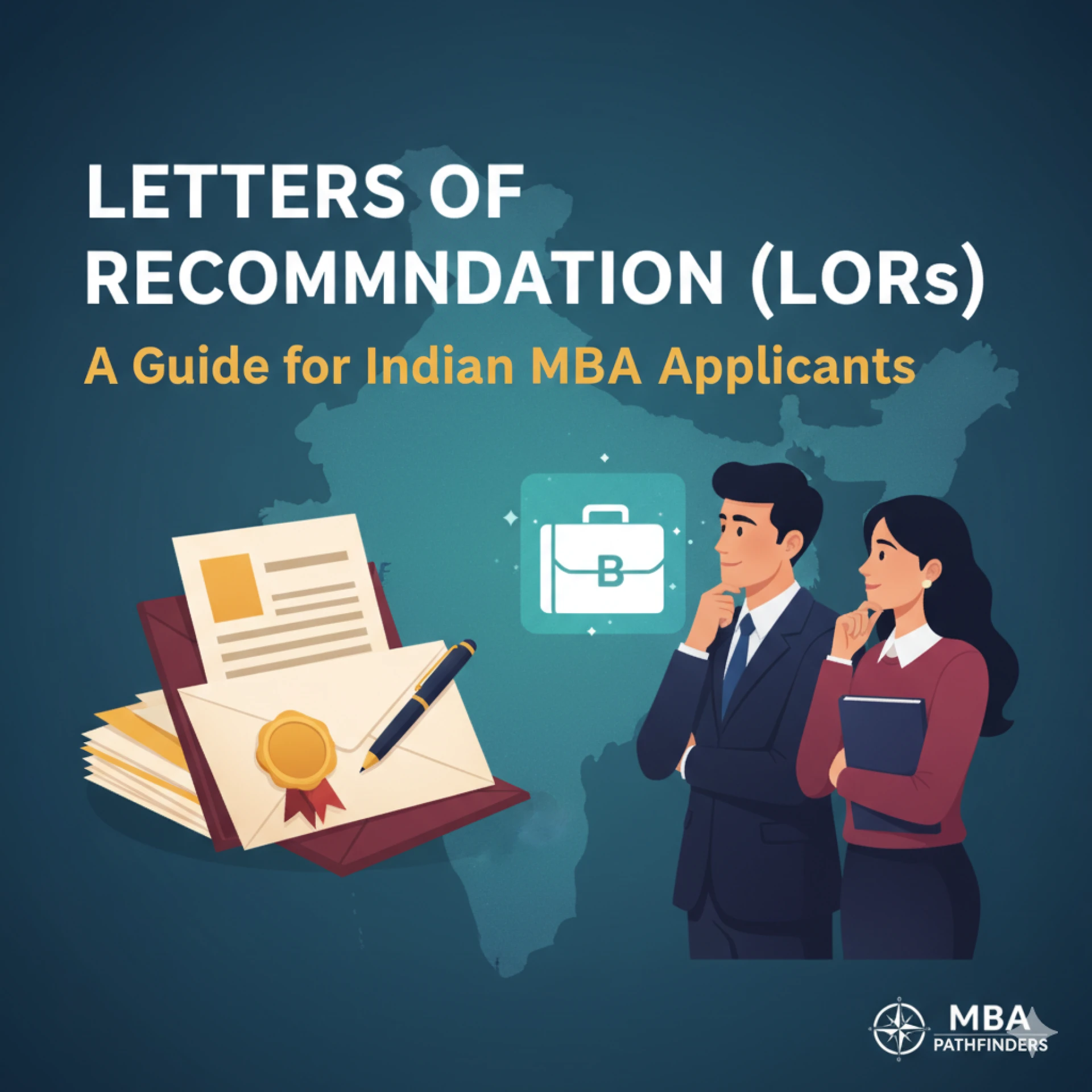
Let's talk about the one part of your MBA application that you don't actually write yourself, but which you have almost complete control over.
It's the one part that can feel incredibly awkward and nerve-wracking.
The Letter of Recommendation. The LOR.
It's that slightly cringey process of having to go to your busy boss or a senior professor and asking them, "Sir... Ma'am... could you please take time out of your life to write nice things about me for a college application?"
Most MBA aspirants are completely clueless about how to handle this. They either make the huge mistake of asking the wrong person, or they ask the right person in the completely wrong way.
Let me be very clear: A powerful, insightful, story-driven LOR can be your secret weapon. It can be the thing that pushes a borderline application into the 'admit' pile. On the other hand, a weak, generic, or lukewarm LOR can be a silent killer. It can raise red flags and plant seeds of doubt in the admissions committee's mind.
So, let's break down the art and science of getting great Letters of Recommendation (LORs). This is a crucial, often underestimated, part of the high-stakes admissions game.
Part 1: The 'Who' - Choosing Your Recommenders (This is 90% of the Battle)
This is the most important strategic decision you will make in the entire LOR process. Choosing the right person is almost everything.
The 'Big Title' Trap: A Classic and Fatal Mistake This is the single biggest mistake I see students make year after year. They think they should ask the most senior, most famous person they know. Their flawed logic goes something like this:
"I met the CEO of my company once at an office party. I'll get him to write my LOR! He's a very important person. The B-school will be so impressed with his designation!"
Wrong. This is a terrible, terrible idea.
Why? Think about it logically. The CEO of a 10,000-person company probably doesn't know you from Adam. He hasn't worked with you on a daily basis. He has never seen you handle a crisis, lead a project, or deal with a difficult client.
So, what kind of letter can he possibly write? He'll ask his secretary for your resume and then write a generic, one-paragraph letter that says something like this:
"Rohan Verma works as a Software Engineer in our organization. His records indicate that he is a hardworking employee. I wish him the best for his future academic endeavors."
This letter is completely useless. In fact, it's worse than useless. It actually hurts your application because it shows extremely poor judgment on your part. It tells the admissions committee that you value fancy, superficial titles over genuine substance. A top B-school like the IILM University Greater Noida wants to see genuine, ground-level insight into your character, your work ethic, and your potential. A generic letter from a big shot provides none of that. This is the first thing to remember about getting good Letters of Recommendation (LORs).
The Golden Rule of Recommender Selection
Choose someone who knows you intimately and has supervised your work directly over someone who simply has a fancy title.
The best recommender is someone who can talk about your specific strengths, your achievements, your potential, and even your areas for improvement with real, concrete stories and examples. Specificity is everything. The quality of the insight in your Letters of Recommendation (LORs) is far, far more important than the designation of the person writing it.
Your Ideal Recommender Profile: A Detailed Breakdown So, who should be on your target list?
Your Direct Manager/Supervisor: This is almost always your best bet. This is the person who has seen you work day-in and day-out for a significant period. They have seen you at your best and at your worst. They know your projects, your work ethic, your successes, and your failures. Their recommendation carries the most weight because it is the most credible.
A Previous Manager: This is a great option if you have recently changed jobs or, more commonly, if you don't want your current manager to know that you're planning to leave for an MBA. A letter from a manager you worked with for two years at your previous company is still incredibly valuable.
A Senior Colleague or a Project Lead: This is perfect if you worked on a critical project where this person, while not your official manager, supervised your work closely and can speak to your specific contributions.
A Professor (Primarily for Freshers): If you are applying straight out of college, you can ask a professor. But—and this is crucial—it cannot be just any professor. It must be a professor whose class you excelled in AND with whom you had a significant personal interaction. For example, maybe you worked on a research project with them, or you helped them organize a conference. They need to know you as more than just a name on an attendance sheet.
A Client (In some special cases): This can be incredibly powerful if you are in a client-facing role like consulting or account management. A glowing letter from a happy, senior client is amazing third-party validation of your skills and professionalism.
Part 2: The 'How' - The Art of Asking (Making Their Job as Easy as Possible)
Once you've identified the right people, you need to approach them in the right way.
Never, Ever Just Forward a Link This is lazy, disrespectful, and is guaranteed to get you a weak, rushed LOR. Never, ever send a one-line email to your boss saying, "Hi Sir, hope you are well. Please write a LOR for me for my MBA application, here is the link. Thanks."
Your recommender is a very busy senior professional. You must respect their time. The secret to getting a great LOR is to make their job as easy as possible. You do this by preparing what's called a 'Recommender's Packet' or a 'Brag Sheet'.
The Recommender's Packet: Your Most Important Tool This is a simple document you prepare for your recommender that gives them all the information and "raw material" they need to write a fantastic, detailed letter about you. It should include:
Your Final, Polished Resume: So they have all your professional details and dates handy.
Your Statement of Purpose (or your key essays): This is so important. It helps them understand your story, your career goals, and your reasons for pursuing an MBA. Their letter can then align with and reinforce your personal narrative, making your whole application consistent and powerful.
A Clear List of Schools & Their Deadlines: A simple Excel sheet with the college name, the program you're applying to, and the specific deadline for their recommendation is incredibly helpful.
The 'Magic Ingredient' - A List of Your Achievements with Them: This is the most important part. Create a bulleted list of 3-4 specific projects you worked on with that person. For each project, use the STAR method (Situation, Task, Action, Result) to remind them of your specific contributions.
Example Point: "Project: 'Phoenix' - Client Crisis Management (2023). I'm hoping you could talk about the time our main client's server crashed. As a reminder, my specific actions were: I took the initiative to create a 24/7 support roster for our team, I acted as the single point of contact for the client's frustrated manager, and I sent them hourly updates to manage their anxiety. The result was that we retained the client, who later praised our team's handling of the crisis."
This packet refreshes their memory and gives them specific, concrete examples to use in their letter. It transforms their job from "I have to think of something impressive to write about this person" to "Wow, this is great material I can easily use to write a strong letter." This is the real secret to getting powerful and detailed Letters of Recommendation (LORs).
The entire process of preparing this packet shows a level of professionalism and strategic thinking that a B-school like the Jagdish Sheth School of Management (JAGSOM) looks for in its candidates.
The Content: What a 'Good' LOR Actually Says
It's all about stories, not just adjectives.
A Weak LOR Excerpt: "Priya is a very intelligent, hardworking, and sincere employee. She is a great team player and has strong leadership potential. I highly recommend her for your program." (This is useless. It's just a string of empty adjectives that could apply to anyone).
A Strong LOR Excerpt: "Priya's leadership potential became truly evident during the 'Triton' project crisis last year. When our team lead quit unexpectedly just two weeks before the deadline, Priya, despite being a junior member, immediately stepped up without being asked. She took charge of coordinating the remaining three team members, worked through two consecutive nights to re-allocate the pending tasks, and acted as the single point of contact for the anxious client, managing their expectations with a level of maturity far beyond her years. She single-handedly turned a potential disaster into a successful delivery. This is just one example of her remarkable sense of ownership and her composure under pressure."
The second one tells a story. It gives concrete proof. That's what makes for great Letters of Recommendation (LORs).
The Bottom Line
Your LORs are the only part of your application where a trusted, senior professional validates all the claims you've made about yourself. They provide a 3D picture of you that your scores and your own essays can't.
The strategy is simple but requires real effort:
Choose your recommenders based on who knows you best, not who has the fanciest title.
Prepare a detailed packet that makes it incredibly easy for them to write a great, story-filled letter for you.
Give them plenty of time and always ask with respect.
That's how you get powerful Letters of Recommendation (LORs) that make the admissions committee sit up and say, "Wow, we need to meet this person."