F# is a modern programming language that is widely used for functional programming and works with the .NET platform. It is designed to help developers create clear, reliable, and maintainable applications. F# also supports object-oriented and imperative programming, making it a flexible choice for different software development needs.
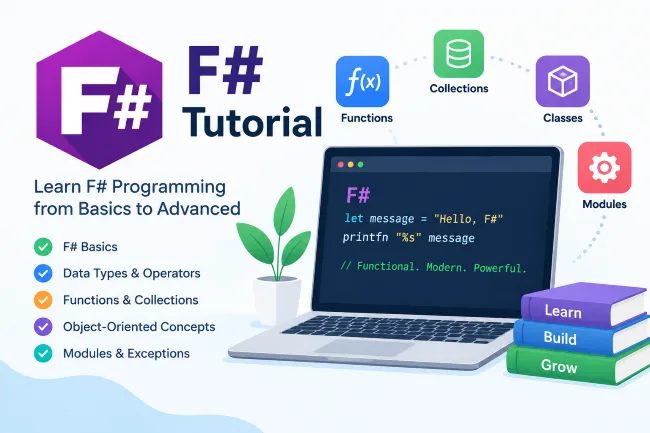
Learning F# starts with understanding its basic concepts. Beginners can explore values, variables, data types, operators, expressions, and conditional statements. These fundamental topics provide a strong foundation for understanding how F# programs are designed and how different elements work together.
One of the important features of F# is its focus on functions. Functions allow developers to organize tasks into smaller and reusable parts. Understanding functions can improve problem-solving skills and make complex applications easier to manage. F# also provides type inference, which can make programming simpler by reducing the need to specify types in many situations.
F# offers several useful data structures and concepts. Learners can study strings, tuples, lists, arrays, sequences, sets, maps, and other collections. Options are also important because they provide a clear way to represent values that may or may not be available. These features make F# useful for working with different kinds of information.
As learners progress, they can explore more advanced concepts such as records, generics, classes, inheritance, and interfaces. These topics help developers understand how F# can be used for larger applications and object-oriented programming requirements. Modules provide another useful way to organize related functions, values, and types into manageable sections.
Exception handling is also an important part of F# programming. It helps applications deal with unexpected situations in an organized manner. Learning how exceptions work can help developers create more dependable software.
F# is useful in areas such as data processing, scientific computing, financial applications, and other software projects where reliable and expressive programming is valuable. Its connection with the .NET ecosystem also allows developers to work with a broad range of technologies and libraries.
For beginners, the best approach is to learn F# step by step. Start with fundamental programming concepts, understand functions and data structures, and then gradually move toward advanced topics. Regular practice and a clear learning resource can make the process easier. Regular practice and a clear learning resource can make the process easier.
Whether you are a student, beginner, or experienced developer, learning F# can expand your programming knowledge and introduce you to functional programming concepts.
For more information about F# programming concepts and features, explore the F# Tutorial.