

Every fall, the same question comes up in a slightly different form. Do I need a leaf blower or a leaf collector? A robot or a manual tool? Something that moves the leaves or something that picks them up? The home improvement store has an entire aisle dedicated to the problem, which somehow makes the decision harder, not easier.
Here's the thing: both tools solve a real problem, but they solve different versions of it. Getting the right one depends less on which is "better" and more on what your yard actually looks like and what you want to do with the leaves once they're off the lawn.
What a Leaf Blower and a Leaf Collector Actually Do
These two tools are often lumped together, but they work in fundamentally different ways.
A leaf blower moves leaves. That's it. It uses airflow to push debris from one place to another — off the lawn, away from the driveway, into a pile at the edge of the yard. What happens to that pile afterward is up to you. Some people bag them, some compost them, some leave them at the curb for municipal pickup. The blower's job ends at the pile.
A leaf collector — sometimes called a leaf vacuum — picks leaves up. It sucks them in, shreds them, and deposits them into an attached bag or bin. The end result is a compressed, bagged volume of leaf material that's ready for disposal or composting without any additional steps. No pile to manage afterward.
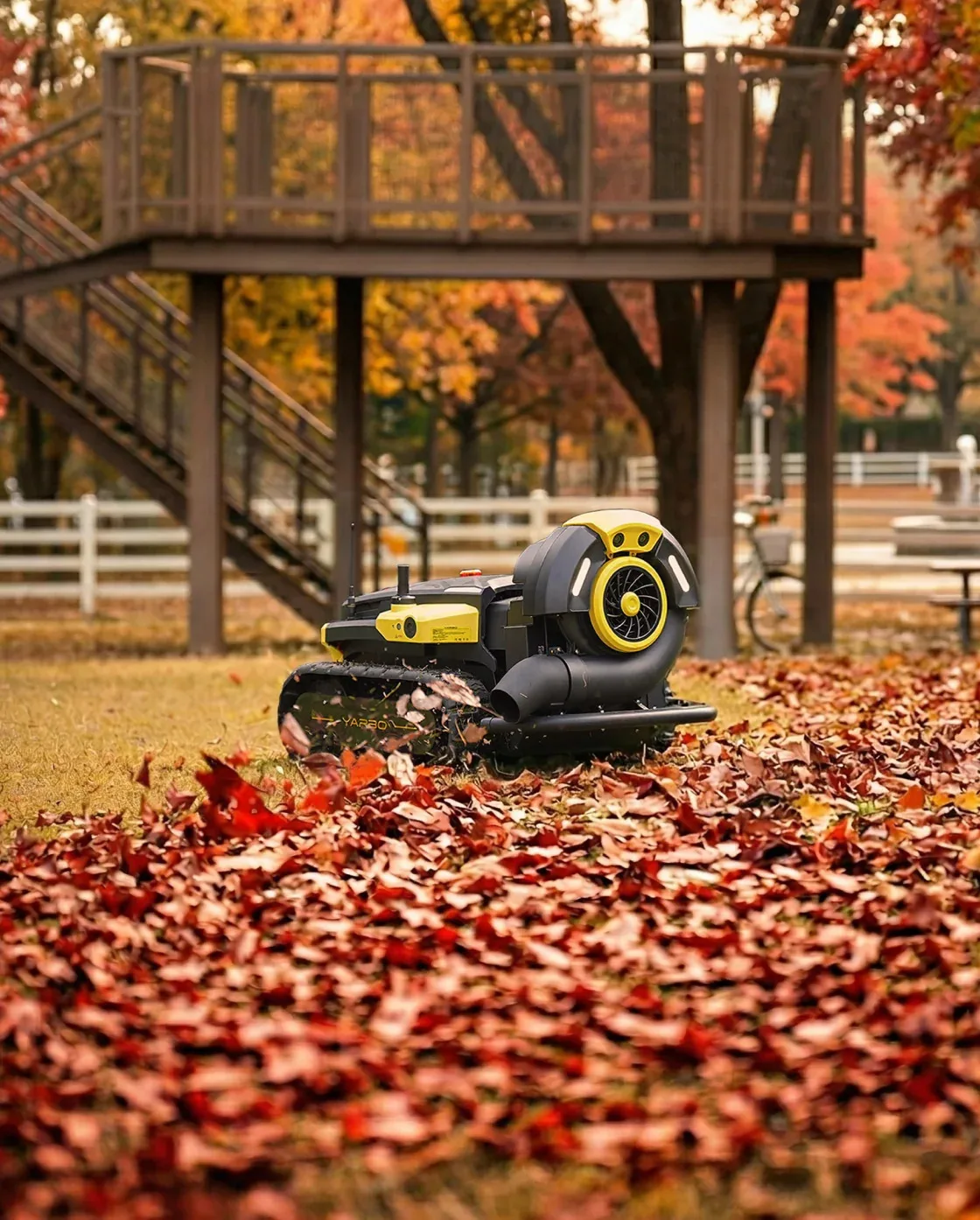
A robot leaf blower, like the one Yarbo makes, applies the blowing approach autonomously. It navigates your property on a set schedule, uses 21N of blowing force to move leaves across varied terrain, and gathers them into consolidated piles — all without you being involved. It's not vacuuming or collecting; it's systematically clearing and stacking, handled by a robot that runs while you're doing something else.
Which One Fits Your Yard and Cleanup Style
Before getting into the specifics, it helps to think about a few practical questions.
How big is your yard? A small, flat lot with a couple of trees is a very different cleanup job than a half-acre property surrounded by maples. Scale matters — both for how much time cleanup takes and for what kind of tool can handle it efficiently.
Where do the leaves end up going? If your municipality picks up leaf piles at the curb, bagging isn't strictly necessary and blowing into a curbside pile is often the fastest workflow. If you're composting, a shredded, collected output is more useful. If you're paying for yard waste bags, a collector that compresses the volume can save money over a season.
How much are you willing to be involved? A handheld leaf blower requires your time and energy every time. A robot leaf blower removes that entirely. A leaf collector — manual or tow-behind — sits somewhere in between.
When a Leaf Blower Makes More Sense
A leaf blower tends to be the better fit when your priority is clearing space quickly and efficiently, and when you have a practical plan for what happens to the leaves afterward.
It's faster for large open areas. Blowing covers ground quickly — much faster than vacuuming the same area — which makes it the more practical tool for bigger lawns where you're moving large volumes of leaves across open space.
It handles wet and heavy leaves better. Leaf vacuums struggle with matted, rain-soaked leaves. Blowers — especially powerful ones — push through wet debris far more effectively. If your fall weather is typically damp, this matters.
It works well when curbside pickup is available. If your town collects loose leaf piles, a blower is all you need. Moving leaves to the curb is exactly what it's designed for, and skipping the bagging step saves a significant amount of time and effort.
And if the idea of not being involved at all is appealing, a robot leaf blower like Yarbo handles the blowing job autonomously. It navigates your property using RTK-GPS and stereo vision, clears your yard on a schedule, and gathers leaves into neat piles — operating on slopes up to 70% and across the kind of uneven terrain that trips up simpler tools. You set it once and come back to a cleared yard, which is a different experience from any manual tool regardless of how well it works.
When a Leaf Collector Is the Better Choice
A leaf collector earns its place when the destination of the leaves matters as much as the act of clearing them.
It's the right tool if you're composting. Shredded leaves break down significantly faster than whole ones. If your composting setup benefits from pre-shredded material — and most do — the built-in mulching function of a good leaf vacuum is a genuinely useful feature, not just a gimmick.
It makes sense when bagging is unavoidable. Some municipalities require bagged yard waste, and a collector that simultaneously shreds and bags leaves does both steps at once. Compared to blowing into a pile and then manually raking that pile into bags, the workflow is much more efficient.
It works better on smaller, more contained areas. A leaf collector is most efficient when you're working in a defined space — a fenced yard, a courtyard, a smaller property where the total volume of leaves is manageable. The trade-off in speed becomes less significant when the area is compact.
Do You Need Both, or Just One?
Honestly, most homeowners can get by with one tool. The question is which one.
If your yard is large, your terrain is uneven, your fall weather is often wet, or you just don't want to spend October weekends doing manual yard work — a leaf blower, and ideally a robot leaf blower, is the more practical choice. It handles the heavy lifting, and the remaining task of disposing of the piles is minimal compared to doing the full cleanup yourself.
If your yard is smaller, you compost regularly, your municipality requires bagged waste, and you don't mind spending an hour on fall cleanup — a leaf collector is the cleaner, more self-contained solution.
Where both genuinely make sense is on larger properties where you want the automation of a robot blower to clear the open lawn, combined with a handheld vacuum for detail work around garden beds, patios, or tight corners. That combination covers the whole yard with minimal manual effort.
How to Choose the Right Tool for Your Fall Cleanup Routine
Start with the size and layout of your yard, and work backwards from there.
Large yard, open terrain, curbside pickup available: a robot leaf blower handles the job with the least involvement. Set the schedule, let it run, and deal with the piles in one short session when they're already consolidated.
Small to medium yard, composting or bagged disposal: a leaf collector gives you a cleaner, more contained workflow and the leaves end up exactly where you want them.
Complex yard with a mix of open lawn and tighter areas: consider whether the robot handles the bulk of the work well enough that a handheld tool covers the rest, or whether the full job is manageable manually with just a collector.
The right tool isn't the most powerful one or the most expensive one. It's the one that fits the way your yard actually works and the amount of time you want to spend on it — every week, from the first leaf drop until the last one hits the ground sometime.


