Delhi has long been the beating heart of India's garment and apparel accessories industry. From the narrow lanes of Sadar Bazar to the organized industrial clusters of Okhla and Narela, the city houses thousands of small and mid-sized units that feed India's massive textile and fashion economy. Among the most essential — yet often overlooked — components of this ecosystem are clothing fasteners: the buttons, snaps, hooks, and closures that hold a garment together and finish its look.
This guide takes a close look at how Delhi became a hub for clothing fastener manufacturers, what sets quality metal button manufacturing apart from mass-produced alternatives, and why polyester button manufacturing has become the fastest-growing segment in the accessories trade.
Why Delhi Is India's Hub for Clothing Fastener Manufacturers
Delhi's position as a fastener manufacturing hub isn't accidental. Several factors have converged over decades to make the city and its National Capital Region (NCR) the natural home for this industry:
- Proximity to garment export clusters — Gurugram, Noida, and Faridabad host hundreds of export-oriented garment units that need a steady, local supply of buttons and fasteners without long shipping lead times.
- Skilled artisan base — Delhi has generations of craftsmen who transitioned from traditional metalwork and mould-making into precision button and fastener manufacturing.
- Raw material access — Zinc, brass, and polyester resin suppliers are concentrated in and around the city, keeping input costs and lead times low.
- Established trade networks — Wholesale markets like Sadar Bazar and Chandni Chowk have functioned as fastener trading hubs for over a century, giving manufacturers direct access to domestic buyers and exporters alike.
A reliable clothing fastener manufacturer in Delhi typically offers far more than buttons off a shelf. It means custom mould development, small-batch prototyping for new fashion lines, and the ability to scale quickly when a buyer's order size grows from a sample run to a bulk production order.
Metal Button Manufacturing: Precision, Durability, and Finish
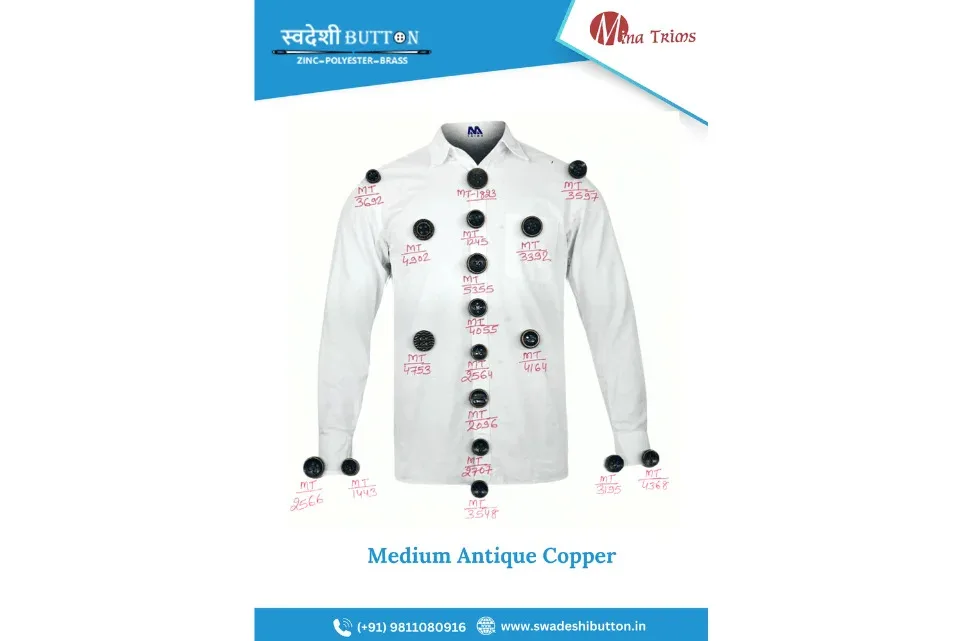
Metal buttons remain the preferred choice for premium garments — blazers, denim, uniforms, and outerwear — because of their weight, durability, and the range of finishes they allow.
The Manufacturing Process
Metal button manufacturing typically follows these stages:
- Die and mould design — A custom die is engineered based on the button's diameter, thickness, and design brief (logo embossing, brand insignia, or a plain finish).
- Zinc casting or stamping — Molten zinc alloy is cast into the mould, or sheet metal is stamped into shape, depending on the button design and order volume.
- Deburring and polishing — Rough edges from casting are smoothed, and the button surface is polished to the required sheen.
- Electroplating — Buttons are plated in finishes such as antique brass, gunmetal, nickel, gold, or matte black to match the garment's aesthetic.
- Quality inspection — Each batch is checked for consistency in shank strength, plating adhesion, and dimensional accuracy before packaging.
Why Buyers Choose Zinc-Casted Buttons
Zinc-casted buttons strike a balance between cost and durability that few other materials match. They hold intricate embossed detail well, resist corrosion when properly plated, and are significantly lighter than solid brass — making them practical for both fashion and functional garments. Manufacturers offering zinc-casted metal buttons typically cater to denim brands, uniform suppliers, and export houses that need consistent finish quality across large production runs.
Polyester Button Manufacturing: The Fast-Growing Segment
While metal buttons dominate premium categories, polyester buttons have quietly become the backbone of everyday apparel — shirts, kidswear, formal wear, and fast fashion. Their popularity is driven by cost-efficiency, design flexibility, and lighter weight for high-volume garment categories.
How Polyester Buttons Are Made
- Resin preparation — Polyester resin is blended with pigments to achieve the exact shade required by the buyer, whether it's a solid colour or a marbled/pearlescent finish.
- Rod casting — The coloured resin is cast into long rods and cured.
- Cutting and shaping — Rods are sliced into button blanks and shaped on precision lathes.
- Hole drilling and polishing — Buttons are drilled (2-hole or 4-hole) and polished to a smooth, consistent finish.
- Sorting and packaging — Finished buttons are graded for colour and size consistency before dispatch.
Advantages of Polyester Buttons for Bulk Orders
- Colour matching precision, essential for brands matching buttons to specific fabric shades.
- Lower cost per unit at scale, making them ideal for mass-market apparel.
- Lightweight and washable, suitable for everyday wear and frequent laundering.
- Design versatility, including marbled, glossy, matte, and two-tone finishes.
Manufacturers specializing in polyester button manufacturing generally serve shirt manufacturers, school uniform suppliers, and export houses working on tight per-unit cost targets.
What to Look for in a Clothing Fastener Manufacturer
Whether you're sourcing metal or polyester buttons, a few criteria separate dependable manufacturers from the rest:
- Sample turnaround time — Can they produce and ship samples within days, not weeks?
- Minimum order quantities (MOQs) — Flexible MOQs matter for brands testing new designs before committing to bulk production.
- In-house mould/die-making capability — This shortens development time for custom button designs and reduces dependency on third-party tooling vendors.
- Consistency across batches — Colour and finish consistency is critical when reordering for repeat production runs.
- Compliance and testing — For export orders, buyers often require nickel-release testing, colourfastness certification, or REACH compliance documentation.
Conclusion
Delhi's clothing fastener manufacturing ecosystem — spanning both metal and polyester button production — continues to serve as a critical, if understated, link in India's garment supply chain. Whether a brand needs the durability and premium finish of zinc-casted metal buttons or the cost-efficient versatility of polyester buttons for high-volume production, the city's manufacturers combine decades of craftsmanship with the scale needed to serve both domestic and export markets.
For garment brands and buyers evaluating clothing fastener manufacturers in Delhi, the right partner is one that can move fluidly between small custom batches and large repeat orders — without compromising on finish, colour consistency, or delivery timelines.