Market Overview
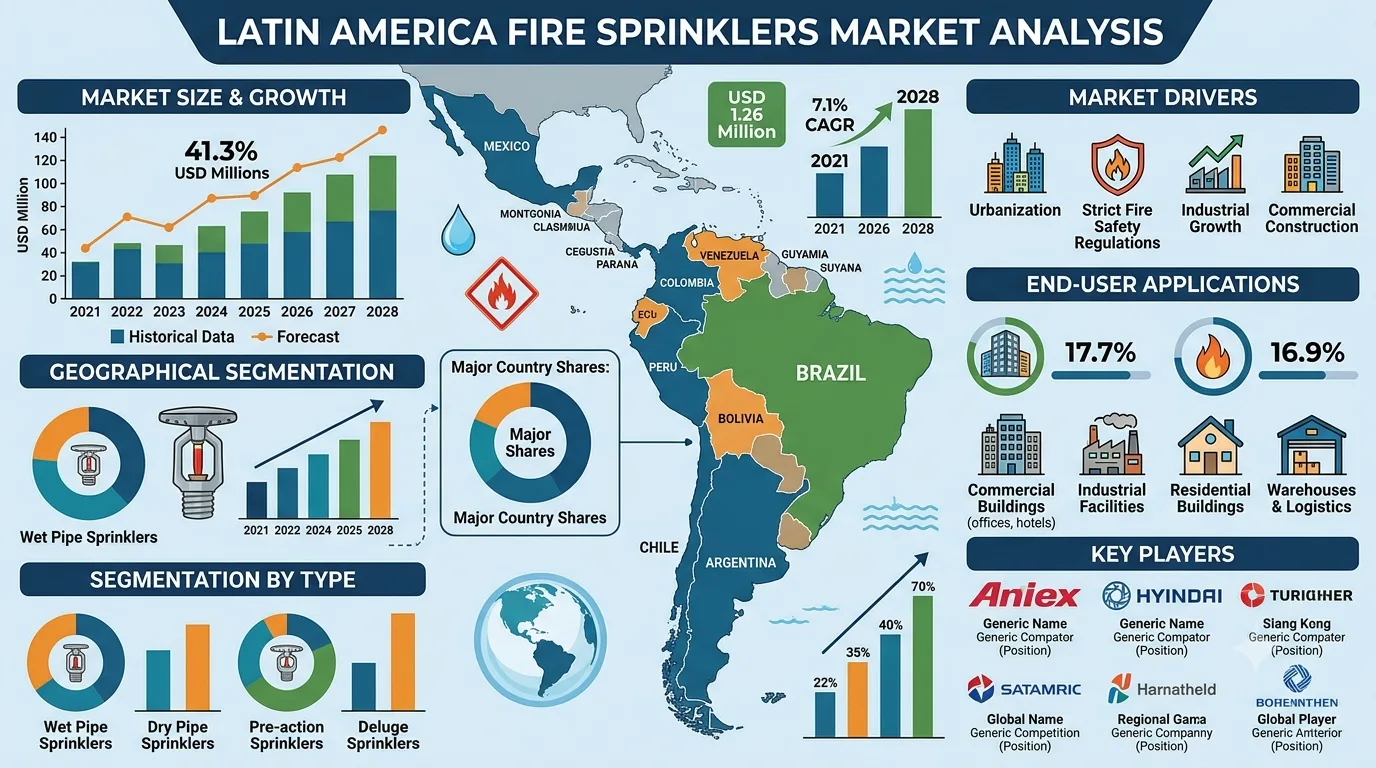
The Latin America fire sprinklers market size reached USD 518.9 Million in 2025 and is projected to reach USD 901.5 Million by 2034, exhibiting a CAGR of 6.14% during 2026-2034. Fire sprinklers are an essential component of fire protection systems, designed to discharge water to extinguish fires and prevent them from reigniting. They are activated when the sprinkler head reaches the activation temperature during a fire breakout, serving as the first line of defense by providing sufficient time for people to escape imminent danger.
This market is strategically important to Latin America's construction, industrial, and public safety infrastructure, supporting the region's transition toward enhanced fire safety standards and building code enforcement. The Latin American fire sprinklers market encompasses wet pipe, dry pipe, deluge, and pre-action systems across commercial, residential, and industrial applications.
The Latin America fire sprinklers market is poised for sustained expansion, underpinned by increasing construction activities, stringent government regulations, and growing awareness of fire safety benefits. With a projected CAGR of 6.14% through 2034, the market presents significant opportunities for manufacturers focusing on technological innovations, HI-FOG systems, and comprehensive service offerings.
LATIN AMERICA FIRE SPRINKLERS MARKET SUMMARY
The Latin America fire sprinklers market encompasses fire sprinkler systems used to discharge water to extinguish fires and prevent them from reigniting, including wet pipe, dry pipe, deluge, and pre-action systems.
The ecosystem spans fire sprinkler manufacturers, component suppliers, engineering service providers, installation contractors, inspection and maintenance firms, and end users across commercial, residential, and industrial sectors.
By Product Type, the market is segmented into Wet Pipe Fire Sprinklers, Dry Pipe Fire Sprinklers, Deluge Systems, Pre-Action Systems, and Others.
By Service, the market covers Engineering Services, Installation, Design Maintenance, Inspection, Managed Services, and Others.
By Component, the market serves Stop Valve, Alarm Valve, Fire Sprinkler Head, Alarm Test Valve, and Motorized Alarm Bell.
By Application, the market serves Commercial Applications, Residential Applications, and Industrial Applications.
By Technology, the market covers Active Fire Protection and Passive Fire Protection.
By Country, the market serves Brazil, Mexico, Argentina, Chile, Colombia, and Rest of Latin America.
Key trends shaping the market include increasing construction activities across commercial, residential, and industrial sectors, growing fire safety awareness, stringent government regulations for fire sprinkler installation, and technological advancements such as HI-FOG systems.
PORTER'S FIVE FORCES ANALYSIS – LATIN AMERICA FIRE SPRINKLERS MARKET
Competitive Rivalry: Moderate. The market features moderate competition among global fire protection companies and regional players. Key players include Honeywell International Inc, Johnson Controls International PLC, Victaulic, Minimax, and Viking Therapeutics Inc. Business implication: Companies must differentiate through product innovation, technological advancements, and comprehensive service offerings.
Supplier Power (Components and Materials): Moderate. Fire sprinkler manufacturers rely on suppliers of valves, sprinkler heads, pipes, and electronic components. The technical expertise required for advanced fire protection systems gives specialised suppliers moderate leverage. Business implication: Strategic supply agreements and vertical integration can reduce supplier dependency.
Buyer Power (Construction Firms and Building Owners): Moderate. Large construction firms and commercial building owners benefit from volume purchasing power. However, the regulatory requirements for fire safety compliance and the critical nature of fire protection systems moderate pure price-based buyer power. Business implication: Manufacturers must invest in product quality, regulatory compliance, and technical support.
Threat of Substitutes: Low. Alternative fire protection methods represent partial substitutes, but the proven effectiveness, reliability, and regulatory mandate of fire sprinkler systems provide strong differentiation across applications.
Threat of New Entrants: Moderate. Significant capital requirements for manufacturing, regulatory compliance, and distribution network establishment create barriers. However, the growing demand for fire protection systems and technological innovations has enabled new entrants focused on specialized solutions.
KEY ASPECTS REQUIRED FOR THE LATIN AMERICA FIRE SPRINKLERS MARKET
Market Performance: USD 518.9 Million in 2025, projected to reach USD 901.5 Million by 2034, driven by increasing construction activities, regulatory enforcement, and fire safety awareness.
Market Outlook: A 6.14% CAGR through 2034 reflects strong growth led by commercial and residential construction, industrial sector demand, and technological innovations such as HI-FOG systems.
Growth Drivers: Increasing construction activities across commercial, residential, and industrial sectors; growing incidences of fire breakouts in risk-prone industries such as energy, oil and gas, and manufacturing; rising awareness about the benefits of fire sprinklers; stringent government regulations for installing fire sprinklers in public and private buildings; elevating living standards and rising disposable income levels increasing expenditures on home protection systems; technological advancements introducing fire sprinkler systems with HI-FOG technology.
Competitive Landscape: Moderate competition with global fire protection companies including Honeywell International Inc, Johnson Controls International PLC, Victaulic, Minimax, and Viking Therapeutics Inc competing across product innovation, service offerings, and distribution networks.
Value Chain Analysis: From component manufacturing and system assembly through engineering services, installation, and design maintenance to inspection and managed services.
Industry Trends: HI-FOG technology adoption with quicker activation rates and enhanced oxygen displacement capabilities; increasing integration of active and passive fire protection systems; expansion of managed services and inspection offerings; growing demand from residential applications; regulatory enforcement driving installation rates.
Strategic Recommendations: Invest in HI-FOG and advanced fire sprinkler technologies; expand commercial and residential application capabilities; strengthen service offerings including installation, inspection, and managed services; pursue regulatory compliance certifications; target Brazil and Mexico's growing construction markets; develop comprehensive fire protection solutions combining active and passive technologies.
Request for Sample Report: https://www.imarcgroup.com/latin-america-fire-sprinklers-market/requestsample
MARKET GROWTH DRIVERS
Increasing Construction Activities Across Commercial, Residential, and Industrial Sectors
The Latin America fire sprinklers market is primarily driven by increasing construction activities across commercial, residential, and industrial sectors. Rapid urbanization and industrialization across the region are driving demand for fire protection systems. Rising disposable income levels and population growth have increased the need to construct residential and commercial complexes. The elevating living standards, supported by rising disposable income levels, have increased expenditures on home protection systems, such as fire sprinklers. Commercial real estate development and industrial facility construction across Brazil, Mexico, and other Latin American countries are creating substantial opportunities for fire sprinkler installations.
Stringent Government Regulations and Fire Safety Standards
Governments across Latin America are imposing stringent regulations for installing fire sprinklers in both public and private buildings and institutions, providing a positive impact on market growth. With the growing number of fire outbreaks across numerous manufacturing facilities and warehouses and the rising awareness about the benefits of fire sprinklers, governments are giving more emphasis on the improvement of fire safety standards. This has increased the installation rate of fire sprinkler systems across the region. Regulatory enforcement across commercial, residential, and industrial applications is driving sustained demand for fire sprinkler systems.
Growing Fire Safety Awareness and Risk-Prone Industries
The growing incidences of fire breakouts in risk-prone industries, such as energy, oil and gas, and manufacturing, are catalyzing market growth significantly. Industrial facilities recognize fire sprinklers as critical infrastructure for protecting assets, ensuring worker safety, and maintaining business continuity. The increasing awareness about the importance of fire protection systems in commercial and residential buildings is driving adoption across all market segments.
Technological Advancements and HI-FOG Systems
Technological advancements have prompted manufacturers to introduce fire sprinkler systems with HI-FOG technology. These systems have quicker activation rates, enhanced oxygen displacement capabilities, and enable minimal water loss. Innovation in fire sprinkler technology is creating premium product opportunities and expanding the addressable market across applications requiring advanced fire protection solutions.
LATIN AMERICA FIRE SPRINKLERS MARKET SEGMENTATION
Segmentation analysis provides a detailed view of the Latin America fire sprinklers market by category:
Product Type Insights:
Wet Pipe Fire Sprinklers – the largest product segment, accounting for the majority of the market share due to their reliability, simplicity, and widespread adoption across commercial and residential applications.
Dry Pipe Fire Sprinklers – anticipated to remain the highest-growth segment during the forecast period, driven by applications in environments where freezing is a concern.
Deluge Systems – used in high-hazard industrial applications requiring simultaneous water discharge across all sprinkler heads.
Pre-Action Systems – serving applications requiring additional protection against accidental discharge, such as data centers and museums.
Others – including specialized and emerging fire sprinkler technologies.
Service Insights: Engineering Services – providing system design and planning; Installation – system deployment and commissioning; Design Maintenance – ongoing system optimization; Inspection – regulatory compliance and safety verification; Managed Services – comprehensive outsourced fire protection management.
Component Insights: Stop Valve, Alarm Valve, Fire Sprinkler Head, Alarm Test Valve, Motorized Alarm Bell.
Application Insights: Commercial Applications – the dominant application segment, driven by office buildings, retail spaces, healthcare facilities, and hospitality properties. Residential Applications – a growing segment driven by rising disposable incomes and home protection system expenditures. Industrial Applications – serving manufacturing facilities, warehouses, energy, and oil and gas sectors.
Technology Insights: Active Fire Protection – systems that actively detect and suppress fires, including fire sprinklers. Passive Fire Protection – building design features that contain fires and prevent spread.
Country Insights: Brazil – the largest market in the region, driven by extensive construction activity, large industrial base, and regulatory enforcement. Mexico – forecasted to be the fastest-expanding market, projected to reach USD 0.52 Billion by 2034. Argentina, Chile, Colombia – significant markets with growing construction and industrial activity. Rest of Latin America – including Peru and other countries with developing fire protection infrastructure.
COMPETITIVE LANDSCAPE
The Latin America fire sprinklers market features moderate competition among global fire protection companies and regional players. Companies compete across product innovation, technological advancements, comprehensive service offerings, and distribution networks.
Key players include:
Honeywell International Inc – Global fire protection and building technologies leader
Johnson Controls International PLC – Major fire protection systems provider
Victaulic – Leading fire sprinkler and piping system manufacturer
Minimax – Global fire protection solutions provider
Viking Therapeutics Inc – Fire protection equipment manufacturer
Potter Electric Signal – Fire alarm and sprinkler monitoring systems provider
HD Fire Protect – Fire protection solutions provider
The competitive landscape is evolving through three primary forces: technological innovation in HI-FOG and advanced sprinkler systems, expansion of comprehensive service offerings including inspection and managed services, and strategic partnerships with construction firms and building owners.
Investment opportunities exist in HI-FOG and advanced fire sprinkler technology development, commercial and residential application expansion, service offerings including installation and inspection, regulatory compliance certifications, and targeted expansion in Brazil and Mexico's growing construction markets.
REGIONAL ANALYSIS
Brazil represents the largest market for fire sprinklers in Latin America, driven by extensive construction activity across commercial, residential, and industrial sectors. The country's large industrial base, growing real estate development, and regulatory enforcement of fire safety standards support sustained demand. Brazil's fire sprinkler systems market spans diverse applications including commercial properties, industrial facilities, and residential buildings.
Mexico is forecasted to be the fastest-expanding market in Latin America, projected to reach USD 0.52 Billion by 2034. Mexico's strong manufacturing base, close trade ties with the United States, and rapidly evolving construction sector drive demand for fire protection systems. Industrial expansion due to nearshoring and growing commercial real estate development support market growth.
Argentina represents a significant market with expanding construction activity and industrial development. The country's growing commercial and residential sectors support fire sprinkler adoption. Economic recovery and infrastructure investment are creating new opportunities.
Chile is a key market driven by construction activity and industrial development. The country's growing commercial real estate sector and mining industry applications support fire sprinkler demand.
Colombia represents an emerging market with expanding construction and industrial sectors. Infrastructure investment and growing commercial real estate development support market growth.
Rest of Latin America includes Peru and other countries with developing fire protection infrastructure, representing growth opportunities as construction activity increases and fire safety awareness rises.
RECENT INDUSTRY DEVELOPMENTS
2025 Activity: The Latin America fire sprinklers market continued its growth trajectory from USD 518.9 Million in 2025 to USD 901.5 Million by 2034 at a CAGR of 6.14%.
2025 Activity: Wet Pipe Systems accounted for the largest market size in 2025, while Dry Pipe Systems was anticipated to remain the highest-growth segment.
2025 Activity: Latin America held approximately 6% of the global fire sprinkler market share.
2025-2026 Activity: Technological advancements, including HI-FOG systems with quicker activation rates and enhanced oxygen displacement capabilities, continued to drive product innovation.
2025-2026 Activity: Governments across Latin America continued imposing stringent regulations for installing fire sprinklers in public and private buildings, increasing installation rates across the region.
2026-2034 Outlook: The market is projected to reach USD 901.5 Million by 2034, driven by construction activities, regulatory enforcement, and technological advancements. Mexico is forecasted to be the fastest-expanding market, projected to reach USD 0.52 Billion by 2034.
FREQUENTLY ASKED QUESTIONS
Q1: What is the current size of the Latin America fire sprinklers market?
A: The Latin America fire sprinklers market size reached USD 518.9 Million in 2025 and is projected to reach USD 901.5 Million by 2034, exhibiting a CAGR of 6.14% during 2026-2034.
Q2: What are the key drivers of the Latin America fire sprinklers market?
A: The market is driven by: (i) increasing construction activities across commercial, residential, and industrial sectors; (ii) stringent government regulations and fire safety standards; (iii) growing fire safety awareness and risk-prone industries; and (iv) technological advancements such as HI-FOG systems.
Q3: What are the major product types in the Latin America fire sprinklers market?
A: Major product types include Wet Pipe Fire Sprinklers (largest segment), Dry Pipe Fire Sprinklers (highest-growth segment), Deluge Systems, Pre-Action Systems, and Others.
Q4: What are the major service segments in the Latin America fire sprinklers market?
A: Major service segments include Engineering Services, Installation, Design Maintenance, Inspection, Managed Services, and Others.
Q5: What are the major components in the Latin America fire sprinklers market?
A: Major components include Stop Valve, Alarm Valve, Fire Sprinkler Head, Alarm Test Valve, and Motorized Alarm Bell.
Q6: What are the major application segments in the Latin America fire sprinklers market?
A: Major application segments include Commercial Applications, Residential Applications, and Industrial Applications.
Q7: Which countries lead the Latin America fire sprinklers market?
A: Brazil represents the largest market in the region, while Mexico is forecasted to be the fastest-expanding market, projected to reach USD 0.52 Billion by 2034. Argentina, Chile, and Colombia are also significant markets.
Q8: How is HI-FOG technology impacting the Latin America fire sprinklers market?
A: Technological advancements have introduced fire sprinkler systems with HI-FOG technology, offering quicker activation rates, enhanced oxygen displacement capabilities, and minimal water loss. This innovation is creating premium product opportunities and expanding applications.
Q9: Who are the major players in the Latin America fire sprinklers market?
A: Major players include Honeywell International Inc, Johnson Controls International PLC, Victaulic, Minimax, Viking Therapeutics Inc, Potter Electric Signal, and HD Fire Protect.
Note: If you need any specific information that is not covered currently within the scope of the report, we will provide the same as a part of customization.
https://www.imarcgroup.com/request?type=report&id=3780&flag=E
Report Format, Delivery, and Customization Details
Report Format Mode: PPT, PDF, and Excel
Report Delivery Mode: Online Delivery, Physical Delivery
Report Delivery Time: Report Delivered Over Email within 24 to 48 hours. If requested by the client, a physical copy will be delivered within three to ten days.
Report Confirmation Mode: Yes via Email
Report Customization Mode: Yes via Email / Call
Report Table of Content: Yes
Report List of Figures: Yes
Report Methodology Mode: Yes
Request For Sample Report: Yes