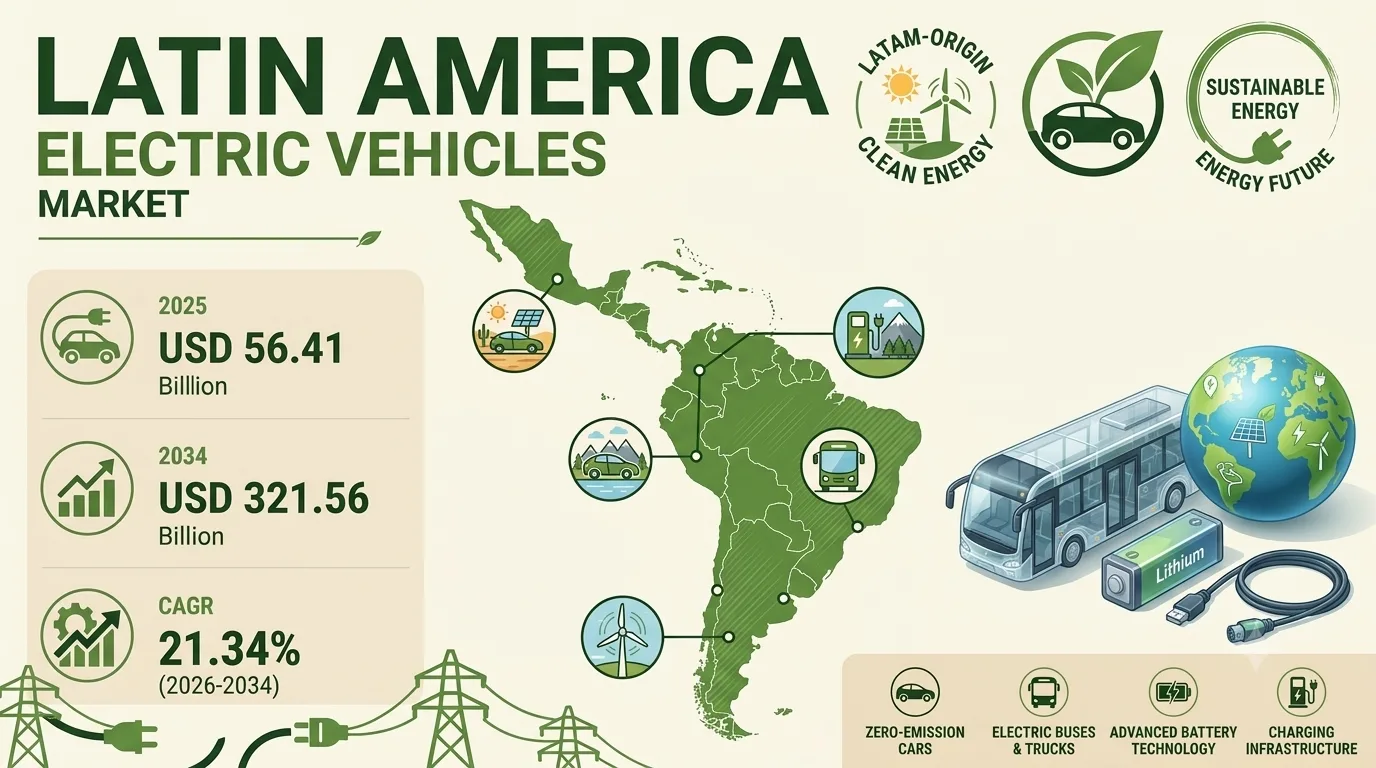
The Latin America electric vehicles market is experiencing remarkable growth driven by favorable government policies, increasing environmental awareness, expanding charging infrastructure, and the growing presence of affordable electric vehicle models from Chinese manufacturers. The market size reached USD 56.41 Billion in 2025 and is projected to reach USD 321.56 Billion by 2034, exhibiting a compound annual growth rate (CAGR) of 21.34% during 2026-2034. The region witnessed a 75% increase in electrified vehicle sales during 2025, led by Brazil and Mexico . Latin America and the Caribbean reached 837,014 electric and plug-in hybrid vehicles in circulation by the first quarter of 2026, with projections to surpass one million units before the end of 2026 .
This market is strategically important to the region's energy transition as it directly supports reducing carbon emissions, decreasing dependence on fossil fuels, and generating annual savings of USD 1.157 billion compared to traditional fuel vehicles .
The Latin America electric vehicles market is poised for sustained expansion, driven by an energy crisis that has made EVs economically attractive, supportive government incentives, and an increasingly diverse vehicle supply chain. With a projected CAGR of 21.34% through 2034, the market presents significant opportunities for established automakers and new entrants focused on affordable, high-performance electric mobility solutions.
Request Sample of PDF Report: https://www.imarcgroup.com/latin-america-electric-vehicles-market/requestsample
LATIN AMERICA ELECTRIC VEHICLES MARKET SUMMARY
The Latin America electric vehicles market encompasses a wide range of products designed for sustainable transportation across personal, commercial, and public transit applications. The ecosystem includes global and regional automotive manufacturers (BYD, Tesla, Volvo, JAC, Zeekr, Geely, Chery, Great Wall Motors), battery suppliers, charging infrastructure providers, and end-use consumers.
Major segments identified in the market include:
- Vehicle Type: Hatchback, Sedan, SUV, Others
- Drive Type: Front-wheel drive, Rear-wheel drive, All-wheel drive
- Propulsion Type: Battery Electric Vehicle (BEV), Fuel Cell Electric Vehicle (FCEV), Plug-in Hybrid Electric Vehicle (PHEV)
- Application: Personal, Commercial
- Price: Entry, Mid-Range, Luxury
The SUV segment is the dominant vehicle category, accounting for 56% of the market in 2025 . The personal segment dominates the market with an 82% share in 2025 . Brazil leads the regional market with 473,362 light electric vehicles, representing more than 50% of the total in the region, followed by Mexico, Colombia, Uruguay, and Costa Rica .
PORTER'S FIVE FORCES ANALYSIS - LATIN AMERICA ELECTRIC VEHICLES MARKET
The competitive dynamics of the Latin America electric vehicles market can be analyzed using Porter's Five Forces framework .
Competitive Rivalry: High
Intense competition between global automotive giants and emerging Chinese manufacturers for market share across Latin American markets. Rivalry is driven by aggressive pricing strategies, product differentiation, and expanding dealer networks. Business implication: Automakers must differentiate through product innovation, competitive pricing, and localized manufacturing to win market share.
Supplier Power (Battery and Component Suppliers): Moderate to High
Suppliers of critical EV components, particularly batteries, have significant negotiating power due to limited regional production capacity and reliance on imports from Asia. Business implication: Manufacturers must develop strategic partnerships with battery suppliers and invest in local production capabilities to reduce dependency.
Buyer Power (Consumers and Fleet Operators): Increasing
Consumers and corporate fleet operators have growing bargaining power as more affordable EV models enter the market and competition intensifies. Business implication: Automakers must offer compelling value propositions, including competitive pricing, extended warranties, and comprehensive charging solutions.
Threat of Substitutes: Moderate
Traditional internal combustion engine vehicles, hybrids, and public transportation alternatives pose substitution threats. However, rising fuel costs and environmental regulations are shifting consumer preferences toward EVs. Business implication: EV manufacturers must articulate clear cost savings and environmental benefits relative to traditional vehicles.
Threat of New Entrants: Moderate to High
Lower barriers for Chinese manufacturers entering the Latin American market, but significant challenges remain in establishing distribution networks, charging infrastructure, and brand recognition. Business implication: Established players should build defensible positions through local manufacturing, strong dealer networks, and customer loyalty programs.
Competitive Rivalry - High (Intensifying)
- Multi-tier competition spans global leaders (Tesla, Volvo, Chevrolet), Chinese disruptors (BYD, Geely, Chery, Great Wall Motors), and traditional automakers transitioning to electric platforms – driving differentiation through product innovation, pricing strategies, and charging infrastructure development.- BYD's dominance in the region: The company supplied 60% of the electric vehicles sold worldwide in 2025 and has established local manufacturing operations in Brazil .- Tesla's market entry: Tesla dominates the 100% electric vehicle market in Chile with a 27.1% share and has rapidly gained market leadership in Colombia with 7,735 units sold through May 2026 .
MARKET GROWTH DRIVERS
Several key factors are propelling the expansion of the Latin America electric vehicles market.
Energy Crisis and Cost Savings
The rise in oil prices resulting from global conflicts has made electric vehicles economically more attractive. EVs generally have lower operating costs than internal combustion vehicles, with annual fuel savings from driving an EV growing 35% compared to 2025 savings . For corporate fleets, these savings can be several times larger, with Mexico's EMA highlighting savings of up to 70% compared to gasoline cars .
Government Incentives and Supportive Policies
Both Brazil and Mexico have implemented active policies to promote electromobility. Brazil has eliminated import tariffs on key components of electrified vehicles – a measure in effect until September 2027. Mexico has eliminated the New Car Tax (ISAN) for hybrid and electric vehicles since 2012 . Chile's National Electromobility Strategy sets ambitious goals, including that 100% of light- and medium-duty vehicle sales be electric in the coming years .
Greater Supply and Chinese Manufacturer Participation
The growing presence of Asian automakers has democratized access to technology. Chinese automakers supplied 60% of the electric vehicles sold worldwide in 2025 . Brands such as BYD, Geely, Chery, and Great Wall Motors have significantly expanded the portfolio of electric and hybrid vehicles available in countries such as Chile, Uruguay, Brazil, Peru, and Argentina .
Infrastructure Development
The entry into operation of the port of Chancay in Peru is redefining vehicle import routes from Asia and positioning the country as a key regional distribution hub . Brazil leads with 21,061 public charging stations, while Chile stands out for its high relative proportion of chargers to its electrified vehicle fleet .
MARKET GROWTH DRIVERS (Continued)
Accelerating Technology Adoption and Evolving Consumer Demands
The Latin America electric vehicles market is also benefiting from accelerating technology adoption and evolving consumer demands. There is a growing shift toward affordable entry-level EV models, with the entry-level segment valued at USD 7.5 billion in 2025 . The SUV segment accounted for 56% of the market in 2025 and is expected to grow at a CAGR of 9.7% till 2035 .
Public Transportation Electrification
The region has made significant progress in electric public transportation. With 4,707 electric buses in operation, Chile is positioned as a regional leader and is currently the second country worldwide with the most electric buses after China . In total, the region has 9,718 electric buses, a number that continues to increase steadily .
Local Manufacturing and Supply Chain Investments
BYD and GWM have already started industrial operations in former Ford and Mercedes-Benz plants in Brazil, anticipating tariffs on electric vehicle imports, which will reach 35% in 2026 . In August 2025, GAC Motor committed USD 1.06 billion to invest in Brazil between 2024 and 2028 – one of the largest foreign investments in EVs in the region .
LATIN AMERICA ELECTRIC VEHICLES MARKET SEGMENTATION
Segmentation analysis provides a detailed view of the Latin America electric vehicles market by category:
- Vehicle Type Insights: Hatchback, Sedan, SUV, Others
- Drive Type Insights: Front-wheel drive, Rear-wheel drive, All-wheel drive
- Propulsion Type Insights: Battery Electric Vehicle (BEV), Fuel Cell Electric Vehicle (FCEV), Plug-in Hybrid Electric Vehicle (PHEV)
- Application Insights: Personal, Commercial
- Price Insights: Entry, Mid-Range, Luxury
- Regional Insights: Brazil, Mexico, Argentina, Peru, Colombia, Chile, Uruguay, Costa Rica, Ecuador, Paraguay
COMPETITIVE LANDSCAPE
The Latin America electric vehicles market features a dynamic competitive landscape, with multi-tier competition spanning global leaders, Chinese manufacturers, and emerging regional players. Key companies operating in the market include:
- BYD Company Ltd. - Market leader in multiple Latin American countries with local manufacturing in Brazil- Tesla, Inc. - Dominant in premium EV segment with 27.1% share in Chile - Volvo Group - Strong presence in electric buses and passenger vehicles- General Motors (Chevrolet) - Established dealer networks across the region- Geely Automobile Holdings - Expanding presence through affordable EV models- Chery Automobile Co., Ltd. - Growing market share with competitive pricing- Great Wall Motors (GWM) - Local manufacturing operations in Brazil- JAC Motors - Significant presence in Mexico's electrified vehicle market- Zeekr - Premium EV brand expanding in Latin America- Maxus - Strong in commercial and passenger EV segments
Strategic developments are shaping the competitive arena, notably BYD and Geely reaching the final round of bidder status for purchasing a Nissan-Mercedes-Benz manufacturing facility in Mexico, and BYD's official launch of its EV line in Argentina in October 2025 .
REGIONAL ANALYSIS
Regional dynamics within the Latin America electric vehicles market are shaped by varying levels of government support, infrastructure development, and consumer adoption.
- Brazil: Regional leader with 473,362 light electric vehicles in circulation, representing more than 50% of the regional total. The country leads in public charging infrastructure with 21,061 stations and is a key manufacturing hub for Chinese automakers .- Mexico: Second-largest market with strong growth driven by nearshoring and manufacturing investments. Sales of electrified vehicles grew 38.5% during 2025, reaching 96,636 units . The charging network reached 56,726 ports, a 26% annual increase .- Chile: Regional leader in electric public transportation with 4,707 electric buses, second only to China globally. Sales of plug-in electrified vehicles reached 8,754 units in the first half of 2026, with BYD as the best-selling brand .- Colombia: Experienced explosive growth with 19,542 electric vehicle registrations in January-May 2026, a 217.6% increase compared to 2025. Tesla's market entry has disrupted the competitive landscape .- Uruguay: Highest per capita EV adoption in the region, with electric vehicles available from USD 19,000 and growing adoption in both fleets and private markets .- Argentina: Emerging market with BYD entering in October 2025. Sales multiplied by twenty times compared to the previous year in Q1 2026 .- Peru: Sales of hybrid and electric vehicles grew 44% year-on-year in the first nine months, reaching a historic record. The port of Chancay is positioning the country as a key regional distribution hub .- Costa Rica: Strong per capita adoption, ranking second after Uruguay in the region .- Ecuador: Nearly quadrupled its EV sales in Q1 2026 compared to the same period last year .
RECENT INDUSTRY DEVELOPMENTS
June 2026: OLACDE reported that Latin America and the Caribbean reached 837,014 electric and plug-in hybrid vehicles in circulation, with projections to surpass one million units before the end of 2026 .
March 2026: Colombia recorded an all-time high with 5,083 electric vehicle units sold, doubling February's figures and surpassing the previous record from December 2025 .
February 2026: BYD and Geely reached the final round of bidder status for purchasing a Nissan-Mercedes-Benz manufacturing facility in Mexico, signaling greater competition among manufacturers and the possibility of localized production .
January 2026: Preliminary data from Q1 2026 showed Latin America defied the global trend of an 8% contraction in EV sales, growing another 75% compared to the same quarter in 2025 .
October 2025: BYD officially launched its electric vehicle line in Argentina, marking a significant expansion into the Latin American market under the Milei administration .
August 2025: GAC Motor committed USD 1.06 billion to invest in Brazil between 2024 and 2028 – one of the largest foreign investments in EVs in the region .
August 2025: An electric mobility project in Mexico aimed at increasing the country's EV charging infrastructure was announced, with a target of 2,200 stations by the end of the year .
Key Aspects Required for the Latin America Electric Vehicles Market
Market Performance
- Market Size (2025): USD 56.41 Billion
- Projected Market Size (2034): USD 321.56 Billion
- CAGR (2026-2034): 21.34%
Market Outlook
A 21.34% CAGR through 2034 indicates robust growth across passenger vehicles, commercial vehicles, and public transportation segments. The region is projected to surpass one million electric vehicles in circulation before the end of 2026, representing a historic milestone in the regional energy transition .
Growth Drivers
- Energy crisis and cost savings: Rising oil prices have made EVs economically more attractive, with annual fuel savings growing 35% compared to 2025
- Government incentives: Brazil's import tariff elimination on key components (until September 2027); Mexico's ISAN tax exemption for hybrid and electric vehicles
- Chinese manufacturer participation: Chinese automakers supplied 60% of electric vehicles sold worldwide in 2025, democratizing access to affordable EV technology
- Infrastructure development: Brazil leads with 21,061 public charging stations; Chile has 3,100+ charging stations with plans for 200 additional units in 2026
- Public transportation electrification: 9,718 electric buses in operation across the region, with Chile ranking second globally after China
Competitive Landscape
A distinctive multi-tier structure with:
- Global leaders: Tesla, Volvo, Chevrolet
- Chinese disruptors: BYD, Geely, Chery, Great Wall Motors, JAC, Zeekr
- Traditional automakers: Transitioning to electric platforms
- Regional players: Emerging domestic manufacturers and distributors
Value Chain Analysis
From raw material extraction (lithium, cobalt) through battery manufacturing, vehicle assembly, distribution networks, charging infrastructure deployment, and after-sales services to end-use consumers across personal, commercial, and public transit applications.
Industry Trends
- Local manufacturing acceleration: BYD and GWM operating in former Ford and Mercedes-Benz plants in Brazil; BYD and Geely bidding for Nissan-Mercedes facility in Mexico
- Smart charging and grid integration: Software, data, and AI as the backbone of transformation, with predictive maintenance resolving 99% of issues before they occur
- Nearshoring phenomenon: Mexico attracting foreign investment for EV and auto parts manufacturing
- Charging infrastructure challenges: Grid capacity constraints requiring integration of batteries, solar panels, and hybrid solutions
- Per capita adoption leaders: Uruguay and Costa Rica leading in per capita EV adoption, demonstrating successful policy frameworks
Strategic Recommendations
- Focus on affordable entry-level models: The entry-level segment valued at USD 7.5 billion in 2025 presents significant opportunities for mass-market adoption
- Invest in local manufacturing: Establish production facilities to avoid import tariffs (reaching 35% in Brazil by 2026) and reduce costs
- Develop comprehensive charging solutions: Address grid capacity challenges through renewable energy integration, battery storage, and smart charging software
- Build strong relationships with fleet operators: Corporate fleets represent a high-growth segment with significant cost-saving potential
- Leverage public-private partnerships: Collaborate with governments on public transportation electrification and infrastructure development
- Differentiate through technology: Invest in software, data analytics, and AI for predictive maintenance, route planning, and energy management
Note: If you need any specific information that is not covered currently within the scope of the report, we will provide the same as a part of customization.
Request Customization: https://www.imarcgroup.com/request?type=report&id=29108&flag=E
Report Format, Delivery, and Customization Details
- Report Format Mode: PPT, PDF, and Excel
- Report Delivery Mode: Online Delivery, Physical Delivery
- Report Delivery Time: Report Delivered Over Email within 24 to 48 hours. If requested by the client, a physical copy will be delivered within three to ten days.
- Report Confirmation Mode: Yes via Email
- Report Customization Mode: Yes via Email / Call
- Report Table of Content: Yes
- Report List of Figures: Yes
- Report Methodology Mode: Yes
- Request For Sample Report: Yes