In today’s fast-paced manufacturing world, precision and efficiency aren’t just desirable—they’re essential. One machine that has quietly transformed both the cutting and joining of materials is the laser cutting welding machine. While the name might sound like a mouthful, its impact in factories, workshops, and production lines around the globe is immense.
So, let’s dive into what makes this machine not only relevant but essential in modern fabrication.
What Is a Laser Cutting Welding Machine?
At its core, a laser cutting welding machine is a versatile industrial tool that combines the capability of two major fabrication processes: laser cutting and laser welding. Cutting involves slicing through materials like metal or plastic with extreme accuracy using a laser beam, while welding refers to fusing materials together with concentrated heat. Combining both in one setup introduces efficiency and consistency that traditional machines can’t match.
Rather than switching between separate devices or setups, operators can streamline their production with a single piece of equipment. This integration allows for smoother workflows, reduced setup times, and tighter tolerances across complex projects.
How It Works
Understanding the working mechanism is key to appreciating the value of the laser cutting welding machine. It operates by focusing a high-powered laser beam onto a small area of the material. For cutting, the energy of the laser heats and melts the material, and a gas—usually nitrogen or oxygen—is used to blow away the molten material to create clean cuts.
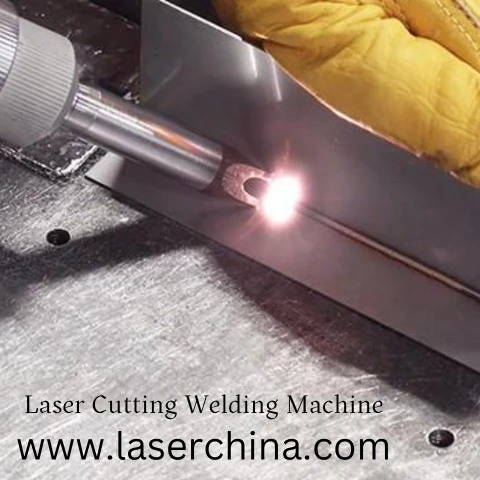
In welding mode, the laser’s energy is controlled and applied to the joint where two pieces of metal meet. The laser melts the metal at the seam, and as it cools, a strong, seamless bond is formed. The same laser source can be used for both processes, usually adjusted by software or operator commands.
This dual functionality is made possible by fiber laser technology, which is known for its high beam quality, energy efficiency, and long operational life.
Industrial Applications of a Laser Cutting Welding Machine
This type of equipment is not a one-trick pony. Its uses span a wide range of industries:
- Automotive Industry: Precision-cut body parts and welded components make for safer, more efficient vehicles.
- Aerospace Manufacturing: The need for lightweight, yet strong materials finds a perfect match with laser fabrication.
- Medical Devices: Tiny, intricate parts require the delicate balance of precise cuts and reliable joints.
- Electronics: High-density circuitry benefits from the fine detailing provided by laser systems.
- Metal Fabrication Shops: From signage to structural frames, fabricators rely on accuracy and speed.
Every industry that demands precision and consistency in metal processing stands to gain from incorporating a laser cutting welding machine into their workflow.
Materials Compatible with Laser Cutting Welding Machines
The versatility of this machine doesn’t stop at its dual functionality. It is capable of processing a wide array of materials:
- Stainless Steel
- Carbon Steel
- Aluminum
- Copper
- Brass
- Titanium
- Galvanized Steel
- Plastics (in certain models)
Each material responds differently to laser heat, but modern machines are equipped with adaptive parameters to ensure optimized processing for each type.
Workflow Efficiency and Precision
One of the most compelling aspects of a laser cutting welding machine is how it streamlines production. In traditional workflows, cutting and welding are separate stages, often requiring different stations, tools, and sometimes even different technicians. This creates room for human error, material misalignment, and longer lead times.
However, when one machine handles both cutting and welding, the entire fabrication process becomes more synchronized. Parts can be cut and immediately welded in place with minimal handling, ensuring greater dimensional accuracy and time savings.
This unified workflow is especially valuable in high-volume or just-in-time production settings where speed and reliability directly affect the bottom line.
Maintenance and Longevity
Modern laser systems are built for durability. Because laser processes are contactless, there's little wear and tear on parts. This reduces downtime due to mechanical failures. In addition, many machines are equipped with automated cooling systems and dust extraction features to maintain cleanliness and operational integrity.
Preventive maintenance schedules usually involve lens cleaning, filter changes, and software updates. Following these ensures your laser cutting welding machine continues to perform at optimal levels for years.
Training and Usability
The idea of combining two complex processes into one machine might sound daunting, but manufacturers have gone to great lengths to simplify the user experience. Most machines are operated via touchscreen panels with intuitive software interfaces. Preloaded settings, auto-focus functions, and user-friendly programming reduce the learning curve significantly.
Technicians can be trained within weeks rather than months, making it accessible to even small-scale workshops and growing businesses.
Innovation and Future Trends
The evolution of the laser cutting welding machine is far from over. Innovations in artificial intelligence, machine vision, and Internet of Things (IoT) integration are pushing these machines into smart factory territory.
Predictive maintenance alerts, remote diagnostics, and real-time data monitoring are all being incorporated into newer models. These advancements help manufacturers prevent breakdowns, track productivity, and adapt faster to changes in demand.
Furthermore, improvements in laser sources are making these machines even more compact, energy-efficient, and powerful—allowing for faster speeds and deeper weld penetration without sacrificing quality.
Why It’s a Game-Changer
In the world of manufacturing, time is money, and quality is non-negotiable. A laser cutting welding machine doesn’t just replace two machines—it transforms your entire production philosophy. By embracing this hybrid approach, businesses no longer need to compromise between speed and precision. It offers the best of both worlds.
Whether you're scaling up production, launching a new product line, or trying to maintain a competitive edge, this machine becomes an indispensable asset. It simplifies logistics, reduces energy consumption, and elevates product quality—all from a single workstation.
Final Thoughts
The question posed earlier—“Can a single machine truly master both precision cutting and strong welding?”—has a clear answer. Yes, and the laser cutting welding machine is proof of that. It's not just a piece of equipment; it’s a symbol of progress in modern fabrication.
By uniting two vital processes into one cohesive system, this machine helps bridge the gap between concept and creation, allowing fabricators to deliver high-quality results faster and more efficiently than ever. As industries continue to demand more precision and speed, the laser cutting welding machine stands out as a forward-looking solution that meets the moment and prepares us for the future.