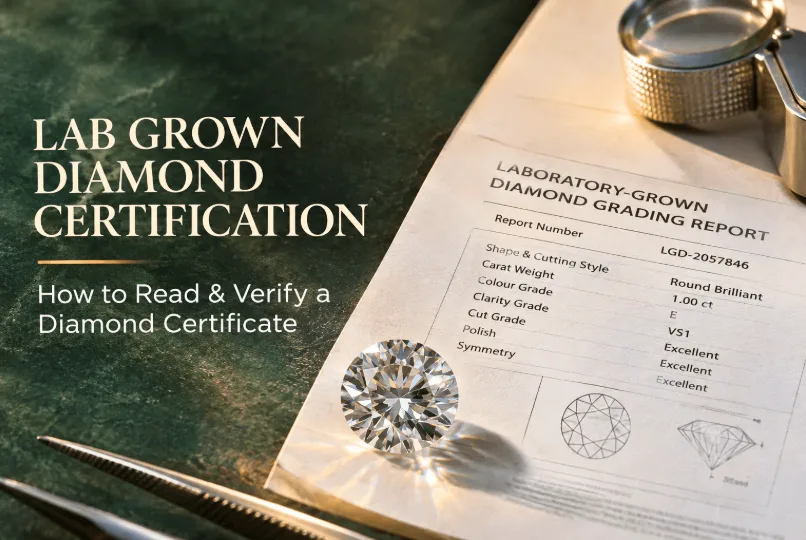
Two diamonds can look very similar at first glance, yet the grading report may reveal important differences in how each stone has been assessed. That is where lab grown diamond certification becomes useful: it gives buyers documented information about the specific diamond rather than leaving the decision to appearance or seller description alone.
Alab grown diamond certificate can record details such as carat weight, colour, clarity, measurements, proportions and other identifying information, depending on the grading laboratory and report type. For buyers, this creates a clearer way to compare stones and verify that the diamond being offered matches the information provided.
In this guide, we’ll explain what certification means, how to read a grading report, what details deserve attention and how to verify the certificate before making a purchase.
What Is a Lab Grown Diamond Grading Report?
A lab grown diamond certificate is an independent report that records the characteristics of a specific stone and confirms its laboratory-grown origin.
Depending on the report, lab grown diamond grading may include carat weight, colour, clarity, measurements, proportions, report number, growth method and treatment details where applicable.A grading report documents the diamond’s assessed characteristics. It is not a monetary appraisal and does not assign a market value to the stone.
What Information Can You Find on a Lab Grown Diamond Report?
A grading report brings several details about a stone together in one place, making it easier to understand exactly what has been assessed. The information shown can vary by laboratory and report type, but the core details usually help with identification, quality comparison and verification.
Diamond Identification
The report number acts as the diamond’s reference within the laboratory’s system. You will also usually find the shape and cutting style, measurements and carat weight. Together, these details help confirm that the report corresponds to the stone being supplied.
Quality Information
Lab grown diamond grading commonly records colour and clarity, along with cut, polish and symmetry where the report format and stone shape allow. Some reports may include proportions, clarity characteristics or other observations relevant to the diamond.
Laboratory-Grown Origin
The report clearly identifies the stone as laboratory-grown, helping buyers distinguish its origin from a naturally formed diamond. IGI, for example, assesses origin as part of its reporting process.
Growth Method and Treatment Information
Where included, the report may state whether the diamond was produced using CVD or HPHT and disclose relevant post-growth treatment. IGI notes that this information can appear in the comments section, while applicable GIA report formats also identify growth type and post-growth treatment.
How to Read a Lab Grown Diamond Certificate
Knowing how to read a diamond certificate helps you move beyond the headline grade and check whether the report actually matches the stone you are buying. The aim is not to memorise every field, but to verify the details that matter most.
1 Check the Report Number
Start with the report number. This is the laboratory’s reference for the specific diamond and is often the first detail used when verifying the report through the grading laboratory’s own database.
2 Check the Diamond Details
Next, compare the basic identification information on the report with the stone being offered. Look at the carat weight, measurements, shape and recorded grading details. These should align with the supplier’s product information rather than being treated as separate pieces of data.
3 Check the Laboratory-Grown Identification
The report should clearly state that the stone is laboratory-grown. This is an important part of confirming origin and ensuring that the document relates to the type of diamond you intended to purchase.
4 Check Treatment and Growth Information
Where the laboratory includes this information, review any reference to CVD, HPHT or post-growth treatment. These details give additional context about how the stone was produced and assessed.
5 Compare the Report With the Actual Diamond
Finally, make sure the grading report belongs to the exact diamond you are purchasing. The report number, measurements and other identifying details should correspond with the stone supplied.
For a broader buying checklist beyond certification, see our guide on [How to Choose a Lab Grown Diamond].
IGI and GIA Lab Grown Diamond Reports
Different laboratories use their own reporting formats, so buyers should understand what each document is designed to communicate rather than assuming every report follows the same grading system.
IGI Certified Lab Grown Diamonds
IGI certified lab grown diamonds are assessed to confirm laboratory-grown origin and document relevant gemmological characteristics. Depending on the report, this can include shape, measurements, carat weight, colour, clarity, cut-related information and comments relating to growth method or treatments. IGI also provides an online verification facility, allowing buyers to enter the report number and check the corresponding grading record directly.
GIA Lab Grown Diamond Reports
The current GIA system works differently. Since 1 October 2025, eligible loose colourless-to-near-colourless laboratory-grown diamonds are assessed using an overall Premium or Standard classification rather than GIA’s traditional natural-diamond colour and clarity nomenclature. The assessment considers factors including clarity, colour, polish, symmetry and cut where applicable.
Buyers searching for a GIA lab grown diamond certificate should therefore look for GIA’s current Laboratory-Grown Diamond Quality Assessment terminology. GIA also offers separate report services for laboratory-grown coloured diamonds, including information on growth type and post-growth treatment.
Do Lab Grown Diamonds Come With a Certificate?
Yes, a laboratory-grown diamond can come with an independent grading report, but not every stone is automatically supplied with one. Whether a particular diamond includes a report depends on the stone, its size or specification, and the supplier’s offering.
If you are asking if lab grown diamonds come with a certificate, the key point is to check what has actually been provided for that specific stone. When a seller states that a diamond has been independently graded, there should be a corresponding report number or document that can be matched to the diamond.
So, do lab grown diamonds have certificates? Many do, but buyers should verify the report rather than assume certification is included. The document should clearly relate to the exact stone being purchased, with matching identification and grading details.
How to Verify a Lab Grown Diamond Report
Verification should be a simple part of the buying process, especially when you are relying on an independent grading report to confirm a stone’s details.
Step 1: Find the Report Number
Start with the unique report number shown on the grading document. This is the key reference used by the laboratory to identify the assessment.
Step 2: Use the Laboratory’s Official Verification Tool
Check the number directly through the grading laboratory’s own website. IGI provides its Verify Your Report service, while GIA offers Report Check for report lookup and confirmation.
Step 3: Compare the Online Record
Make sure the online result matches the report you have been given, including the report number and recorded diamond details.
Step 4: Check Identifying Details
Compare measurements and any relevant inscription information with the stone itself. GIA states that its laboratory-grown diamonds are laser-inscribed with the GIA report number and the words “LABORATORY-GROWN”, providing an additional point of identification.
What Should UK Buyers Check Before Buying?
For UK jewellers, retailers and trade buyers, the grading report should be treated as part of the buying process, not an afterthought. Before placing an order, check:
- whether the stone comes with an independent grading report
- which laboratory issued the document
- whether the report number matches the stone being offered
- whether the document clearly identifies the diamond as laboratory-grown
- whether any growth method or treatment information is included where applicable
- whether the measurements and other identifying details match the product listing
- whether the report can be verified through the laboratory’s official online system
These checks help buyers confirm that the paperwork belongs to the exact diamond being purchased. For repeat sourcing or matched requirements, this becomes even more important because consistency depends on comparing verified specifications rather than relying on appearance alone.
Why Certification Matters When Buying Lab Grown Diamonds
Certification gives buyers a clearer basis for comparing stones because the key characteristics are documented by an independent laboratory. Instead of relying only on appearance or a product description, buyers can review the recorded information and make a more informed decision.
For jewellery businesses, this documentation is useful across several buying situations. It can support stock selection for retail inventory, help confirm specifications for bespoke pieces, assist with customer-led requirements and make repeat sourcing easier when consistency matters.
For trade buyers, certification also adds transparency to the purchasing process because the stone can be compared against a recognised grading record rather than judged on description alone.If you are sourcing certified lab grown diamonds for trade buyers, having accessible grading information can make the selection process more structured, consistent and easier to manage across different requirements.
Final Thoughts
A grading report is more than supporting paperwork. It gives buyers documented information about the specific diamond they are considering and provides a practical way to check its recorded characteristics, origin and identifying details.
When the report is issued by a recognised laboratory and can be verified through the official system, it adds another layer of confidence to the buying process.
For businesses sourcing stones for stock, bespoke work or repeat requirements, that clarity can make purchasing decisions easier and more consistent.
Explore Certified Lab Grown Diamonds