
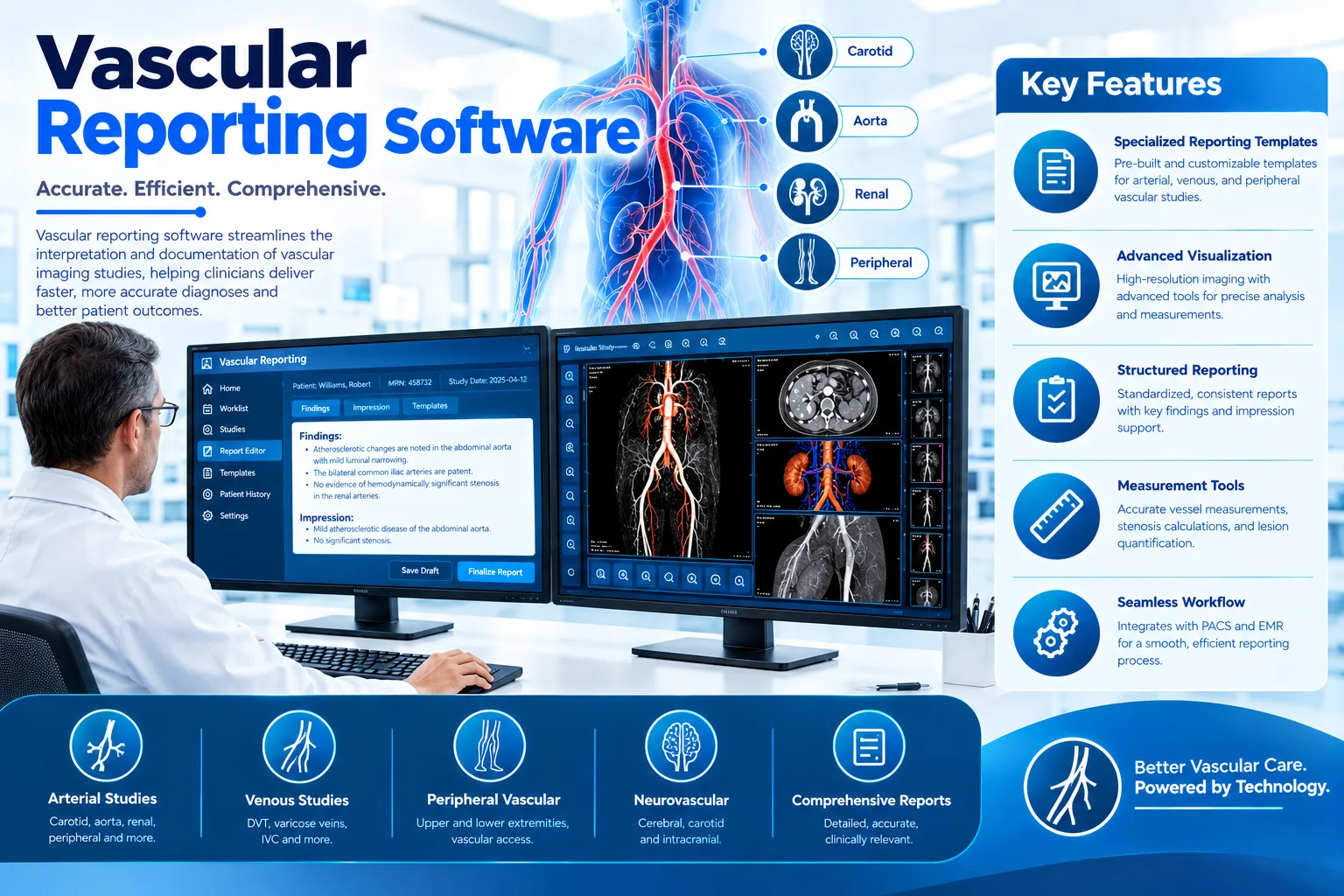
Vascular imaging plays an important role in evaluating blood vessels, identifying abnormalities, and monitoring conditions that affect circulation. Healthcare professionals use ultrasound, Doppler studies, angiography, and other imaging techniques to examine arteries and veins. As diagnostic procedures become more complex, healthcare facilities need efficient systems to manage imaging data, measurements, and clinical reports.
Vascular Reporting Software helps streamline these processes by organizing examination data, automating selected reporting tasks, and supporting consistent documentation. When integrated with vascular imaging equipment and clinical information systems, it can improve workflow efficiency and help healthcare professionals access relevant diagnostic information.
Understanding the key features of modern vascular reporting systems can help hospitals, vascular laboratories, and outpatient imaging centers select solutions that meet their clinical and operational needs.
1. Automated Measurement Capture and Mapping
Accurate measurements are essential for interpreting vascular studies and documenting findings. During vascular examinations, clinicians may collect measurements related to blood flow, vessel diameter, Doppler velocities, and other parameters.
Modern Vascular Reporting Software can capture supported measurements from compatible imaging equipment and automatically transfer them into the appropriate fields within a report.
Reducing Manual Data Entry
Automated measurement mapping helps reduce repetitive typing and manual transcription. It can also minimize discrepancies between measurements recorded during an examination and those included in the final report.
The system should support the equipment and measurement types used by the facility. Healthcare organizations should evaluate how measurements are transferred, validated, and reviewed before reports are finalized.
2. Structured Reporting Templates
Structured reporting is an important feature of modern vascular reporting systems. Instead of relying entirely on free-text documentation, clinicians can use predefined templates to record examination findings in an organized format.
Templates can be configured for different procedures, including carotid ultrasound, venous duplex studies, arterial examinations, and other vascular assessments.
Consistent Clinical Documentation
Structured templates help clinicians document relevant findings in a consistent manner. Depending on the system, templates may include predefined fields, dropdown selections, measurement tables, and standardized terminology.
Organizations can also customize report layouts to reflect their clinical protocols and documentation requirements.
Consistent reporting makes it easier for referring physicians to locate important findings and compare information across examinations. However, templates should remain flexible enough to accommodate unusual findings and individual patient requirements.
3. Interactive Vascular Diagrams
Vascular diagrams provide a visual way to document anatomical locations and examination findings. Rather than describing every location through lengthy text, clinicians can use interactive diagrams to indicate relevant vessels, segments, and abnormalities.
A vascular reporting system may provide diagrams with selectable anatomical regions, customizable labels, and procedure-specific layouts.
Improving Report Clarity
Visual documentation can help clinicians communicate the location and extent of findings more clearly. For example, a report may use a diagram to identify the vascular segments examined and highlight areas associated with abnormal measurements.
When diagrams are linked to structured reporting fields, they can help maintain consistency between visual representations and written findings.
Healthcare organizations should assess whether the available diagrams match their examination protocols and whether users can customize them when necessary.
4. Integration With Vascular Imaging Equipment
Vascular laboratories often use equipment from different manufacturers and manage multiple types of imaging data. A modern reporting platform should support integration with the relevant imaging devices and associated clinical applications.
Vascular Imaging workflows may involve ultrasound images, Doppler measurements, angiographic studies, procedural images, and other examination information. A connected reporting environment helps bring these elements together for review and documentation.
Supporting Different Data Formats
DICOM provides a standard framework for exchanging medical imaging information. However, some vascular workflows also involve non-DICOM data, external measurement files, or information generated by specialized applications.
The reporting system should accommodate the data formats required by the organization and preserve the relationship between patient information, examination details, images, and measurements.
Appropriate integration reduces fragmented workflows and helps clinicians access relevant examination information without repeatedly switching between disconnected applications.
5. Access to Previous Studies and Comparisons
Comparing current findings with previous examinations can help clinicians evaluate changes in vascular conditions over time. Historical measurements and reports provide useful context when monitoring patients or assessing the results of treatment.
Vascular Reporting Software can support this process by allowing users to retrieve previous reports and review earlier findings alongside the current examination.
Supporting Longitudinal Assessment
Some systems provide side-by-side comparison tools and options to reuse selected information from previous reports. These features can reduce repetitive documentation when appropriate.
However, previous findings must always be reviewed carefully. Measurements and conclusions should reflect the current examination rather than being copied automatically without verification.
Easy access to historical information helps clinicians maintain continuity across follow-up visits and supports more informed clinical assessments.
6. Voice Recognition and Reporting Efficiency
Voice recognition can help clinicians dictate findings and observations directly into reports. When combined with structured templates, editing tools, and spell-check functionality, it can reduce the need for extensive manual typing.
These features are particularly useful in busy vascular laboratories where staff must manage multiple examinations and complete documentation efficiently.
A suitable reporting system should allow clinicians to review and correct dictated content before finalizing a report. Medical terminology, abbreviations, and procedure-specific language should be handled appropriately to minimize transcription errors.
Efficient reporting tools can help reduce administrative workload while allowing clinicians to maintain control over the final documentation.
7. Integration With EHR and Clinical Systems
Vascular reporting rarely operates in isolation. Healthcare facilities often rely on electronic health records (EHRs), hospital information systems (HIS), and radiology or diagnostic information systems to manage patient data and examination workflows.
Integration can help transfer patient demographics, examination orders, measurements, and finalized reports between connected applications.
Standards such as HL7 can support clinical information exchange, while APIs and other interfaces may enable additional connections based on system compatibility.
A well-integrated environment can reduce duplicate data entry, improve information availability, and help referring physicians access completed reports through their usual clinical applications.
8. Security, Analytics, and Workflow Management
Modern vascular reporting systems should protect sensitive patient information while helping organizations monitor operational performance.
Important security features may include role-based access controls, user authentication, audit logs, and secure data transmission. Healthcare organizations should confirm that their systems meet applicable privacy requirements and internal security policies.
Workflow management tools can also help teams organize examinations, track report status, and identify outstanding documentation. Analytics may provide information about procedure volumes, equipment utilization, turnaround times, and other operational measures.
These capabilities help administrators identify bottlenecks and make informed decisions about staffing, resource allocation, and process improvement.
Conclusion
Modern Vascular Reporting Software supports efficient diagnostic imaging through automated measurement capture, structured templates, interactive diagrams, historical comparisons, and integration with clinical systems. These capabilities help healthcare professionals organize findings and maintain consistent documentation across vascular procedures.
By evaluating reporting flexibility, equipment compatibility, security, and workflow integration, healthcare organizations can choose a solution suited to their needs. A well-designed system can simplify Vascular Imaging workflows, reduce repetitive administrative tasks, and improve access to diagnostic information for coordinated patient care.