
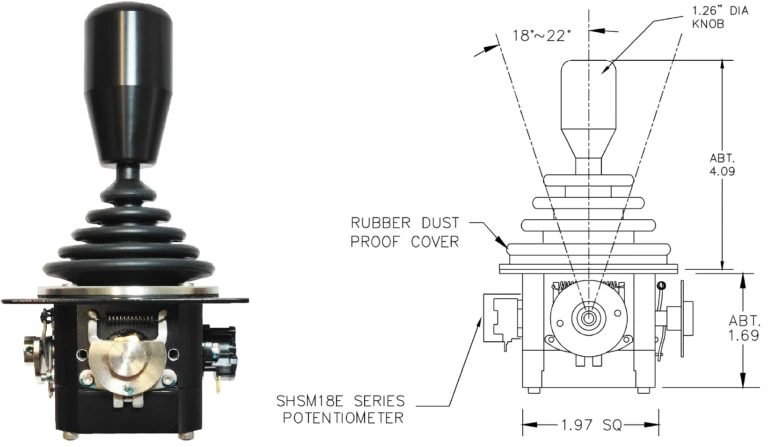
When upgrading industrial machinery, integrating an industrial joystick can significantly improve precision control, operator comfort, and operational efficiency. ETI Systems manufactures industrial-grade joysticks engineered for demanding environments, ensuring long-lasting reliability and smooth performance. This article outlines the critical factors engineers and operators must consider before integrating or replacing joystick systems in modern equipment.
How Industrial Joysticks Improve Machine ResponsivenessAn industrial joystick translates operator hand movements into electrical signals that control machinery motion. These devices are core components in mobile equipment, robotics, cranes, construction vehicles, and marine systems. Unlike consumer-grade controls, industrial joysticks are designed to deliver precision under pressure, ensuring high responsiveness in mission-critical tasks. They also support multiple axes, proportional control, and customizable button functions, depending on application needs.
Ensuring Control System Compatibility Before Joystick Installation
Proper compatibility with your existing control system is essential. Whether your equipment uses analog voltage signals, current loops, or digital interfaces like CANbus or RS-485, the joystick must provide the correct output. Mismatched signal types can cause communication errors or even equipment failure. ETI Systems simplifies integration by offering a range of interface options and providing detailed documentation, wiring diagrams, and technical support.
Additionally, physical mounting options (such as panel mount, pedestal, or armrest integration) must align with available space and operator reach. Joystick handles can also be customized with specific switch types, button layouts, or safety triggers to fit the application.
Operator Ergonomics and Usability
Operator fatigue and error can be minimized by focusing on ergonomics. Joysticks should be designed for natural hand posture, with grip styles suited for the type of work—such as palm grips for construction or finger-tip precision handles for control rooms. Resistance levels, tactile feedback, and throw distance all impact usability.
ETI Systems offers modular designs with customizable grips, allowing operators to work longer with less strain. For example, in forestry or mining equipment, gloves are typically worn—requiring joystick knobs and switches that are glove-friendly and tactile.
Choosing the Right Joystick for Harsh Environments
Industrial joysticks often function in harsh conditions. Dust, water, temperature swings, and vibration can quickly degrade lesser components. Joysticks for outdoor or rugged use should carry an IP65 or higher rating and offer sealed contact mechanisms to protect internal electronics.
ETI Systems designs its industrial joystick products to operate reliably across extreme temperatures and under high-vibration loads. Models for marine and offshore use are corrosion-resistant, while heavy-duty variants for construction and agriculture come with rugged housing and reinforced components.
Building in Safety: Joystick Features That Protect Equipment
Safety is non-negotiable in industrial control. Joysticks must include return-to-center springs, mechanical stops, redundant sensors, or watchdog circuits to ensure the system defaults to a safe state in case of failure. For example, in aerial work platforms or overhead cranes, joystick failure must not result in uncontrolled motion.
ETI Systems includes dual-channel output options for redundancy and supports electronic fail-safe outputs, ensuring equipment shuts down safely or holds position until manual control is restored.
Customizing Joysticks to Match Complex Machinery Needs
Modern industrial joysticks are not one-size-fits-all. ETI Systems offers a variety of handle styles (ball, T-grip, palm), multi-axis control options, and programmable buttons or triggers. Depending on your system’s complexity, you can select from:
· 1, 2, or 3-axis control
· Proportional or on/off response
· Push-button and rocker switch integration
· USB, CANopen, or analog output
Custom configurations reduce operator error and enhance equipment performance by streamlining the interface.
Tailoring Joystick Selection to Industry-Specific Demands
Different industries demand different joystick capabilities:
· Cranes and Lifting Equipment: Need precise proportional control with heavy-duty build.
· Marine Vessels: Require corrosion resistance, sealed housings, and high sensitivity.
· Industrial Automation: Prefer compact joysticks with multi-function buttons and high resolution.
· Construction Vehicles: Must be glove-compatible and survive intense vibration and outdoor exposure.
ETI Systems helps match joystick features to these specialized demands, ensuring each integration is fit for purpose.
Common Mistakes to Avoid When Upgrading Joysticks
1. Ignoring Signal Compatibility: Always match output types and voltage ranges.
2. Overlooking Operator Needs: Comfort and intuitive layout directly affect productivity.
3. Neglecting Environmental Conditions: A joystick built for office use won’t survive in a mine.
4. Forgetting Safety Functions: Lack of proper fail-safes can lead to dangerous equipment behavior.
Avoiding these mistakes saves time, increases safety, and ensures a smooth upgrade process.
Trusted Joystick Solutions Backed by ETI Systems Expertise
ETI Systems has decades of experience delivering high-performance control solutions. Their industrial joystick products are built for precision, longevity, and seamless system integration, making them a preferred choice in industrial automation, heavy equipment, and specialty machinery upgrades. The company supports OEMs and end-users with custom design assistance, technical support, and dependable product delivery.