Every industry eventually outgrows its old playbook. For decades, global sourcing ran on one formula: chase the lowest price, move product as fast as possible, and scale up volume. It worked, until it didn't. Today's buyers want proof of where a product came from. Regulators want documentation, not assurances. And the companies still thriving are the ones who stopped treating suppliers as line items and started treating them as partners. That shift — from transactional sourcing to relationship-driven sourcing — is the through line of Katrina Pierce sustainable sourcing, and it's worth understanding in detail.
Who Is Katrina Pierce
Katrina Pierce is a U.S.-based international trade professional connected to Avenue 27, operating as Shea Nexus. Her work spans sourcing strategy, supplier management, logistics, and compliance, but what defines her approach isn't any single specialty — it's a consistent belief that sourcing done right is sourcing done responsibly.
She doesn't present sustainability as a side initiative bolted onto a normal sourcing strategy. In her framing, it's the strategy. A supply chain built on shortcuts and price pressure alone tends to fracture the moment it's tested — by a disruption, an audit, or simply time.
Defining Sustainable Sourcing With More Than a Slogan
"Sustainable sourcing" gets used loosely across the industry, often as a marketing phrase rather than a working standard. Katrina Pierce's version is more grounded. It comes down to habits a business can actually verify:
- Choosing suppliers for consistency and integrity, not just the lowest quote
- Keeping communication transparent well after a contract is signed
- Holding product quality steady across every shipment, not just the first one
- Building logistics processes reliable enough to plan a business around
- Measuring supplier relationships in years, not single orders
- Actually knowing — and being able to explain — where materials and goods originate
These aren't abstract values. They're checkpoints. And that's precisely what separates genuine sustainable sourcing from a company simply claiming it.
Why Ethical Sourcing Belongs at the Center, Not the Edges
Too often, ethical sourcing gets treated as an optional extra — something companies add on once cost and speed are already settled. Katrina Pierce's work challenges that order of priorities. Ethical sourcing isn't a moral add-on sitting outside good business strategy; it's a core part of it, because it forces a business to confront the questions that eventually determine whether a supply chain survives contact with the real world:
- Can we actually trace where this product comes from?
- Are the people producing it being treated fairly?
- Is this supplier's operation transparent enough to hold up under pressure?
If this relationship were examined publicly tomorrow, would it hold?
A slightly cheaper supplier who is unreliable, secretive, or exploitative isn't really cheap at all. The real costs — quality breakdowns, reputational fallout, sudden shortages — tend to arrive later, and they usually outweigh whatever was saved upfront.
Responsible Sourcing as a Chain, Not a Checkbox
A distinct feature of Katrina Pierce's approach is refusing to treat sourcing as a single, isolated decision. Instead, she frames it as an interconnected sequence, where each stage depends directly on the one before it:
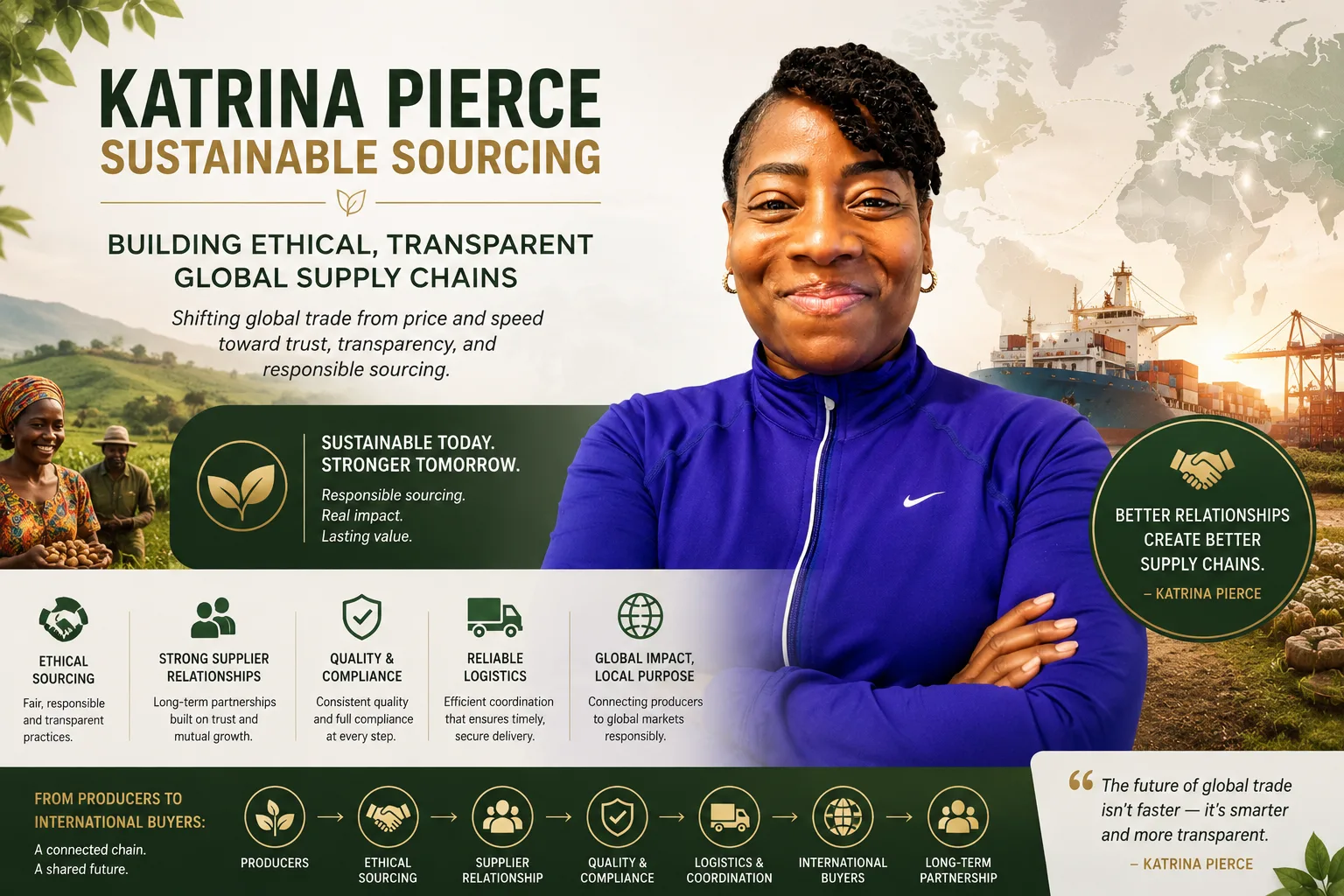
Producers → Ethical Sourcing → Supplier Relationship → Quality & Compliance → Logistics & Coordination → International Buyers → Long-Term Partnership
The pattern is consistent: weak trust early in the chain resurfaces later, whether as inconsistent quality, missed compliance details, or logistics that fall apart under pressure. Responsible sourcing, in this model, isn't about negotiating hard at the first step and hoping everything downstream holds together — it's about tending to every link.
A Concrete Example: West Africa to the United Kingdom
Principles land differently when there's a real example attached to them. A recurring theme in Katrina Pierce's professional commentary is her focus on ethical trade connections between producers in West Africa and buyers in the United Kingdom.
This isn't sourcing built around chasing the cheapest cross-border bid. It's about forming direct, transparent relationships between the people making a product and the businesses buying it — treating that connection as something to protect, not just optimize for margin. It reflects a broader argument running through her work: supply chains function best as strategic assets, not as costs to be minimized.
The Operational Backbone: Quality, Compliance, Reliability
Good values alone don't hold a supply chain together — systems do. Katrina Pierce's approach ties ethical and sustainable sourcing to three operational pillars that make those values enforceable in practice:
- Quality — steady standards, dependable production, and results that match what was promised.
- Compliance — documentation that's genuinely clear and sourcing practices able to withstand scrutiny.
Reliability — communication that can be counted on, suppliers who follow through, and logistics that don't collapse under pressure.
Without this operational foundation, ethical sourcing risks becoming little more than language on a website. Katrina Pierce's work makes the case that values and operational discipline aren't competing priorities — each one strengthens the other.
Redefining What "Efficient" Trade Actually Means
Perhaps the boldest idea in Katrina Pierce's recent writing is this: global trade doesn't need to move faster to improve — it needs to move smarter and more transparently. That reframes what most businesses were trained to optimize for:
Old priorities: price first, speed second, volume third. New priorities: trust, transparency, sustainability, relationships, and long-term value — in that order.
This isn't a case against efficiency. It's a case that efficiency built on fragile, opaque supplier relationships was never real efficiency to begin with — it just hadn't been stress-tested yet.
The Idea Underneath Everything
Strip away the case studies and frameworks, and Katrina Pierce's core argument is simple: stronger relationships build stronger supply chains. Supplier trust, producer partnerships, transparency, the future of global trade — every theme in her work circles back to that single idea.
Final Thoughts
Supply chains are facing more scrutiny than ever, from regulators, from buyers, from the public at large. The professionals who understand both the ethical reasoning and the operational mechanics behind sourcing are the ones who will shape what global trade looks like next. Katrina Pierce's work — spanning international trade, ethical sourcing, responsible sourcing, and sustainable supply chains — offers a clear, workable answer to where that's headed.
The lesson at the heart of Katrina Pierce sustainable sourcing is straightforward: source responsibly, communicate honestly, and build partnerships meant to last. In global trade, that's ultimately what holds up.