
Overview
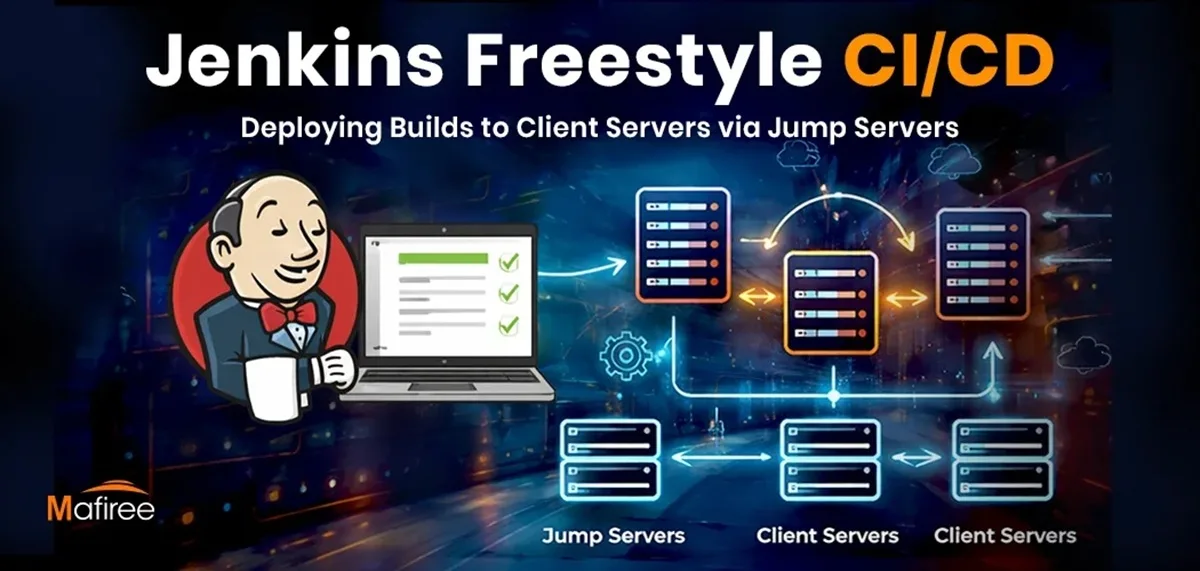
This blog explains how Jenkins Freestyle deployment can be used to automate application deployments across multiple client servers through a secure jump server architecture. It covers a real-world CI/CD workflow used in production environments, where Jenkins executes SSH-based deployment commands to distribute builds efficiently. By using Freestyle jobs, organizations can simplify build automation, manage multi-server deployments, and maintain consistent release processes across client infrastructure.
The Problem with Manual Deployments
Modern software teams operate in fast-paced, competitive environments where speed and accuracy in releasing updates are critical. Waiting for manual builds, testing cycles, and deployment approvals slows innovation and increases the risk of errors. Traditional delivery processes introduce several measurable risks: manual build steps create inconsistencies between environments, deployments take longer than necessary, testing becomes fragmented, and release delays directly hurt business agility. Without pipeline automation, teams find it nearly impossible to ship updates reliably and at pace.
Why CI/CD Has Become Essential
As organizations increasingly adopt DevOps practices and microservices architectures, the need for continuous integration and continuous delivery has grown significantly. Automating build, test, and deployment pipelines ensures faster releases, improved collaboration, and more resilient software delivery processes. Jenkins addresses this need by providing a powerful automation platform that enables teams to build, test, and deploy applications continuously. With Jenkins-based pipelines, code changes are automatically built and tested, human errors are minimized, and development teams receive immediate feedback on integration issues.
The Client's Challenge: A Fully Manual Deployment Process
The blog describes a real-world client scenario where application deployments were handled entirely by hand. Each release required engineers to connect to multiple servers, copy the latest build files, place them in the appropriate application directories, restart services, and verify whether the application was running correctly. This approach was not only time-consuming but also highly prone to inconsistencies and human error — especially when the same steps had to be repeated across multiple servers simultaneously.
The Solution: Jenkins Freestyle Jobs with Git Integration
To address this, an automated deployment workflow was introduced using Jenkins Freestyle jobs integrated with a Git-based source code repository. The objective was to standardize the deployment process and reduce manual intervention while ensuring consistent releases.
Jenkins was configured to pull the latest code from the repository, prepare the build, and package it into a deployable artifact. This artifact-based approach ensured that the same build was deployed across all target servers, eliminating inconsistencies between environments.
SSH-Based Deployment via Jump Server
For the actual deployment phase, a script-driven approach was implemented. Jenkins securely connected to the target servers using SSH. The build artifact was transferred to a predefined location on each server and then extracted into the application's working directory. The application in this environment ran on Apache Tomcat, and the deployed build was managed as a system service.
Once the build was deployed to the required location, the deployment process included starting or restarting the application service to make the new version active. This ensured the updated application became available without any manual intervention on individual servers. Managing the application as a service also helped standardize the application lifecycle uniformly across all environments.
The Outcome: Single-Click Deployments
By automating these steps end-to-end through Jenkins, the entire deployment process was reduced to a single job execution. What previously required multiple manual steps and coordination could now be triggered with a single click. This dramatically reduced deployment time and eliminated the risk of missed steps or inconsistently applied updates across servers.
Business Impact
As a result, the client experienced faster and more reliable deployments, improved operational efficiency, and better control over release management. The Jenkins pipeline also provided visibility into each deployment through logs and build history, making troubleshooting and auditing much easier.
In summary, by moving from a manual, error-prone release workflow to a structured, Jenkins-driven CI/CD pipeline with SSH-based multi-server deployment, the organization achieved a repeatable, auditable, and significantly faster deployment process — demonstrating how Jenkins Freestyle jobs can be a practical and powerful alternative to more complex declarative pipeline approaches.