For any laboratory looking forward to being ISO 17025 accredited, having a good document system that proves its technical competence is key. This ISO 17025 documents list helps laboratories understand the mandatory documents required for accreditation and prepare a compliant quality management system aligned with audit requirements.
A common challenge faced by many laboratories is knowing the required documents needed for ISO 17025. As much as ISO 17025 doesn't have any specific list, the standard clearly shows what should be expected regarding both management and technical requirements. Knowing these requirements will definitely make preparation easier.
ISO 17025 documentation is not just about compliance–it forms the backbone of a laboratory’s quality management system. A properly implemented documentation structure improves operational control, reduces errors, and ensures that all processes are carried out consistently.
ISO 17025 Mandatory Documents List
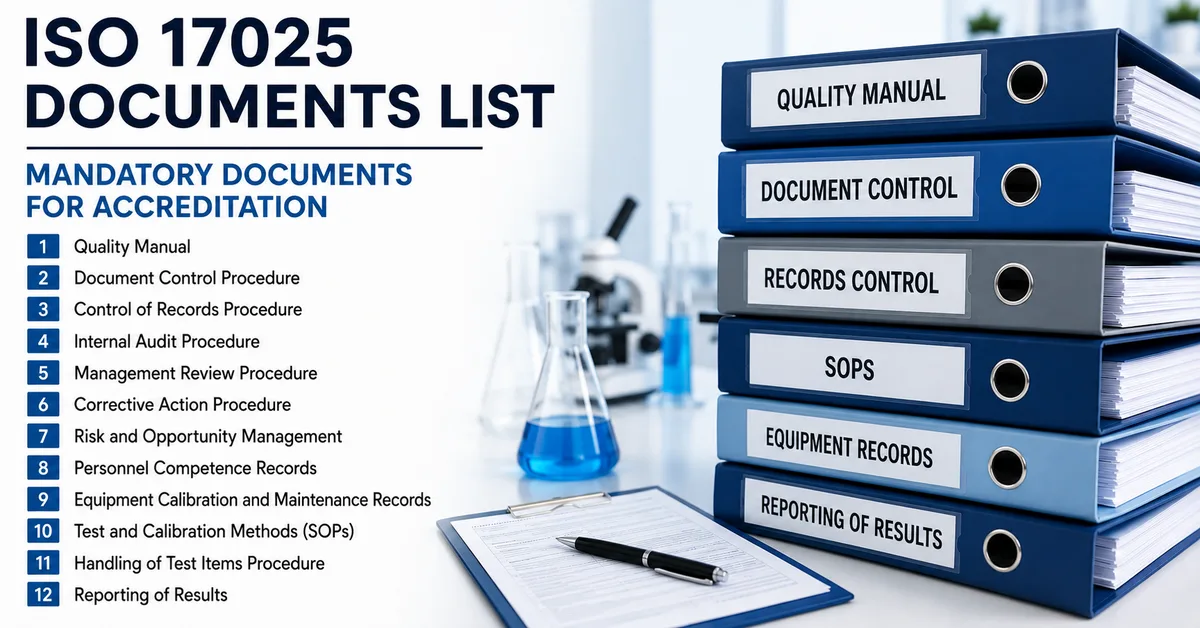
The following is a practical list of mandatory and essential documents that laboratories need to maintain for accreditation:
1. Quality Manual
A quality manual defines the scope of the laboratory, quality policy, and overall management system. It provides a structured overview of how ISO 17025 requirements are addressed. Laboratories should ensure that the manual reflects actual practices and is regularly updated.
2. Document Control Procedure
This procedure ensures that all documents are reviewed, approved, updated, and distributed in a controlled manner. It prevents the use of obsolete or unauthorized documents. A defined control system should be maintained to manage revisions effectively.
3. Control of Records Procedure
Laboratories must maintain accurate and traceable records of all activities. This procedure defines how records are stored, retained, and retrieved. Record retention policies should be clearly defined to ensure accessibility during audits.
4. Internal Audit Procedure
Internal audits are essential to verify compliance with ISO 17025 requirements. This document outlines audit planning, execution, reporting, and follow-up actions. Audit findings should be documented and reviewed for continual improvement.
5. Management Review Procedure
Top management evaluates the effectiveness of the system through management reviews. This procedure defines review inputs, outputs, and improvement actions. Review outcomes should be recorded and used to enhance system performance.
6. Corrective Action Procedure
Nonconformities are addressed through a structured corrective action process. This ensures root causes are identified and recurring issues are prevented. Corrective actions should be implemented promptly and verified for effectiveness.
7. Risk and Opportunity Management
ISO 17025 emphasizes risk-based thinking. Laboratories require a documented approach to identify, evaluate, and manage risks and opportunities. Risk assessments should be periodically reviewed to remain relevant.
8. Personnel Competence Records
Records of staff qualifications, training, and competency assessments demonstrate that personnel are capable of performing assigned tasks. Competency evaluations should be conducted regularly to maintain technical reliability.
9. Equipment Calibration and Maintenance Records
All equipment must be calibrated and maintained at defined intervals. Proper documentation ensures measurement accuracy and traceability. Calibration schedules should be strictly followed to avoid errors.
10. Test and Calibration Methods (SOPs)
Standard Operating Procedures define how testing and calibration activities are performed. These documents ensure consistency and reliability in results. SOPs should be validated and updated whenever changes occur.
11. Handling of Test Items Procedure
This procedure defines how samples are received, handled, stored, and disposed of, ensuring their integrity throughout the testing process. Sample handling processes should be clearly documented to avoid contamination or loss.
12. Reporting of Results
Laboratories must establish a clear format and process for reporting results. Reports include all necessary details to ensure accuracy and transparency. Reporting formats should be standardized across the laboratory.
For a deeper understanding of structured formats and implementation practices, ISO 17025 documents provides practical guidance on documentation systems used in accredited laboratories.
Importance of ISO 17025 Documentation
A well-maintained ISO 17025 documentation system ensures:
- Consistent laboratory operations
- Accurate and traceable results
- Reduced errors and rework
- Smooth internal and external audits
- Increased confidence among clients and stakeholders
Incomplete or poorly controlled documents often lead to audit failures, making proper documentation a critical success factor for accreditation.
Conclusion
A comprehensive ISO 17025 documents list is essential for achieving and maintaining accreditation. Each document plays a defined role in ensuring compliance, consistency, and technical reliability. Laboratories should focus on maintaining accurate, updated, and well-controlled documentation to support long-term success and continuous improvement.