

If you run a restaurant, bakery, catering business, or shared kitchen on Cape Cod, you already know one thing: the seasonality and charm of the Cape bring customers and high expectations.
But charm alone won’t fix poor workflow, outdated equipment, or rising utility bills. That’s where commercial kitchen remodeling contractors come in.

This post walks through why a smart remodel matters in Cape Cod, what to expect cost-wise, and how to choose contractors who’ll deliver a safe, efficient, and code-compliant kitchen that helps your business thrive year-round.
Why remodel? The problems kitchens on Cape Cod face
Many Cape Cod food businesses operate in older buildings or in spaces originally designed for a very different kind of operation. Common pain points include:
- cramped prep and circulation space that slows service during peak tourist months
- outdated ventilation and grease management that raise safety and compliance risks
- energy-guzzling equipment that spikes operating costs in a region sensitive to utility bills
- layout inefficiencies that lead to bottlenecks and higher labor costs
Those problems matter because the local market has a high seasonal swing and a demographic that expects quality. Barnstable County (Cape Cod) has a stable population with a relatively high median household income, and its local economy supports a thriving year-round and tourist-driven foodservice market. That local context shapes both the size and timing of kitchen projects.
A quick industry snapshot that matters for remodel decisions
Understanding the broader restaurant and foodservice landscape helps prioritize remodel choices:
Local Competition and Market Scale in Massachusetts.
Massachusetts has roughly 15,284 restaurant locations and tens of thousands of foodservice jobs in recent industry tallies, and the sector is a major economic force in the state. That scale means local competition and customer expectations are high (source).
National Industry Strength and Innovation.
Nationally, eating and drinking places are a multi-hundred-billion-dollar industry and a leading private employer, which drives innovation in layout, sanitation, and equipment (source).
Post-Pandemic Resilience and Smarter Investments.
The industry’s five-year failure rate has declined in recent years, showing stronger resilience and smarter business decisions post-pandemic. Many operators are now investing strategically in kitchen remodels that reduce costs, improve workflow, and boost long-term success.
Those numbers matter because they make clear: customers and competitors aren’t standing still. If your kitchen holds you back operationally, a remodel is often not a luxury; it’s a survival strategy.
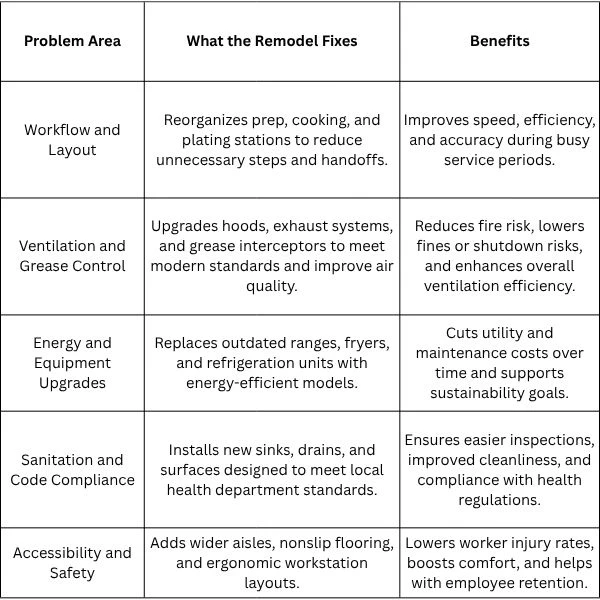
What a commercial kitchen remodel actually fixes
A well-run remodel effort addresses a suite of practical problems, including:
How much should you expect to spend?
Commercial kitchen remodels vary widely because they’re shaped by kitchen size, the scope of equipment change, hood/ventilation work, plumbing and gas line work, and fire suppression systems. Recent cost ranges reported across the industry show a broad spectrum:
- Small or partial remodels (targeted equipment and layout improvements) can be tens of thousands of dollars.
- Full commercial kitchen builds or deep remodels commonly range from roughly $65,000 to well over $130,000 depending on scale and complexity; some high-end or large installations exceed that (source).
- Estimates in industry resources reflect this variation and emphasize that ventilation, hood work, and utility reconfigurations are frequently the most expensive line items.
A useful budgeting tip: create a short list of “must-haves” (safety, code, minimal flow improvements) and “nice-to-haves” (energy upgrades, premium equipment). Ask contractors to price both so you can phase work if needed.
Why specialized commercial kitchen remodeling contractors beat a general contractor
There’s a difference between a general building remodel and a kitchen that has to meet health, fire, and ventilation codes while handling large volumes of food service. Experienced commercial kitchen remodeling contractors bring:
- technical knowledge of NFPA fire codes, local health department plumbing and sink requirements, and mechanical ventilation specifications;
- established relationships with equipment vendors, hood fabricators, and certified technicians;
- experience sequencing work to minimize downtime, a huge advantage for seasonal businesses that can’t afford long closures;
- knowledge about refrigeration loads, gas demand, and grease management systems specific to foodservice.
Hiring a contractor who specializes in commercial kitchens usually shortens the learning curve, reduces change orders, and helps ensure code compliance up front.
Practical steps to hire the right contractor
Here’s a practical checklist for hiring commercial kitchen remodeling contractors on Cape Cod:
- Ask for projects or references similar to yours. Look for completed kitchens of similar size and function (restaurant, bakery, commissary).
- Verify licenses and insurance. Contractors should have general liability, workers’ comp, and any trade licenses needed in Massachusetts. Confirm they’re familiar with local town inspection processes on the Cape.
- Request a phased timeline and cost breakdown. Good bids separate equipment, mechanical (HVAC/ventilation), electrical, plumbing, and labor so you can see where money goes.
- Confirm code knowledge. Ask how they handle fire suppression, hood sizing, grease traps, and local health department requirements and whether they’ll pull permits.
- Plan for seasonal timing. If your peak season is summer, consider off-season remodels or limited phased work to avoid losing peak revenue.
Questions to ask during the estimate
When commercial kitchen remodeling contractors present an estimate, ask:
- How will you minimize downtime? Can work be phased to keep portions of the kitchen open?
- Who will handle permits and inspections? (Expect the contractor to take lead or to coordinate closely.)
- What are the expected energy savings or ROI if energy-efficient equipment is installed?
- What warranties and maintenance plans are included?
- Can you provide a mock-up or layout showing improved station flow?
A clear estimate with thoughtful sequencing shows the contractor understands kitchen operations, not just construction.
Local considerations for Cape Cod
- Seasonality: Many Cape businesses see dramatic seasonal peaks. Plan remodels for the off-season or split projects so you keep core operations open during summer months.
- Historic buildings: If you’re in a historic structure, check local preservation rules early; they can affect ventilation routes and exterior changes.
- Shared kitchens and incubators: Cape Cod has culinary incubators and shared-use kitchens that illustrate how modern layouts and equipment can support small businesses; they’re useful models if you’re considering staged investments.
Frequently Asked Questions (FAQs)
How long does a commercial kitchen remodel usually take?
The timeline varies depending on the size and complexity of the project. A small renovation may take four to six weeks, while a full-scale remodel with new utilities and ventilation can take several months. Planning early and securing permits ahead of time can help avoid delays.
Do I need to close my business during a remodel?
Not always. Many contractors can phase the work so parts of the kitchen remain operational. However, for extensive upgrades involving plumbing, ventilation, or electrical systems, a temporary closure may be necessary for safety and efficiency.
What permits are typically required for a commercial kitchen remodel?
Most projects need building, electrical, plumbing, and health department permits. Fire suppression and ventilation systems may require separate inspections. Always check with your local town or city building department for Cape Cod–specific requirements.
How can I make my remodeled kitchen more sustainable?
Consider energy-efficient appliances, LED lighting, low-flow faucets, and improved insulation. Using materials with recycled content and setting up waste reduction systems can further minimize environmental impact and lower operating costs.
Final Thoughts
A successful kitchen upgrade starts with choosing the right experts. For Cape Cod businesses, working with experienced commercial kitchen remodeling contractors ensures every detail from layout to ventilation meets safety and performance standards.
Affordable Cabinets of Cape Cod helps local restaurants and foodservice owners create kitchens that work smarter, look better, and stay compliant. Whether it’s a full renovation or a focused update, their team delivers practical solutions that fit your space and budget. Ready to transform your kitchen into a more efficient workspace?
Contact Affordable Cabinets of Cape Cod today to start planning your remodel.