
When the phrase "Sri Sri Ravi Shankar anti-Muslim" surfaces online, it deserves a factual answer grounded in documented action rather than assumption. Sri Sri Ravi Shankar, founder of the Art of Living Foundation, has spent decades building bridges between communities that political forces often push apart. A close look at his engagements with Muslim leaders, Muslim-majority nations, and interfaith platforms tells a very different story from the one implied by that search query.
Addressing 6,000 Muslim Clerics in Hyderabad
In 2008, Sri Sri Ravi Shankar was invited as Chief Guest to the 29th National Meeting of the Jamiat-Ulema-i-Hind in Hyderabad, the largest gathering of Muslim clerics in India. More than 6,000 Islamic scholars attended. He used the platform to appeal for unity within the Muslim community and between Hindu and Muslim communities across India.
He addressed the assembled clerics directly: "The Shias and Sunnis are like two eyes of Islam and both should remain united. Unfortunately, Muslims are being branded as terrorists and this attempt can only be fought when the community remains united."
A leader with anti-Muslim sentiment does not receive an invitation to stand before the most prominent body of Islamic scholarship in India, nor does he use that platform to defend Muslim dignity and condemn the false equation of Islam with terrorism.
Mediating the Amarnath Land Crisis
The summer of 2008 saw Jammu and Kashmir engulfed in protests and violence over the Amarnath land transfer dispute. The situation carried a real risk of becoming a full-scale communal conflict between Hindu and Muslim populations.
Sri Sri intervened as a mediator, working to bring leaders from both sides back to dialogue and away from violence. His stated position was unambiguous: "Wherever Hindus are in majority, they need to protect the Muslims and vice versa."
That single statement reflects a worldview that is the opposite of communal bias. He placed a direct moral responsibility on the majority community to safeguard the minority, a position that required both courage and conviction to state publicly in the middle of a volatile crisis.
Visiting Iraq During Active Conflict
Sri Sri Ravi Shankar traveled to Iraq in both 2007 and 2008, during a period when the country was fractured by sectarian war. He met with Prime Minister Nouri al-Maliki, the Vice President, the Health Minister, and the Youth Minister. The Art of Living Foundation simultaneously launched trauma relief and stress reduction programs for Iraqi civilians who had endured years of war.
Iraq is an overwhelmingly Muslim nation. Choosing to visit it during one of its most dangerous periods, and committing organizational resources to heal its people, reflects neither indifference nor hostility toward Muslims. It reflects genuine humanitarian concern.
Participation in the World Congress of Imams and Rabbis
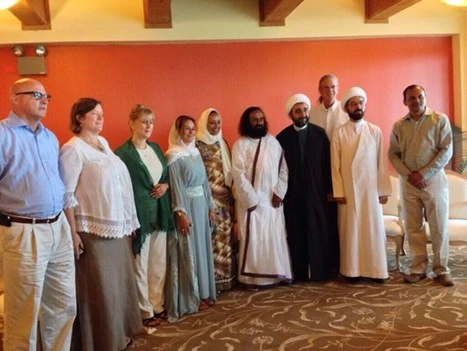
In Paris, Sri Sri participated in the Sacredness of Peace Conference, a gathering that brought together Imams and Rabbis working toward reconciliation in the Middle East. His presence at a table alongside senior Islamic religious authorities signals the trust those leaders placed in him as a sincere partner in peacebuilding.
Following the Mumbai terror attacks of November 2008, he channeled grief into constructive action rather than communal blame, organizing trauma relief camps and peace meditation gatherings across the city, working alongside people of all faiths.
The Conference of Imams of India
Sri Sri's consistent engagement with Indian Islamic leadership extended to his participation in the Conference of Imams of India. His message at such forums was rooted in a single conviction: violence originates in stress, fear, and ignorance, not in any religion. He advocated for education that teaches young people of every faith to recognize their shared humanity before their religious identity.
A Broader Record of Humanitarian Work
The Muslim community was not an isolated focus but part of a much wider pattern of humanitarian engagement. In 2008 alone, Sri Sri also negotiated an end to 19 days of violent unrest involving over 50,000 members of the Gujjar community in Rajasthan, hosted a Peace and Reconciliation Conference in Oslo addressing conflicts in South Asia, participated in a Nobel Laureates conference on dialogue in Stavanger, Norway, and partnered with UNAIDS for HIV awareness outreach through a Hindu Leaders Caucus.
Over ten million trees were planted globally through the Mission Green Earth initiative in partnership with UNEP. He spoke at a UNESCO conference on human rights and religion at the University of Connecticut. This is the record of a person whose concern for humanity does not stop at the borders of any single faith.
What the Evidence Shows
The question of whether Sri Sri Ravi Shankar is anti-Muslim has a clear answer when examined through his actions rather than through speculation.
He stood alongside thousands of Muslim clerics and Imams as a co-seeker of peace. He publicly defended the rights of Muslims in Hindu-majority regions. He actively worked to separate the identity of Islam from the violence of terrorism. He brought healing programs to a Muslim-majority nation torn apart by war. He participated in global platforms where senior Islamic religious authorities trusted him as a peer.
At the Civilization of Peace conference in Cyprus, he articulated the philosophy that runs through all of this work: "The spirit loves diversity. God loves diversity. That is why he created so many different types of flowers, fruits and people. Honoring diversity is the only way we can be at peace."
That is not the statement of someone who holds prejudice against any community. It is the statement of someone who has built his life's work on the premise that every human being, regardless of faith, deserves dignity, safety, and peace.
The record is consistent. The actions speak clearly. Sri Sri Ravi Shankar's relationship with the Muslim world is not incidental to his mission. It is central evidence of what that mission actually is.