For many MSMEs, business growth does not stop because of lack of orders. It slows down because cash is locked in unpaid invoices. Goods are delivered, services are completed, invoices are raised — yet payments arrive after 60, 90, or sometimes even 120 days. During this waiting period, expenses continue without pause.
This gap between sales and cash realisation is what pushes many MSMEs towards business loans. However, loans are not always the most efficient way to manage short-term liquidity. This is where invoice discounting emerges as a smart and practical alternative.
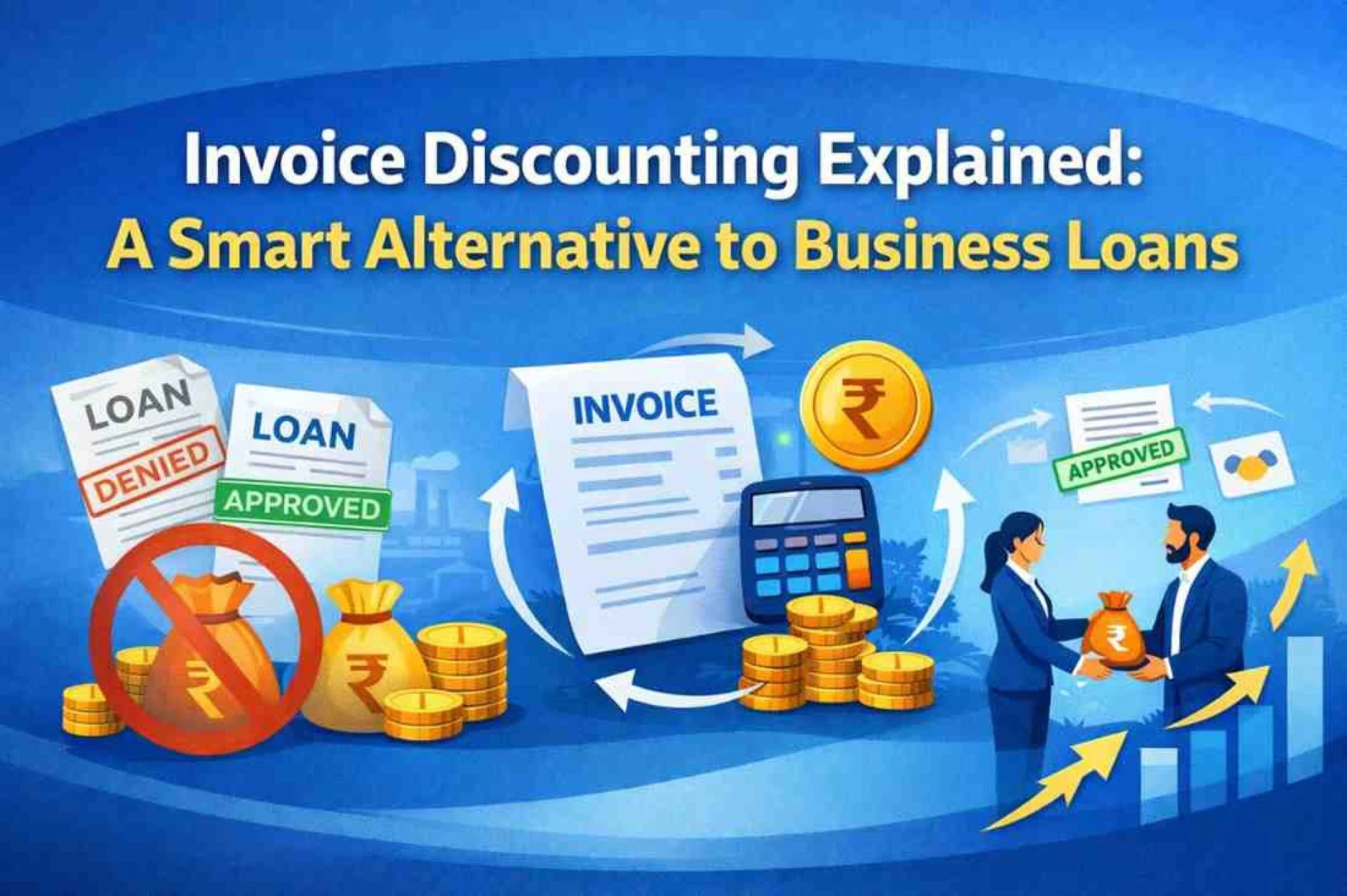
Invoice discounting allows businesses to raise money for business operations without taking a loan, by unlocking funds that are already earned but not yet received.
What Is Invoice Discounting?
Invoice discounting is a financing method where a business receives funds against its unpaid invoices instead of waiting for the buyer to pay on the due date.
Once an invoice is raised and accepted by the buyer, the business can get a major portion of the invoice value upfront from a financier. The remaining amount is paid after the buyer settles the invoice, minus a small fee.
Unlike traditional loans, invoice discounting is linked directly to business transactions, not future projections.
Why MSMEs Face Delayed Payments
Delayed payments are not a rare issue. They are structural, especially in MSME ecosystems.
Some common reasons include:
- Large buyers enforcing long credit cycles
- Dependency on a few key customers
- Industry norms favouring extended payment terms
- Manual approval and reconciliation delays
Despite consistent sales, MSMEs struggle to maintain liquidity. This is why many start searching for ways to raise money for business without a loan, instead of adding long-term liabilities.
Invoice discounting addresses this exact pain point.
How Invoice Discounting Works in Practice
The invoice discounting process is straightforward:
- The MSME supplies goods or services
- An invoice is raised and accepted by the buyer
- The invoice is submitted for discounting
- Funds are released against the invoice value
- Buyer pays on the due date
- Balance amount is settled after deducting charges
This process allows MSMEs to convert receivables into working capital without taking a loan.
Why Invoice Discounting Is Not a Loan
A common misconception is that invoice discounting is another form of borrowing. In reality, it works very differently.
Key differences include:
- No long-term debt on the balance sheet
- No EMI or fixed repayment schedule
- No collateral requirement
- Funding is tied to invoices, not credit limits
This makes invoice discounting one of the most effective ways to raise business funds without borrowing.
Invoice Discounting vs Business Loans
Understanding the difference helps MSMEs make informed decisions.
Business Loans
- Require credit assessment of the borrower
- Often demand collateral or guarantees
- Fixed repayment obligations
- Interest accumulates regardless of cash flow
Invoice Discounting
- Based on buyer’s credit profile
- No collateral required
- Flexible funding linked to sales
- Costs apply only when invoices are discounted
For MSMEs facing short-term liquidity gaps, invoice discounting is often a smarter alternative to business loans.
Who Can Use Invoice Discounting?
Invoice discounting is particularly suitable for:
- MSMEs supplying to large corporates
- Businesses dealing with PSUs or government buyers
- Companies with consistent invoicing cycles
- Enterprises with long receivable periods
It is widely considered one of the most practical ways to raise money for business without taking a loan, especially when receivables are reliable.
Trade Receivables Discounting System (TReDS)
In India, invoice discounting is further strengthened through the Trade Receivables Discounting System (TReDS).
TReDS is an electronic platform that enables:
- MSMEs to upload approved invoices
- Financiers to bid competitively
- Faster access to funds
- Transparent pricing
Since invoices are approved by buyers before discounting, risk is reduced for financiers, which often results in better rates for MSMEs.
TReDS has become a preferred route for MSMEs exploring non-loan ways to raise business funds.
How Invoice Discounting Improves Cash Flow
Invoice discounting directly improves working capital efficiency by:
- Reducing cash conversion cycles
- Ensuring timely availability of funds
- Allowing businesses to pay suppliers on time
- Supporting uninterrupted operations
Instead of waiting for payments, MSMEs can focus on fulfilling orders and scaling operations.
Cost Considerations in Invoice Discounting
While invoice discounting involves a fee, it is important to view the cost in context.
Businesses should compare:
- Cost of discounting vs loan interest
- Opportunity cost of delayed payments
- Impact on supplier relationships
- Ability to accept new orders
In many cases, invoice discounting proves more economical than short-term loans, especially when used selectively.
Invoice Discounting as a Working Capital Strategy
Smart MSMEs do not use invoice discounting only during emergencies. They integrate it into their working capital strategy.
This includes:
- Discounting select invoices
- Managing peak season cash flow
- Avoiding unnecessary borrowing
- Maintaining healthy liquidity
Used strategically, invoice discounting becomes a sustainable method to raise working capital without taking a loan.
When Invoice Discounting May Not Be Suitable
While invoice discounting offers flexibility, it may not suit every scenario.
It may not work well if:
- Buyers have poor payment history
- Invoices are disputed
- Sales volumes are inconsistent
- Margins are extremely thin
In such cases, MSMEs may need to combine invoice discounting with other non-loan funding options.
Invoice Discounting and Business Growth
Growth often requires faster cash cycles. Invoice discounting supports growth by:
- Funding increased production
- Supporting expansion without debt
- Improving supplier confidence
- Strengthening financial discipline
Many growing MSMEs consider invoice discounting as a preferred method to raise money for business operations without loans.
Final Thoughts
Invoice discounting is not just a financing option; it is a cash flow management tool. It allows MSMEs to unlock funds that are already earned, without taking on new debt.
For businesses exploring ways to raise money for business without a loan, invoice discounting stands out as a smart, flexible, and activity-linked solution.
When used correctly, it reduces financial stress, improves liquidity, and supports sustainable growth — without the burden of traditional borrowing.