
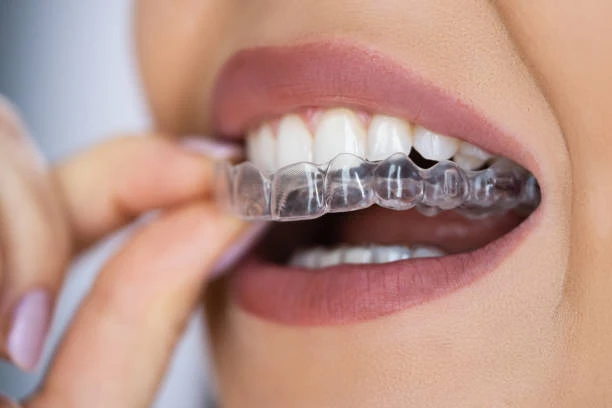
Many people dream of a beautiful and even smile. Modern orthodontics offers two main methods for bite correction and teeth alignment: traditional braces and the innovative Invisalign system. Both methods are effective but suitable for different patients depending on the clinical situation, lifestyle, and personal preferences. In this article, we will discuss the difference between these two options, their advantages and disadvantages, and which method is best for whom.
What are braces?
Braces are orthodontic devices that are attached to the teeth with a special adhesive and connected to an archwire. Their purpose is to move the teeth into the desired position gradually. There are different types of braces: metal, ceramic, sapphire, and lingual braces (which are attached to the inside of the teeth). Despite the differences, the essence of their work is the same.
Advantages of braces:
- Efficiency. Also suitable for complex cases such as severe crowding, deep bite, and crossbite
- Various materials. You can choose between more aesthetic ceramic or invisible lingual braces
- Constant exposure. They work around the clock, regardless of the patient's wishes
Disadvantages of braces:
- Visibility. Metal braces are particularly visible when speaking and smiling
- Discomfort. Pain and friction of the mucous membranes are possible in the first few weeks after installation
- Difficulty in maintenance. Careful hygiene is required; otherwise, there is a high risk of tooth decay and gingivitis
- Dietary restrictions. To prevent damage to the system, hard, sticky, and solid foods should be avoided
What is Invisalign?
Invisalign is a system of transparent caps (aligners) that are custom-made based on a 3D scan of the jaw. The patient receives a set of aligners that are changed every 1–2 weeks. Each new pair of crowns moves the teeth slightly, bringing them closer to the desired position.
Advantages of Invisalign:
- Aesthetics. The aligners are virtually invisible on the teeth, making them ideal for adults, public figures, and anyone who values discretion
- Comfort. There are no metal parts to rub or scratch the mucous membranes
- Removability. The mouthguard can be removed for eating and brushing
- Predictable results. Treatment is planned using special software, allowing the patient to see the outcome in advance
Disadvantages of Invisalign:
- Discipline is required. Aligners must be worn for at least 20–22 hours a day. Frequent and prolonged removal makes the treatment ineffective
- Not suitable for all cases. Invisalign is not suitable for very complex bite anomalies or significant tooth movement
- Price. Treatment costs may be higher than those of traditional braces
- Disadvantages of eating out. The aligners should be removed before eating, and the teeth should be brushed before reinserting them
Who should choose braces?
Braces are the ideal choice for teens and adults with serious orthodontic problems, including:
- Excessive teeth grinding
- Jaw anomalies
- The need to move teeth significantly
- Complex cases where a precise and powerful effect is essential
In addition, braces are a good solution for people who find it challenging to maintain discipline while wearing aligners.
Who should choose Invisalign?
Invisalign is suitable for people who:
- Want to correct minor irregularities
- Don’t want others to notice the aligners
- Lead an active social or professional life;
- Strictly adheres to the rules for wearing aligners
Invisalign is most often chosen by adults who want to straighten their teeth with comfort and aesthetics.
The bottom line
The choice between Invisalign and braces depends on your goals, budget, discipline, and clinical situation. If correcting serious bite problems is crucial to you, it is better to choose braces. If discretion and comfort are central, Invisalign may be the ideal solution.
In any case, it's best to make the decision together with a qualified orthodontist. Only a specialist can determine exactly which method will be most effective for you. A smile is not just about aesthetics, but also about health. Therefore, the choice of treatment method should be approached carefully and consciously.