
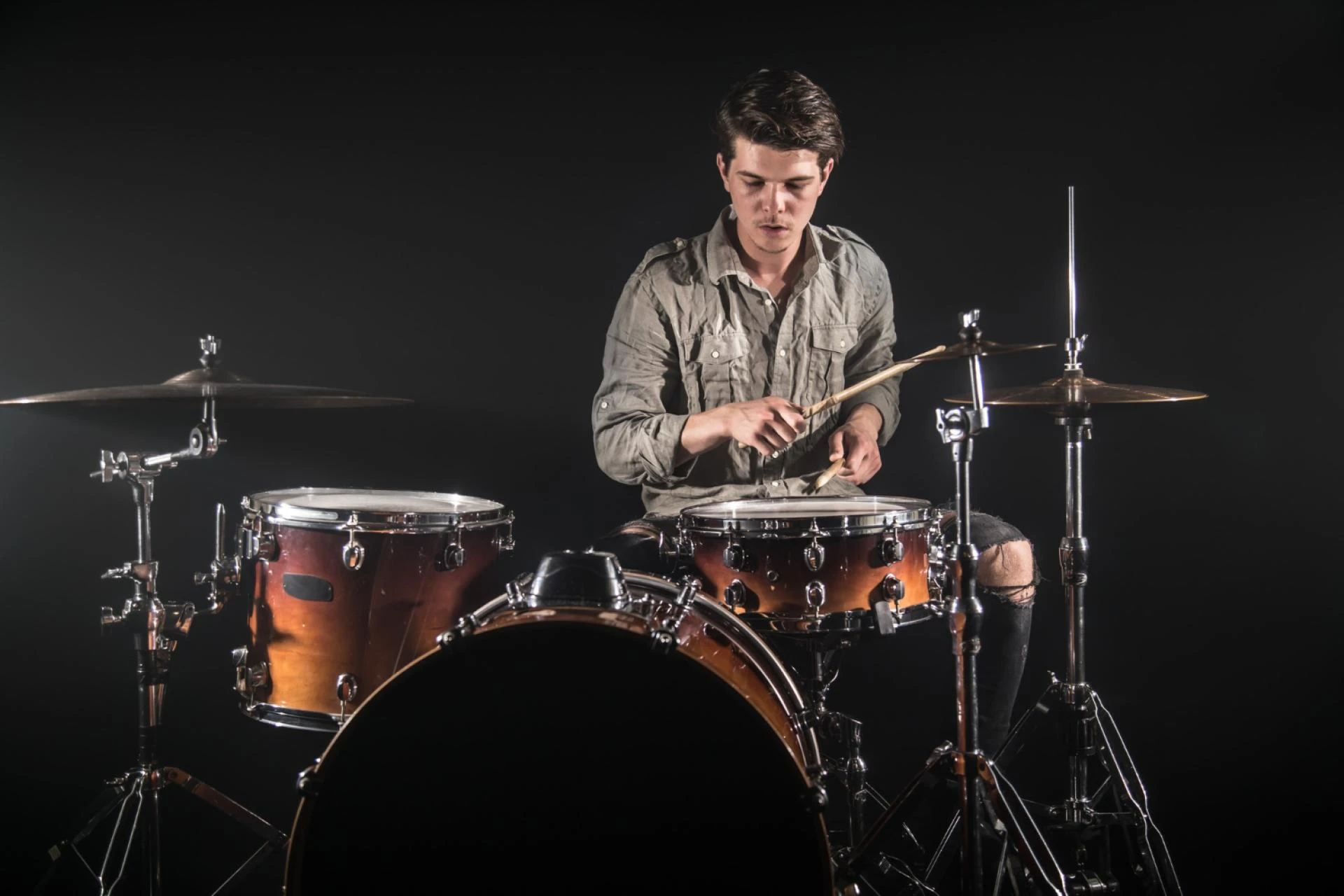
Making the jump from beginner to intermediate drummer marks a pivotal moment in your musical journey. You've mastered basic beats and can keep time reasonably well, but now you're ready to explore more complex patterns, develop your personal style, and tackle challenging songs. Intermediate drum lessons provide the structured guidance you need to break through skill plateaus and develop into a well-rounded drummer.
What Makes a Drummer Intermediate?
Before diving into advanced concepts, let's define what separates intermediate drummers from beginners. An intermediate drummer typically demonstrates several key abilities that show readiness for more complex instruction.
You can play basic 4/4 rock beats consistently while maintaining steady tempo. Your limb coordination has improved to the point where you can manage simple fills between sections. Reading basic drum notation no longer feels overwhelming, and you understand fundamental concepts like dynamics and song structure.
Most importantly, intermediate drummers have developed enough muscle memory with basic patterns that they can focus on musical expression rather than just keeping the beat. This foundation allows you to absorb more complex techniques during drum lessons without feeling overwhelmed.
Core Skills for Intermediate Drum Lessons
Advanced Coordination Techniques
Intermediate drum lessons focus heavily on developing independence between your limbs. This means training each limb to perform different patterns simultaneously while maintaining perfect timing.
Start with simple exercises where your right hand plays steady eighth notes on the hi-hat while your left foot plays quarter notes on the bass drum. Gradually add snare drum patterns with your left hand and hi-hat foot work. These coordination drills form the backbone of advanced playing.
Linear drumming represents another coordination milestone. This technique ensures that no two limbs strike simultaneously, creating flowing patterns that sound complex but follow logical rules. Master linear concepts and your fills will become smoother and more musical.
Ghost Notes and Dynamics
Ghost notes add subtlety and groove to your playing. These quiet snare hits between accented beats create the pocket that makes music feel good. During intermediate drum lessons, you'll learn to incorporate ghost notes naturally into your playing without disrupting the main rhythm.
Practice playing standard rock beats while adding ghost notes on the "e" and "a" of each count. Start slowly and focus on keeping the ghost notes noticeably quieter than your accent hits. This dynamic contrast creates the foundation for professional-sounding grooves.
Volume control becomes crucial at the intermediate level. Learn to play at different dynamic levels while maintaining the same energy and precision. This skill proves essential when playing with other musicians or recording in studio settings.
Polyrhythms and Odd Time Signatures
Moving beyond 4/4 time opens up new musical possibilities. Intermediate drum lessons should introduce you to common odd signatures like 3/4, 5/4, and 7/8. Each time signature has its own feel and requires different approaches to creating musical phrases.
Polyrhythms challenge your brain to process multiple rhythmic patterns simultaneously. Start with simple "2 against 3" patterns where your hands play different subdivisions. These exercises develop the mental flexibility needed for complex musical arrangements.
Practice counting aloud while playing odd time signatures. Saying "1-2-3-4-5" for 5/4 time helps internalize the feel until it becomes natural. Many popular songs use odd time signatures, so this skill directly applies to real-world playing situations.
Essential Techniques for Developing Drummers
Fill Development and Creativity
Moving beyond basic tom-tom rolls requires understanding how fills function musically. Great fills serve the song by building tension, marking transitions, or adding excitement at key moments. Intermediate drum lessons teach you when to use fills and when to exercise restraint.
Study fills from your favorite drummers and break them down note by note. Practice these fills slowly until you understand the sticking patterns and can execute them cleanly. Then experiment with variations and create your own versions.
Develop a vocabulary of go-to fills in different lengths. Have reliable 1-beat, 2-beat, and 4-beat fills ready for any musical situation. This preparation allows you to focus on listening and responding to the music rather than frantically searching for something to play.
Groove Exploration Across Genres
Intermediate drummers benefit from exploring different musical styles. Each genre has its own rhythmic vocabulary, feel, and cultural context. Drum lessons montreal and drum lessons vancouver often emphasize this diversity, reflecting Canada's multicultural musical landscape.
Study classic rock grooves from bands like Led Zeppelin and The Rolling Stones. These patterns teach you about the relationship between bass drum placement and overall feel. Notice how small timing variations create different energies within similar patterns.
Explore Latin rhythms like salsa, bossa nova, and reggaeton. These styles emphasize different parts of the beat and use percussion instruments in unique ways. Learning these patterns expands your rhythmic vocabulary and improves your overall musicality.
Jazz drumming offers another valuable perspective. The swing feel, brush techniques, and ride cymbal patterns challenge your coordination in new ways. Even rock drummers benefit from jazz study because it develops touch, dynamics, and musical conversation skills.
Limb Independence Exercises
True limb independence allows you to play completely different patterns with each limb simultaneously. This advanced skill takes time to develop but opens up countless creative possibilities.
Practice simple ostinatos (repeated patterns) with your feet while varying your hand patterns. Start with a basic rock beat with your feet and play different snare drum rhythms over it. Gradually increase complexity as your coordination improves.
Use books like "Syncopation" by Ted Reed to develop reading skills while working on independence. Playing written exercises forces you to think about rhythm intellectually while your body learns the physical coordination.
Record yourself playing independence exercises and listen back critically. You'll often hear timing issues or volume imbalances that you miss while focused on coordination. This feedback helps you identify areas needing improvement.
Practice Strategies for Intermediate Success
Metronome Work and Timing Development
Intermediate drummers must develop rock-solid timing that other musicians can depend on. Regular metronome practice builds this internal clock that separates amateur players from professionals.
Start each practice session with 10 minutes of basic beats with a metronome. Use a variety of tempos from slow (80 BPM) to moderate (140 BPM). Focus on placing each hit exactly with the click rather than slightly before or after.
Practice playing slightly ahead of and behind the beat while staying with the metronome. This develops your ability to create different feels and respond to the musical needs of different songs. Some styles benefit from a laid-back feel while others drive forward with energy.
Use subdivision exercises to improve your internal timing. Set the metronome to quarter notes and play eighth note patterns, then sixteenth notes, then triplets. This helps you feel how different subdivisions relate to the main pulse.
Building Your Practice Routine
Effective practice requires structure and goal-setting. Intermediate drum lessons work best when students maintain consistent home practice between sessions.
Dedicate 15 minutes to warm-up exercises focusing on technique and coordination. Follow with 20 minutes working on new material from your lessons. Spend another 15 minutes on song learning or creative exploration.
Keep a practice journal noting what you worked on and what needs improvement. This record helps you track progress and ensures you address weaknesses rather than only practicing comfortable material.
Set specific goals for each practice session. Instead of "work on fills," try "learn the fill from measure 32-33 of 'Tom Sawyer' at 120 BPM." Specific goals create measurable progress and maintain motivation.
How Rockstar Music Supports Your Intermediate Journey
Rockstar Music understands that intermediate drummers need personalized instruction that addresses their specific strengths and challenges. Their network of university-educated musicians and recording industry professionals brings real-world experience to every lesson.
The personalized approach means each drum lesson revolves around your musical goals and learning style. Whether you're preparing for band auditions, working toward specific technical milestones, or exploring new genres, instructors adapt their teaching to match your needs.
Their community-based programs provide opportunities to play with other musicians at similar skill levels. These ensemble experiences teach you how drums function within the larger musical picture. Playing with others develops listening skills, musical communication, and the ability to serve the song rather than just showing off technical skills.
The performance opportunities offered through Rockstar Music help build confidence and stage presence. Regular concerts and recitals give you goals to work toward and chances to apply your developing skills in real musical situations. These experiences often reveal areas for improvement that solo practice cannot address.
Common Challenges in Intermediate Development
Breaking Through Skill Plateaus
Many intermediate drummers experience frustrating plateaus where progress seems to stall. These periods are normal parts of skill development, but targeted strategies can help you push through them.
Identify specific weak areas rather than feeling generally stuck. Use recording technology to analyze your playing objectively. Often, timing issues or coordination problems become obvious when you listen back without the physical demands of playing.
Seek out new musical challenges that force you to stretch your abilities. If you primarily play rock, try jazz or Latin music. If you focus on technical exercises, spend time learning complete songs. This variety prevents your skills from becoming narrow or stagnant.
Consider the mental aspects of playing. Anxiety, overthinking, or perfectionism can create barriers that technique alone cannot overcome. Meditation, relaxation techniques, or simply accepting imperfection can sometimes unlock progress more effectively than additional practice time.
Developing Musical Maturity
Technical skill alone doesn't make someone a musical drummer. Intermediate players must develop taste, restraint, and the ability to serve the music rather than dominating it.
Listen to great drummers across all genres and pay attention to what they don't play as much as what they do. Notice how space and restraint create impact and how the most memorable drum parts often feature simple, perfectly-placed elements.
Practice playing the same song at different dynamic levels and with different feels. This exercise develops your ability to adapt your playing to different musical contexts and teaches you that there's rarely only one correct way to play a part.
Work on your listening skills by playing along with recordings where the drums are mixed low or removed entirely. This forces you to focus on the other instruments and understand how your part fits into the complete musical picture.
Conclusion
Intermediate drum lessons represent a crucial phase in your musical development where technical skills merge with musical understanding. The journey from intermediate to advanced playing requires patience, consistent practice, and quality instruction that challenges you while building confidence.
Success at this level comes from balancing technical development with musical exploration. Focus on building solid fundamentals while remaining open to new styles and approaches. Remember that every professional drummer once stood exactly where you are now, working through the same challenges and celebrating the same breakthrough moments.
Ready to take your drumming to the next level? Connect with the experienced instructors at Rockstar Music to explore personalized intermediate drum lessons that will accelerate your progress and keep you motivated on your musical journey.
Frequently Asked Questions
How often should I take intermediate drum lessons?
Most intermediate students benefit from weekly 45-60 minute lessons. This frequency allows time to practice new concepts between sessions while maintaining steady progress and momentum in skill development.
What equipment do I need for intermediate drum lessons?
You'll need a practice pad, metronome, and drumsticks at minimum. Access to a full drum set (acoustic or electronic) helps significantly, though many concepts can be developed using practice pads and online resources.
How long does it take to advance from intermediate to advanced level?
Timeline varies greatly depending on practice consistency and natural aptitude. With regular lessons and daily practice, most students show significant advancement within 12-18 months of focused intermediate study.
Should I focus on one genre or explore multiple styles?
Exploring multiple genres during intermediate development creates a more well-rounded musical foundation. Each style teaches different concepts that ultimately make you a more versatile and creative drummer.
What's the difference between intermediate drum lessons and advanced instruction?
Intermediate lessons focus on expanding your rhythmic vocabulary and coordination skills. Advanced instruction emphasizes musical interpretation, complex arrangements, and developing your unique voice as a drummer within different musical contexts.