
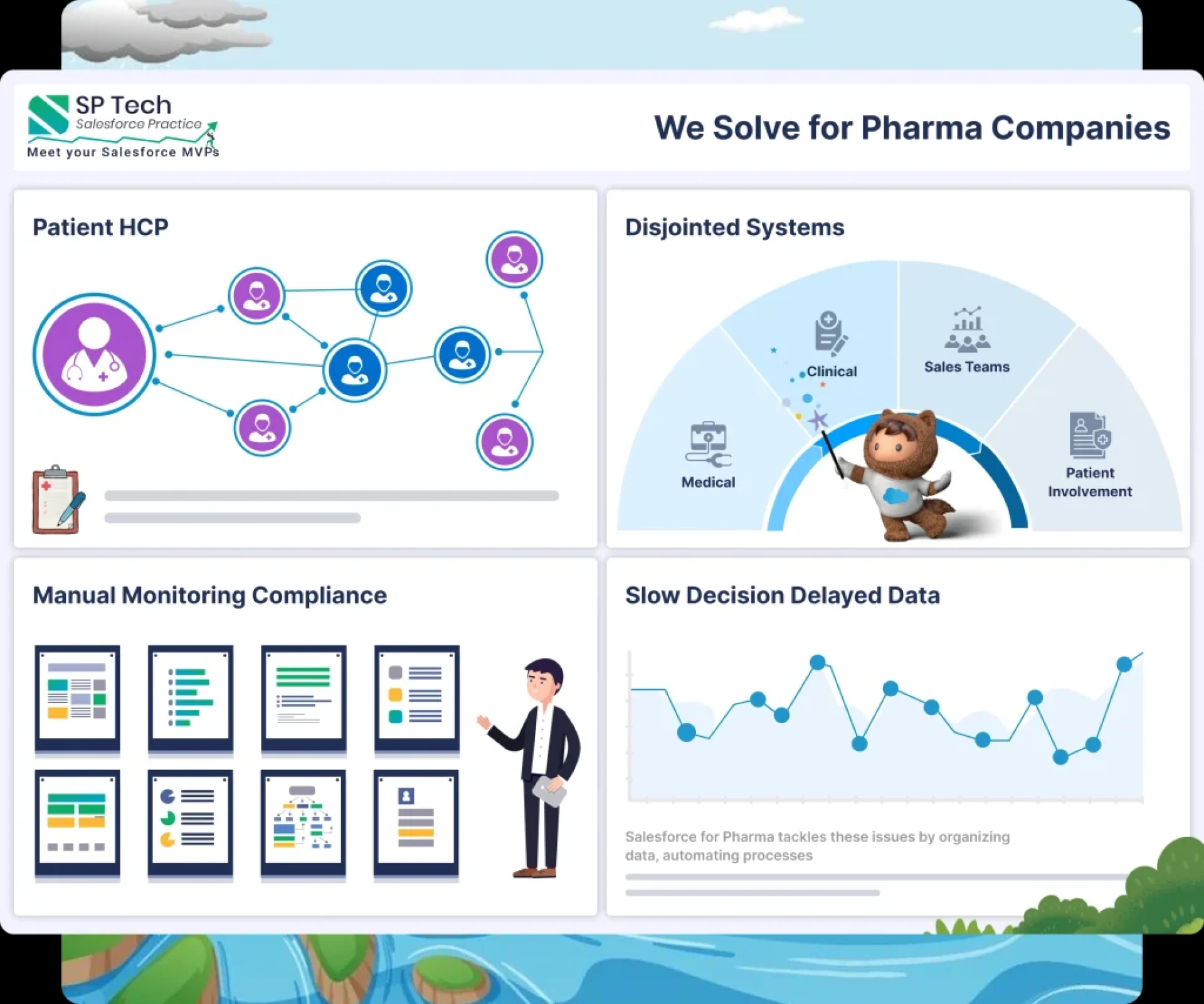
Pharmaceutical companies manage multiple complex processes, from production and inventory to sales and customer management. Enterprise Resource Planning (ERP) systems handle back-office operations, while Salesforce provides tools for customer relationships, sales tracking, and marketing insights. Integrating Salesforce with pharma ERP systems creates a cohesive environment that enables smoother operations, better decision-making, and stronger collaboration across departments.
The Need for Integration
Pharma organizations often work with disconnected systems. ERP platforms track production schedules, finances, and inventory, while CRM systems focus on sales, marketing, and customer communication. When these systems operate independently, data silos can form, leading to delays, errors, and inefficiencies.
Integrating Salesforce in pharma industry systems ensures that critical information flows seamlessly between departments. Sales teams gain visibility into inventory levels and delivery schedules, while operations teams can align production with actual demand. This unified view improves coordination, reduces errors, and allows companies to respond more quickly to market changes.
How Integration Works
Integrating Salesforce for pharma with ERP systems involves connecting CRM modules with ERP functionalities like order management, inventory tracking, and financial reporting. This allows for automatic synchronization of information, so updates in one system reflect across the organization without manual input.
Key components of integration include:
- Order and inventory tracking: Sales teams can view product availability and order status directly within Salesforce.
- Customer data consistency: Customer records in ERP are linked to Salesforce accounts, ensuring uniformity across departments.
- Compliance and reporting: Data from both systems can be used for accurate financial reporting and regulatory documentation.
This setup provides a single source of truth, enabling teams to make informed decisions while reducing the need to toggle between multiple platforms.
Benefits for Sales and Marketing
Sales and marketing departments rely on real-time information to plan strategies and manage relationships. Integrating Salesforce for pharma CRM with ERP systems gives teams visibility into customer orders, stock levels, and shipment timelines.
Sales representatives can access the latest inventory and order information, allowing them to provide accurate updates to clients. Marketing teams can plan campaigns based on product availability, while management gains insights into sales trends for better forecasting. This improves operational efficiency and supports timely responses to customer needs.
Operational Advantages
Integration also benefits production, inventory, and supply chain teams. They can use insights from Salesforce to anticipate demand and adjust manufacturing schedules. This alignment helps prevent overproduction or stock shortages, controlling costs while maintaining supply reliability.
Moreover, regulatory compliance becomes easier when both ERP and Salesforce data are synchronized. Quality records, batch details, and audit information remain accurate across systems, reducing the risk of errors during inspections.
Technical Considerations
Successful integration requires careful planning. Key considerations include:
- Data mapping: Clearly align data fields between ERP and Salesforce to avoid inconsistencies.
- Update frequency: Determine which data should update in real-time and which can be synchronized periodically.
- Security and compliance: Ensure data transfer meets pharmaceutical regulations and privacy standards.
- Workflow alignment: Tailor integration to existing business processes to prevent disruptions.
Consulting with experienced professionals can simplify implementation and ensure the integration meets organizational goals. Salesforce for pharma in Atlanta providers can offer industry-specific expertise for local and regional requirements.
Common Challenges
Integration is not without challenges. Organizations may encounter:
- Legacy system limitations: Older ERP systems may need middleware or custom connectors to integrate with Salesforce.
- Data quality issues: Incomplete or inconsistent data can disrupt synchronization.
- Adoption hurdles: Staff may require training to work effectively with the integrated system.
Addressing these challenges through careful planning, testing, and continuous monitoring is essential for maintaining smooth operations.
Best Practices
To maximize the benefits of Salesforce and ERP integration:
- Define clear goals: Understand what processes and outcomes the integration should achieve.
- Prioritize critical data: Start with high-value data such as orders, inventory, and customer accounts.
- Test thoroughly: Validate data flow, workflows, and reporting before full deployment.
- Train staff: Ensure employees know how to use the integrated system effectively.
- Monitor and adjust: Regularly review the integration for performance, accuracy, and compliance.
Following these steps helps pharmaceutical companies build a reliable and efficient integration that supports both operational and strategic goals.
Conclusion
Integrating Salesforce with pharma ERP systems connects sales, operations, and compliance teams, creating a unified platform for managing data and processes. Salesforce pharma CRM tools allow sales teams to access accurate information while operational teams can align production and inventory with actual demand. SP Tech assists organizations in implementing these integrations successfully, ensuring that pharmaceutical companies can operate efficiently, maintain compliance, and make informed decisions across all departments.