In commercial construction, the choice of steel doors determines performance, maintenance costs, and safety outcomes for years to come. Even the most durable door hardware means little if the door’s core material fails against moisture, corrosion, or fluctuating weather. That’s why contractors and building owners often face one pressing question: what to choose between Cold Rolled vs Galvannealed Steel Doors, what’s the difference between the two?
Understanding this difference isn’t just a matter of industry knowledge; it’s a cost-saving decision that prevents rust, delays replacements, and reduces overall building maintenance.
This article breaks down both materials in detail, offering fact-based insights to guide optimal selection, especially for those prioritizing long-term weather resistance and rust prevention.
Understanding the Foundation: Cold Rolled Steel Doors
Cold-rolled steel starts as hot-rolled steel that’s allowed to cool, then re-rolled at room temperature. The process results in a dense, smooth, and precise surface highly valued for its sleek finish and dimensional accuracy.
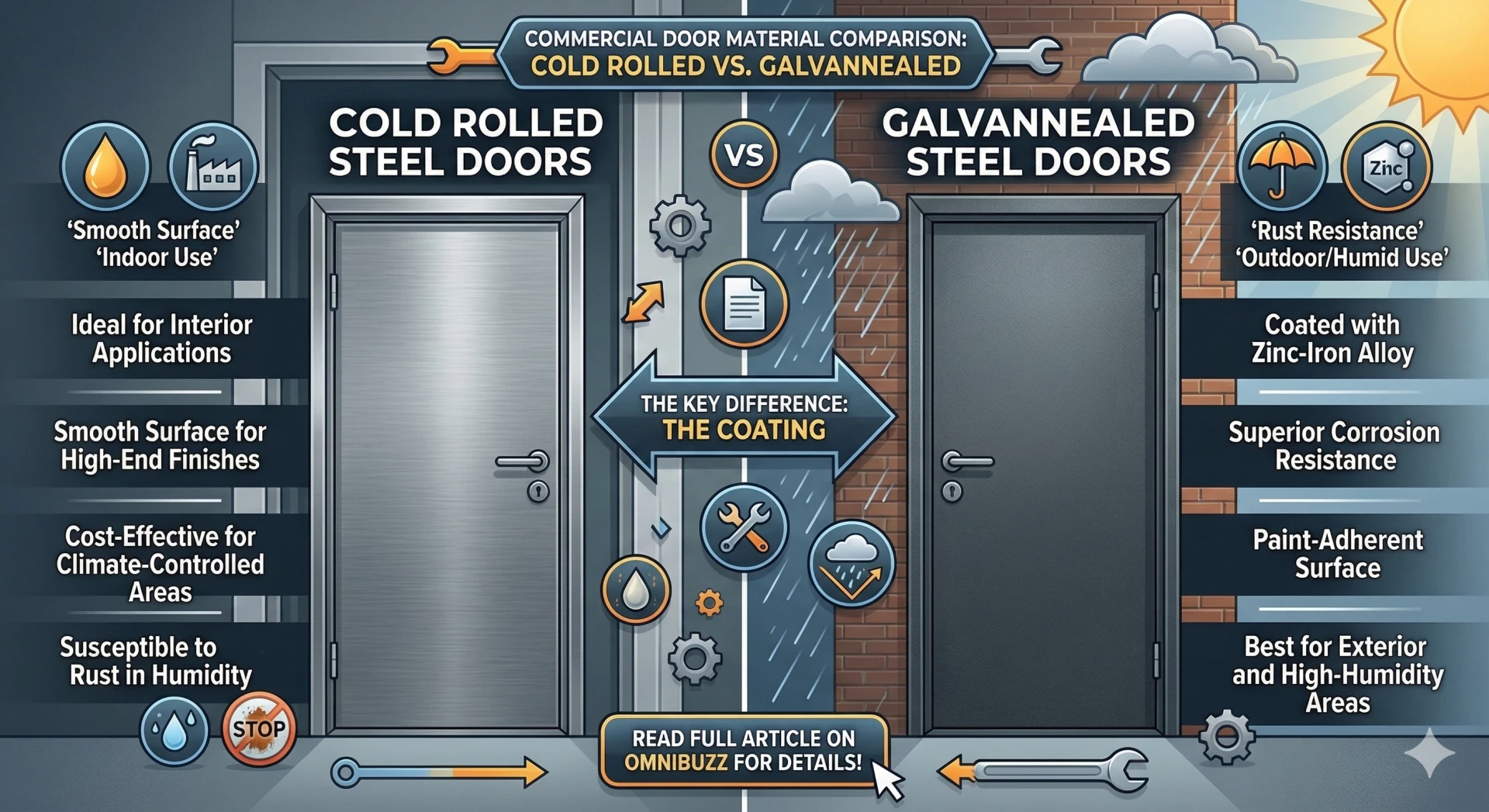
These doors are often used in interior environments with limited moisture exposure, such as schools, office buildings, and commercial interiors. The fine surface texture also provides excellent paint adhesion, giving architects a clean, uniform aesthetic across doorframes and panels.
However, while Cold Rolled steel maintains exceptional strength and finish consistency, it lacks inherent corrosion protection. Without a robust primer or coating system, it can degrade quickly when exposed to humidity, salt, or other outdoor conditions. For this reason, it’s rarely recommended for outdoor applications unless properly sealed and maintained with high-performance finishes.
In short, Cold Rolled steel is ideal for projects demanding precision and aesthetics—but not necessarily high moisture resistance.
Introducing Galvannealed Steel Doors: Built for Weather Resistance
Galvannealed Steel Doors are designed specifically for environments that demand superior durability and moisture protection. This material begins as Galvanized steel, which is hot-dipped in zinc to prevent rust. But unlike typical Galvanized steel doors and frames, Galvannealed steel undergoes a heat-treatment process that fuses zinc into the steel’s surface. The result: a zinc-iron alloy layer offering enhanced hardness, paintability, and corrosion resistance.
That metallurgical bond makes a significant difference. While a standard Galvanized door provides surface-level protection, the Galvannealed finish integrates zinc into the steel matrix, ensuring corrosion resistance even if the surface is scratched or abraded. This is what makes Galvannealed steel doors for commercial buildings especially durable in exterior conditions, high-traffic areas, and coastal or industrial zones where exposure to salt or moisture is continuous.
Contractors evaluating A40 vs A60 steel—the two most common galvannealed coatings—will note that A60 contains a slightly thicker zinc-iron layer, offering increased resistance to oxidation and longer-term paint adhesion. Both options outperform uncoated or cold rolled steel under environmental stress, though A60 remains the preferred specification for exterior installations and retrofit projects in humid regions.
Galvannealed vs Galvanized: The Technical Distinction That Matters
At a glance, Galvannealed vs Galvanized steel seems like a matter of terminology, but the difference determines long-term performance. Galvanized steel receives a visible zinc coating, often leaving a slightly spangled finish. It resists corrosion well but can make painting more challenging due to its oily or shiny surface.
Galvannealed steel, meanwhile, undergoes annealing, which creates a matte gray finish that is ideal for primer adhesion. This formation provides better surface grip for paint and sealant systems, a key factor in preventing rust over decades of use. The matte coating also helps avoid glare and blends easily into architectural façades where uniformity matters.
When door panels, frames, and hardware are properly aligned—especially in custom hollow metal door installations—the durability of Galvannealed steel ensures long-term alignment without flaking, peeling, or corrosion bleed-through.
Related: “Top Benefits: Why Steel Outlasts Wood 4 to 1?”
Choosing the Right Door for Weather Resistance
For any commercial project, door placement and exposure determine the most appropriate steel type:
- Cold Rolled Steel Doors should be installed in interior corridors, offices, or climate-controlled environments. Their appeal lies in precision and a seamless painted finish.
- Galvannealed Steel Doors, however, are purpose-built for exteriors, alleys, freight docks, warehouses, and schools where environmental contact is constant.
Selecting Galvannealed steel ultimately reduces maintenance frequency, repaint needs, and repair costs over time. When combined with factory priming and properly matched hardware, these doors deliver a complete weather-resistant system.
To achieve exact door sizing and fitment—crucial to prevent air or moisture intrusion—contractors are encouraged to take precise measurements of frame openings and thresholds before ordering. This eliminates costly mismatches and ensures a perfect installation that maximizes the door’s performance characteristics.
How Automatic Door and Hardware Simplifies Material Selection?
Automatic Door and Hardware™ (ADH), a trusted commercial hardware supplier since 1997, provides both Cold Rolled and Galvannealed Steel Doors made to exact specifications for industrial, retail, healthcare, and educational buildings. The company’s custom hollow metal door solutions are manufactured using industry-standard fire ratings, precise frame engineering, and corrosion-resistant coatings for superior performance.
ADH’s catalog includes:
- Fire-rated hollow metal doors and frames tested for exterior endurance
- Hardware solutions compatible with ADA-compliant openings
- A dedicated advisory team helping contractors match material grades with local weather demands
Each door solution is engineered to perform under the conditions the building will actually face—reducing callbacks and long-term maintenance costs. Their Maverick Automatic Doors and Ranger Storefront systems can also integrate with Galvannealed steel configurations, offering enhanced durability for high-traffic entrances.
Built to Resist, Designed to Last
When balancing cost, longevity, and weather protection, Galvannealed Steel Doors clearly offer a measurable advantage. Their zinc-iron coating not only prevents rust but also enhances paint adhesion, ensuring years of durability in challenging conditions. Cold-rolled steel is a good choice for interiors that demand a clean aesthetic, but when durability against weather and corrosion is the priority, Galvannealed remains the superior choice.
To guarantee material precision, proper fit, and long-term performance, professionals can rely on Automatic Door and Hardware—a leader in U.S. commercial door manufacturing and distribution.
Explore high-grade steel door systems designed for your environment at Automatic Door and Hardware, or email [email protected] for project-specific guidance.
Reliable, weather-resistant, and built to last; it all starts here!