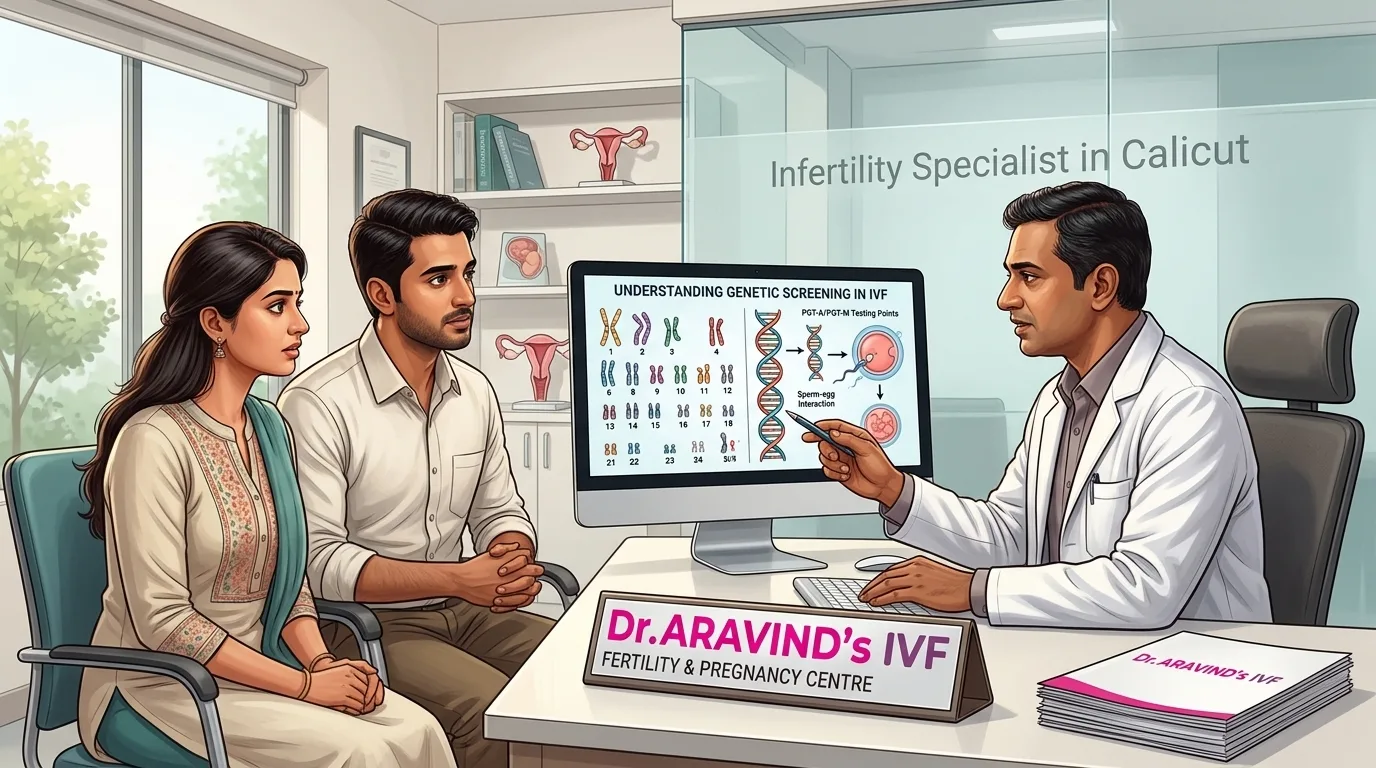
When a couple experiences difficulty conceiving, fertility evaluation usually begins with common factors such as ovulation, ovarian reserve, sperm health, and the condition of the uterus. In some situations, however, doctors may consider whether genetic factors could be contributing to infertility, repeated pregnancy loss, or unsuccessful fertility treatment.
Genetic testing is not necessary for every couple trying to conceive. It is generally recommended only when there is a specific medical reason or history that suggests a possible genetic or chromosomal concern.
If you are searching for an Infertility Specialist in Calicut, understanding when genetic testing may be useful can help you have a clearer conversation with your fertility specialist.
What Is Genetic Testing in Fertility Care?
Genetic testing involves examining genetic material to identify certain changes that may influence reproductive health.
The tests used in fertility care can look for different types of genetic or chromosomal conditions.
Depending on the situation, testing may involve:
- The woman
- The man
- Both partners
- An embryo created through IVF
The appropriate test depends on the couple's medical history and the reason for testing.
Why Can Genetic Factors Matter in Infertility?
Human reproduction involves complex genetic processes.
For a pregnancy to develop normally, the egg and sperm need to contribute the appropriate genetic material.
Sometimes, genetic changes may affect:
- Sperm production
- Egg development
- Embryo development
- Fertilization
- Pregnancy continuation
Some genetic conditions may be inherited, while others can occur spontaneously.
Not every genetic finding causes infertility, and a genetic result should always be interpreted in the context of the couple's overall fertility history.
When Might Genetic Testing Be Recommended?
Genetic testing may be considered in specific situations, including:
- Recurrent pregnancy loss
- Severe male infertility
- Very low sperm count
- Azoospermia
- Repeated IVF failure in selected cases
- Known genetic disease in the family
- Previous pregnancy affected by a genetic condition
- Abnormal findings in previous genetic testing
The recommendation depends on individual circumstances.
A fertility specialist may also refer the couple to a genetic counsellor when detailed interpretation is needed.
Recurrent Miscarriage and Genetic Testing
Repeated pregnancy loss can be emotionally difficult.
One possible cause is a chromosomal abnormality in one or both partners.
A test called a parental karyotype may sometimes be recommended to look for certain chromosomal rearrangements.
For example, a balanced chromosomal rearrangement may not cause health problems in the parent but could increase the risk of producing embryos with an unbalanced chromosome pattern.
However, genetic causes are only one possible explanation for recurrent miscarriage.
Other factors may include:
- Uterine abnormalities
- Hormonal conditions
- Blood clotting disorders
- Thyroid problems
- Age-related egg quality changes
A comprehensive evaluation is often required.
Male Infertility and Genetic Testing
Genetic testing may be particularly relevant in men with severe abnormalities in sperm production.
Men with very low sperm counts or azoospermia may sometimes have genetic conditions affecting sperm production.
Depending on the situation, doctors may consider:
- Karyotype testing
- Y-chromosome microdeletion testing
- Cystic fibrosis-related genetic testing in selected cases
These tests are not required for every man with fertility problems.
The decision depends on semen analysis results, medical history, physical examination, and other findings.
What Are Chromosomal Abnormalities?
Chromosomes are structures that carry genetic information.
Humans typically have 46 chromosomes arranged in 23 pairs.
Changes in chromosome number or structure may sometimes affect fertility or pregnancy.
Some chromosomal abnormalities can lead to:
- Difficulty conceiving
- Recurrent miscarriage
- Abnormal embryo development
- Certain genetic conditions in children
The significance of a chromosomal finding depends on the specific abnormality.
What Is a Karyotype Test?
A karyotype test examines the number and structure of chromosomes in a person's cells.
It may be recommended for selected couples with:
- Recurrent pregnancy loss
- Severe male infertility
- Certain genetic concerns
- Previous pregnancy affected by a chromosomal condition
The test may identify structural changes that are not visible through routine fertility testing.
A normal karyotype does not rule out every possible genetic condition, but it can provide useful information in appropriate cases.
Can Genetic Testing Be Done on Embryos?
Yes.
For couples undergoing IVF, embryo genetic testing may be considered in specific situations.
Preimplantation genetic testing, commonly called PGT, involves examining cells from an embryo before transfer.
Different types of PGT are used for different purposes.
These may include testing for:
- Specific inherited genetic conditions
- Certain chromosomal abnormalities
- Chromosome number changes
PGT is not suitable or necessary for every IVF patient.
The decision should be made after discussing the potential benefits, limitations, and implications with a fertility specialist and, when appropriate, a genetic counsellor.
Does Genetic Testing Guarantee a Healthy Pregnancy?
No.
Genetic testing can provide valuable information, but it cannot guarantee a successful pregnancy or a healthy baby.
Tests have limitations, and not every genetic or developmental condition can be detected.
Even when an embryo is found to have a reassuring genetic test result, pregnancy may still be affected by other factors.
Therefore, genetic testing should be viewed as one part of fertility and pregnancy planning.
What Happens If a Genetic Problem Is Found?
The next step depends on the type of finding.
Couples may be offered:
- Genetic counselling
- Further testing
- IVF with appropriate embryo testing
- Donor egg or sperm options in selected circumstances
- Other reproductive planning options
The decision is personal and should be made after understanding the medical information and available choices.
Genetic counselling can help couples understand inheritance patterns and possible reproductive implications.
Is Genetic Testing Needed Before Every IVF Cycle?
No.
Most couples undergoing IVF do not automatically require genetic testing.
It may be considered when there is:
- A known inherited genetic condition
- Recurrent pregnancy loss
- Severe male infertility
- A history suggesting chromosomal abnormalities
- Specific reproductive risks
A fertility specialist can determine whether testing is clinically appropriate.
Genetic Counselling and Fertility Planning
Genetic counselling can be especially useful when test results are complex.
A genetic counsellor may explain:
- What the test can detect
- What it cannot detect
- The chance of passing a condition to a child
- Possible treatment options
- The implications for future pregnancies
This helps couples make informed decisions without unnecessary fear or confusion.
When Should You Discuss Genetic Testing?
Consider discussing genetic evaluation with a fertility specialist if you:
- Have experienced repeated miscarriages
- Have severe male infertility
- Have very low sperm counts
- Have a family history of inherited conditions
- Have had a previous pregnancy affected by a genetic disorder
- Have experienced repeated IVF failure
- Have concerns about a known genetic condition
Early counselling may help clarify which tests, if any, are appropriate.
Conclusion
Genetic testing can be an important part of fertility care for selected couples, particularly when there is recurrent pregnancy loss, severe male infertility, a known inherited condition, or a history suggesting chromosomal abnormalities. However, it is not necessary for everyone experiencing infertility.
If you are looking for a Best IVF clinic in Kerala, a detailed fertility assessment can help determine whether genetic testing may be relevant to your situation. The right test should be chosen based on your personal and family history rather than performed routinely without a clear reason. Book an Appointment with a fertility specialist to discuss your fertility history, understand the possible role of genetic evaluation, and explore the reproductive options available to you.
Frequently Asked Questions
1. Does every infertile couple need genetic testing?
No. Genetic testing is usually recommended only when there is a specific reason, such as recurrent pregnancy loss, severe male infertility, a known inherited condition, or certain previous reproductive outcomes.
2. Can genetic testing identify the cause of recurrent miscarriage?
It may identify some chromosomal factors, particularly in selected couples. However, recurrent miscarriage can have many causes, so a complete evaluation may be necessary.
3. Is genetic testing useful for severe male infertility?
It can be. Men with very low sperm counts or azoospermia may sometimes be offered genetic tests to identify conditions affecting sperm production.
4. Can IVF embryos be tested for genetic conditions?
Yes. In selected cases, preimplantation genetic testing may be used during IVF to assess embryos for specific inherited conditions or certain chromosomal abnormalities.
5. Does a normal genetic test guarantee a healthy baby?
No. Genetic testing has limitations and cannot detect every possible health or developmental condition. A normal result can provide useful information but does not guarantee a completely healthy pregnancy or child.