
Industrial workplaces rely on machines, electrical systems, production lines, valves, and other equipment to keep operations running. But when that equipment needs to be inspected, cleaned, adjusted, repaired, or serviced, the same energy that powers production can become a serious safety hazard.
This is where Lockout Tagout (LOTO) plays an important role.
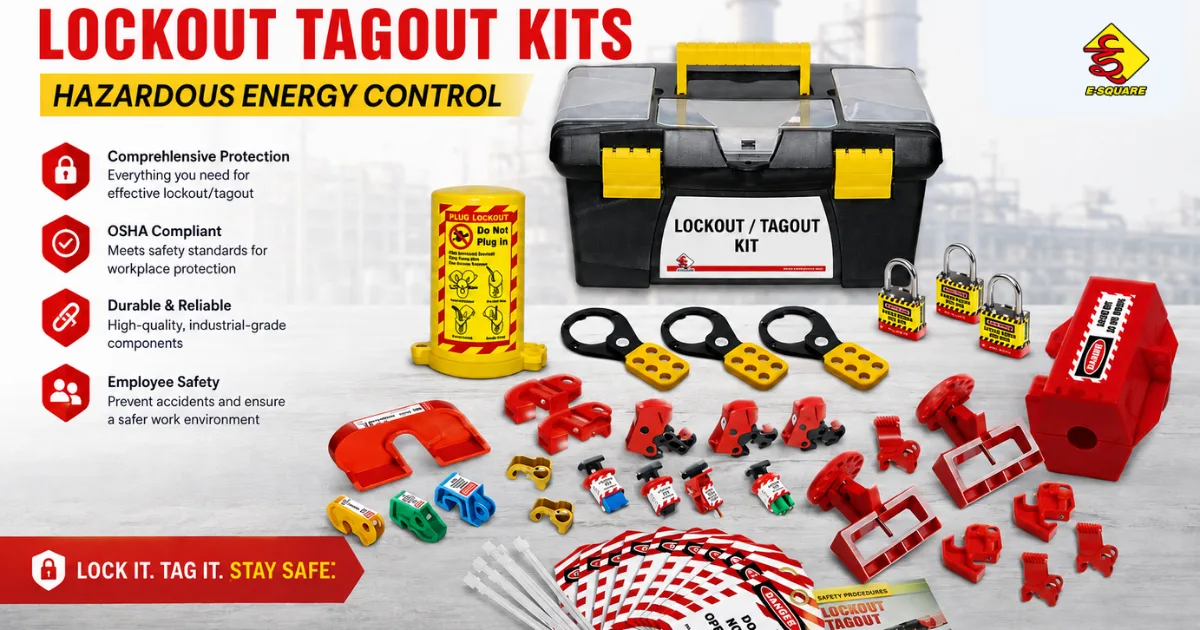
Industrial Lockout Tagout Kits bring together the devices workers need to isolate hazardous energy and prevent unexpected equipment startup during maintenance. A well-organized kit can make it easier for authorized employees to identify energy sources, apply appropriate lockout devices, and follow established energy-control procedures.
For manufacturers, maintenance teams, contractors, and industrial facilities, choosing the right LOTO equipment is not simply about having locks and tags available. The kit should match the machinery, energy sources, workplace procedures, and specific isolation points found at the facility.
What Is Lockout Tagout?
Lockout Tagout is a safety procedure used to control hazardous energy before employees perform maintenance or servicing on machinery and equipment.
Machines can contain several forms of hazardous energy. Electrical power is perhaps the most familiar, but it is not the only source that needs to be considered. Mechanical movement, hydraulic pressure, pneumatic pressure, steam, thermal energy, chemical energy, and stored or residual energy can also create hazards.
The basic purpose of LOTO is to make sure that equipment is properly shut down, isolated from its energy source, and prevented from being restarted while work is being performed.
A typical process involves identifying the energy sources, shutting down the equipment, isolating the energy, applying appropriate lockout and tagout devices, releasing or controlling stored energy, and verifying that isolation has been achieved before work begins.
Why Industrial Lockout Tagout Kits Matter
Maintenance activities often involve several energy sources and different types of equipment. A single safety padlock may not be enough to properly isolate a complex machine.
For example, a production machine may have an electrical disconnect, pneumatic supply, hydraulic pressure, and multiple valves. Each isolation point may require a different type of lockout device.
An Industrial Lockout Tagout Kit provides a selection of commonly required devices in one organized package. Instead of searching for individual components every time maintenance work begins, authorized employees can access the appropriate equipment from a designated LOTO kit or station.
This can help improve organization, availability, and consistency within a workplace energy-control program.
What Can an Industrial LOTO Kit Include?
The exact contents of a kit depend on the application. A comprehensive industrial kit may contain several types of lockout devices and accessories.
1. Lockout Safety Padlocks
Safety padlocks are used to secure lockout devices and communicate that equipment must not be operated.
They are generally designed specifically for safety applications and can be available in different colors and configurations. Color coding can help organizations distinguish employees, departments, or specific functions when it is incorporated into their established procedures.
2. Lockout Tags
Lockout tags provide a visible warning that equipment has been locked out and should not be operated.
Tags can communicate important information such as the person responsible for the lockout, the date, or other workplace-specific information. Tags should be used as part of a complete lockout procedure rather than as a substitute for physical energy isolation.
3. Lockout Hasps
A lockout hasp allows multiple authorized employees to apply their personal locks to a single energy-isolation point.
For group maintenance activities, hasps can help ensure that equipment remains locked out until each authorized employee has completed their work and removed their personal lock according to the site's procedure.
4. Circuit Breaker Lockouts
Electrical systems often require specialized lockout devices. Circuit breaker lockouts can be used to prevent the operation of compatible breakers during maintenance.
Different breaker designs may require different lockout solutions, so selecting the correct device for the specific breaker is important.
5. Valve Lockout Devices
Industrial facilities frequently use valves to control water, gas, steam, chemicals, hydraulic fluids, and other systems.
Valve lockout devices can help prevent valves from being operated after the energy source has been isolated. Different valve configurations may require different lockout designs, including solutions for ball valves, gate valves, butterfly valves, and other applications.
6. Plug Lockouts
Electrical plugs can create a potential energy source during maintenance. Plug lockout devices can help prevent a plug from being connected to a power source while servicing is underway.
They can be particularly useful for portable equipment and electrical tools.
7. Cable Lockout Devices
Cable lockouts are versatile solutions for applications where conventional lockout devices may not fit.
A cable can be routed through multiple isolation points or around difficult-to-access components, depending on the specific device and procedure. This makes cable lockout equipment useful for complex machinery and multi-point isolation applications.
Understanding Hazardous Energy
One of the most important parts of an effective LOTO program is recognizing that hazardous energy is not limited to electricity.
Electrical Energy
Electrical energy can remain dangerous even after machinery has been switched off. Appropriate disconnects and isolation devices should be identified and controlled according to the site's energy-control procedure.
Mechanical Energy
Moving components, rotating parts, elevated equipment, springs, flywheels, and other mechanisms can store or generate mechanical energy.
Hydraulic Energy
Hydraulic systems can remain pressurized even after a machine is shut down. Pressure may need to be isolated and safely released according to the equipment's procedures.
Pneumatic Energy
Compressed air can create unexpected movement when pressure remains in lines, cylinders, or other components.
Thermal Energy
Hot surfaces, steam, heated fluids, and other thermal sources may present hazards during servicing.
Stored Energy
Energy can remain stored in capacitors, springs, pressure vessels, elevated components, or other systems. Workers should identify and control residual energy before beginning work.
The correct LOTO kit should therefore be selected based on the complete energy profile of the equipment rather than only its primary power source.
Choosing the Right Industrial Lockout Tagout Kit
There is no universal LOTO kit that is ideal for every workplace. The right selection begins with understanding the equipment and energy sources involved.
Consider the Type of Equipment
Start by identifying the machinery that will be serviced. A simple electrical panel may require different devices from a large production machine with electrical, pneumatic, and hydraulic systems.
Identify Every Energy Source
Review the machine's energy-control procedure and identify all applicable energy sources and isolation points.
Check Compatibility
Lockout devices need to fit the equipment they are intended to isolate. Before purchasing a kit, check breaker designs, valve sizes, plug types, disconnects, and other isolation points.
Consider Individual and Group Lockout
If several employees may work on the same equipment, group lockout equipment such as hasps or group lock boxes may be necessary.
Think About Storage
A LOTO kit is most useful when employees can quickly locate it. Portable carrying cases, pouches, cabinets, and dedicated lockout stations can help keep devices organized and accessible.
Benefits of a Well-Organized LOTO Program
Industrial Lockout Tagout Kits are only one part of an overall energy-control program. Their value increases when they are supported by clear procedures, training, equipment-specific instructions, and regular review.
A well-organized program can help:
- Improve access to required lockout devices
- Reduce confusion during maintenance activities
- Support consistent energy-isolation procedures
- Improve visibility of equipment under lockout
- Support individual and group lockout applications
- Help organizations address different types of hazardous energy
- Keep LOTO equipment organized and ready for use
Most importantly, LOTO should be treated as a planned safety process rather than simply a collection of locks and tags.
Common Mistakes When Using LOTO Equipment
Even high-quality lockout equipment cannot compensate for an incomplete procedure.
One common mistake is focusing only on electrical energy while overlooking pneumatic, hydraulic, mechanical, thermal, or stored energy.
Another problem is selecting a lockout device without checking whether it is compatible with the actual isolation point. A device that does not properly fit the equipment may not provide the intended level of control.
Poor organization can also become an issue. If workers cannot quickly find the required lockout device, they may be tempted to improvise.
Another important consideration is verification. After energy isolation and before work begins, the authorized employee should follow the established procedure to verify that the equipment has been effectively isolated and that hazardous energy has been controlled.
LOTO Kits for Manufacturing Facilities
Manufacturing environments often contain multiple machines, production lines, electrical panels, valves, motors, conveyors, and automated systems.
For these workplaces, a combination of individual machine-specific kits and centralized LOTO storage can be useful. Equipment-specific kits can contain the devices required for particular machines, while a central LOTO station can provide additional devices for less common applications.
The exact arrangement should be based on the facility's equipment inventory and energy-control procedures.
LOTO Kits for Maintenance Teams
Maintenance professionals may work on many different types of equipment throughout a facility. Their requirements can therefore be broader than those of an individual machine operator.
A maintenance-oriented LOTO kit may include a variety of padlocks, tags, hasps, electrical lockouts, valve lockouts, cable devices, and other accessories.
A portable kit can also make it easier for maintenance personnel to carry essential equipment directly to the job location.
Why Quality and Compatibility Matter
LOTO devices are safety equipment. They should be selected based on the application's requirements rather than simply choosing the lowest-cost option.
Durability, visibility, ease of use, environmental suitability, and compatibility with the isolation point are important considerations.
For outdoor applications or harsh industrial environments, organizations may also need to consider exposure to moisture, chemicals, temperature variations, dust, or other workplace conditions.
The goal is to ensure that the selected equipment supports the site's established energy-control procedures and remains suitable for the conditions in which it will be used.
Building a Better Hazardous Energy Control Strategy
An effective LOTO strategy starts with identifying the hazards.
Facilities can review machinery and document energy sources, isolation points, and required lockout devices. Based on this information, organizations can develop equipment-specific procedures and select appropriate LOTO kits.
Training is another essential element. Employees who are authorized to perform lockout procedures should understand the equipment, energy sources, isolation methods, lockout devices, verification steps, and site-specific requirements.
Periodic reviews can help identify missing equipment, damaged devices, changes to machinery, or gaps in existing procedures.
Industrial Lockout Tagout Solutions from E-Square Alliance
E-Square Alliance provides a wide range of Industrial Lockout Tagout Kits and hazardous energy control products for industrial applications.
The product range includes lockout safety padlocks, lockout hasps, circuit breaker lockouts, valve lockout devices, cable lockouts, plug lockouts, tags, group lockout solutions, and other LOTO equipment.
Organizations can select products based on their equipment, energy sources, maintenance requirements, and workplace procedures.
For companies looking to improve the organization of their energy-isolation equipment, a properly configured LOTO kit can be a practical starting point.
Final Thoughts
Hazardous energy control is an important consideration whenever employees work on machinery or equipment. Industrial Lockout Tagout Kits provide a convenient collection of devices that can support the isolation process and help workers access the right equipment when it is needed.
However, the effectiveness of a LOTO kit depends on more than the products inside the case. Equipment compatibility, machine-specific procedures, employee training, verification, and regular program review all contribute to a stronger energy-control system.
By identifying hazardous energy sources and selecting suitable lockout devices for each application, industrial facilities can create a more organized approach to maintenance safety.
E-Square Alliance offers industrial Lockout Tagout products and solutions designed for a wide range of energy-isolation applications.