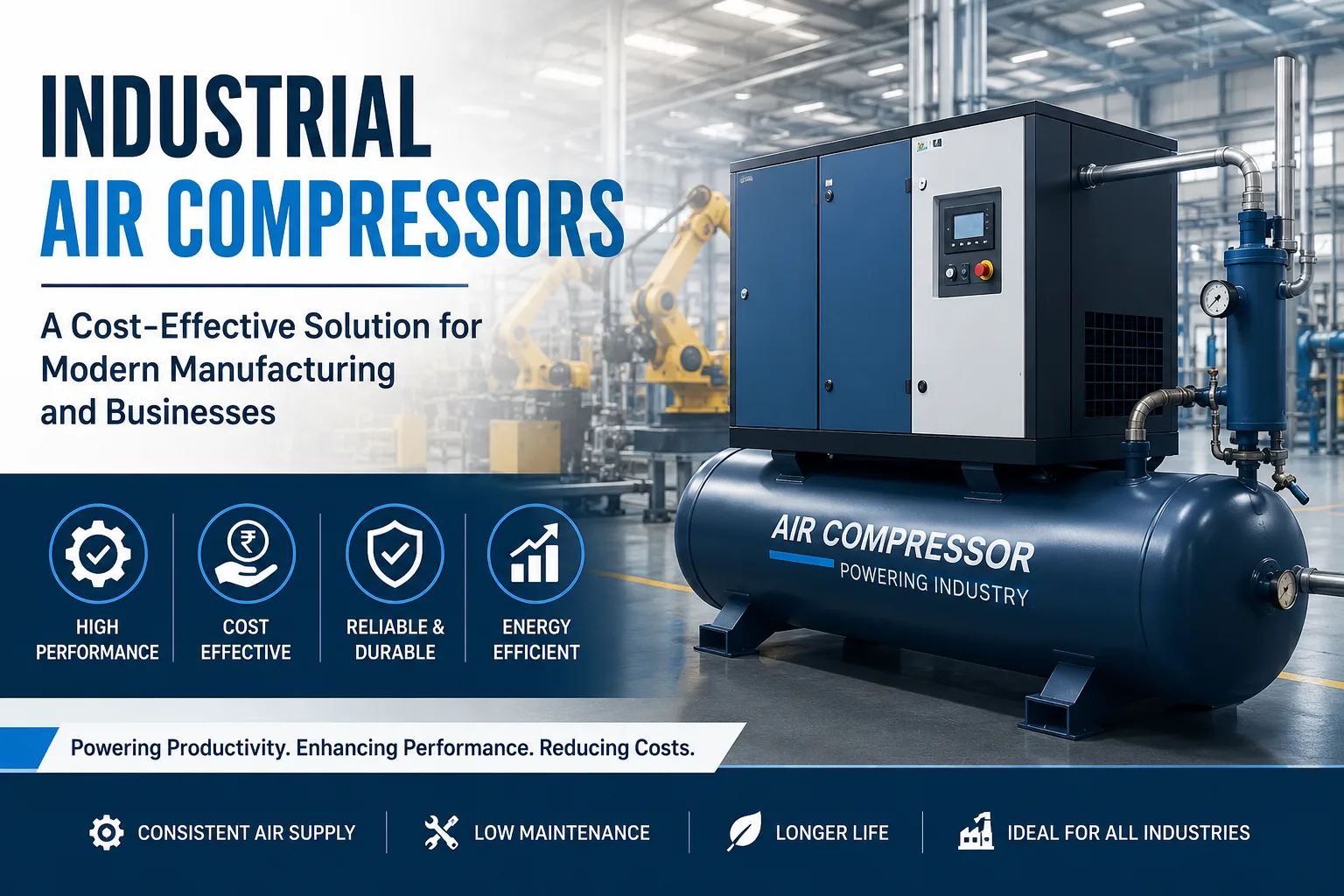
Manufacturing and industrial businesses are constantly looking for ways to improve productivity, reduce operating costs, and maintain consistent product quality. As competition increases, businesses need equipment that can deliver reliable performance without creating unnecessary expenses. One such important piece of equipment is an industrial air compressor.
An air compressor converts electrical or mechanical energy into compressed air, which can then be used to operate machinery, pneumatic tools, automation systems, cleaning equipment, and various industrial applications. From small workshops to large manufacturing plants, compressed air has become an essential utility for many businesses.
What Is an Industrial Air Compressor?
An industrial air compressor is a machine designed to generate and store compressed air for different applications. Unlike small household compressors, industrial models are built for continuous or heavy-duty operation.
Depending on the application, businesses can choose from different types, including rotary screw compressors, reciprocating compressors, and other specialized systems. The right choice depends on factors such as required air pressure, air consumption, operating hours, available space, and budget.
For manufacturing companies, selecting an appropriately sized compressor is important. An oversized machine can increase electricity consumption, while an undersized compressor may struggle to meet production requirements.
Why Compressed Air Is Important in Manufacturing
Compressed air is often called a useful industrial utility because it can power several types of equipment. Pneumatic tools, automated machinery, material-handling systems, spray-painting equipment, and cleaning systems can all use compressed air.
One major advantage is flexibility. Instead of installing individual electric motors for every small operation, manufacturers can use a centralized compressed-air system to supply multiple machines.
This can make factory operations more organized and can support automation in production environments.
Major Benefits of Industrial Air Compressors
1. Improved Productivity
Reliable compressed air allows pneumatic machines and tools to operate consistently. In a manufacturing environment, consistent machine performance can help reduce interruptions and maintain production schedules.
For businesses where production speed is important, a properly designed compressed-air system can become an important part of daily operations.
2. Suitable for Automation
Modern manufacturing increasingly depends on automation. Pneumatic cylinders, valves, actuators, and other automated components often require compressed air.
An efficient compressor can therefore support automated production lines and help businesses improve operational efficiency.
3. Lower Maintenance Requirements for Certain Applications
Pneumatic equipment can have fewer electrical components at the point of operation compared with some electrically powered alternatives. This can make certain industrial processes easier to maintain.
However, compressor maintenance remains important. Filters, oil systems, air dryers, belts, and other components should be inspected according to the manufacturer’s recommendations.
4. Better Workplace Flexibility
Compressed air can be distributed through pipelines to different areas of a factory or workshop. This gives businesses flexibility when arranging machinery and workstations.
A centralized system can also reduce the need to move individual compressors around the facility.
5. Long-Term Cost Advantages
Although purchasing industrial equipment requires an initial investment, the overall cost should be evaluated over its working life rather than only by purchase price.
An efficient compressor with suitable capacity can help businesses control energy consumption and avoid unnecessary production downtime. Choosing equipment based on actual air demand is one of the most important ways to manage operating costs.
How to Choose a Low-Cost Air Compressor
For small businesses and startups, budget is naturally an important consideration. However, the cheapest compressor is not always the most economical option.
Businesses should consider the total cost of ownership, including electricity consumption, maintenance, replacement parts, installation, and expected service life.
A low-cost solution can be achieved by selecting the correct compressor capacity rather than simply purchasing the smallest available model.
Before buying, businesses should consider:
- Required air pressure
- Required air flow
- Daily operating hours
- Number of pneumatic machines
- Available installation space
- Electricity availability
- Maintenance requirements
- Initial purchase price
- Long-term energy consumption
For example, a workshop that uses compressed air for only a few hours each day may have very different requirements from a factory operating pneumatic machinery continuously.
Energy Efficiency Can Reduce Business Costs
Energy consumption is one of the biggest operating expenses associated with compressed-air systems. Air leaks, excessive pressure, poor maintenance, and inappropriate compressor sizing can increase energy costs.
Regularly checking pipelines and connections for leaks can prevent unnecessary compressor operation. Maintaining filters and other components can also help the system operate efficiently.
Businesses can further improve efficiency by matching compressor output with actual demand. In facilities where air consumption changes throughout the day, variable-speed technology may also be worth considering, depending on the application and operating pattern.
Applications Across Different Industries
Industrial air compressors are used across a wide range of sectors.
Manufacturing
Factories use compressed air for pneumatic tools, automation, assembly operations, cleaning, and machinery control.
Automotive Workshops
Vehicle service centers can use compressed air for impact wrenches, air guns, tyre equipment, spray painting, and other workshop applications.
Construction
Construction companies may use compressors to operate pneumatic tools and equipment at job sites.
Packaging Industry
Packaging machinery can use compressed air for actuators, control systems, filling equipment, and automated movement.
Food and Beverage Industry
Compressed air can be used in certain production and packaging processes. Where air may come into contact with products, businesses need to select an appropriate air-treatment system and follow applicable industry requirements.
Maintenance Is Essential for Better Performance
Even a high-quality compressor needs regular maintenance. Neglecting maintenance can lead to higher energy consumption, reduced performance, and unexpected downtime.
A basic maintenance program may include checking filters, inspecting connections, monitoring oil levels where applicable, removing moisture, and following recommended service intervals.
Businesses should also monitor unusual vibration, noise, temperature, or pressure changes. Identifying problems early can help prevent more expensive equipment failures.
Why Businesses Should Focus on Value Instead of Just Price
When purchasing industrial machinery, focusing only on the initial price can sometimes lead to higher costs later. A machine with a lower purchase price may consume more electricity or require more frequent maintenance.
Instead, businesses should compare performance, efficiency, reliability, warranty support, spare-parts availability, and maintenance requirements.
The best low-cost solution is usually the one that provides the required performance at a reasonable overall operating cost.
Conclusion
Industrial air compressors can provide a practical and versatile solution for manufacturing companies, workshops, construction businesses, and other industrial operations. They can support pneumatic equipment, automation, production processes, and a variety of everyday applications.
For businesses working with limited budgets, selecting the right capacity and focusing on energy efficiency can make a significant difference. Instead of choosing equipment based only on the lowest purchase price, businesses should evaluate long-term operating expenses, maintenance requirements, reliability, and productivity.
With proper selection, installation, and maintenance, an industrial air compressor can become a valuable investment that supports business growth while helping control operational costs.