
Selecting the right venue architecture for a tactical entertainment business defines your balance sheet long before your first customer registers a hit. Investors and family entertainment center (FEC) operators face a strategic crossroads between climate-controlled arenas and sprawling open-air fields, each carrying vastly distinct capital expenditure profiles and cash-flow characteristics.
Choosing between a climate-controlled arena and an open-air battlefield dictates your upfront capital, seasonal revenue stability, and maintenance overhead. Securing versatile commercial laser tag equipment https://lasertag.net/equipment designed for varied lighting conditions is the baseline requirement before committing to either real estate model.
What Are the Key Operational Differences Between Both Formats?
Location and real estate strategy dictate daily operations across every commercial laser tag business comparison. An indoor laser tag arena setup relies on dense urban or suburban commercial retail zones, typically anchored inside shopping malls, standalone entertainment centers, or sports complexes. This positioning guarantees sustained foot traffic consistency and insulates your business from rainfall, high winds, and sub-zero temperatures. However, this foot traffic carries an aggressive square-foot retail lease premium and long-term commitments that pressure your monthly baseline margin.
Conversely, launching an outdoor laser tag business shifts the geographic focus toward peri-urban fringe land, agritourism ranches, campgrounds, and public parks. Open-air venues leverage vast footprints, often scaling across several acres rather than square feet, driving down land acquisition or leasing rates to a fraction of indoor costs. In exchange for low overhead, outdoor operators absorb extreme laser tag weather dependency, where wet turf, storms, and intense heat waves dictate operational uptime.
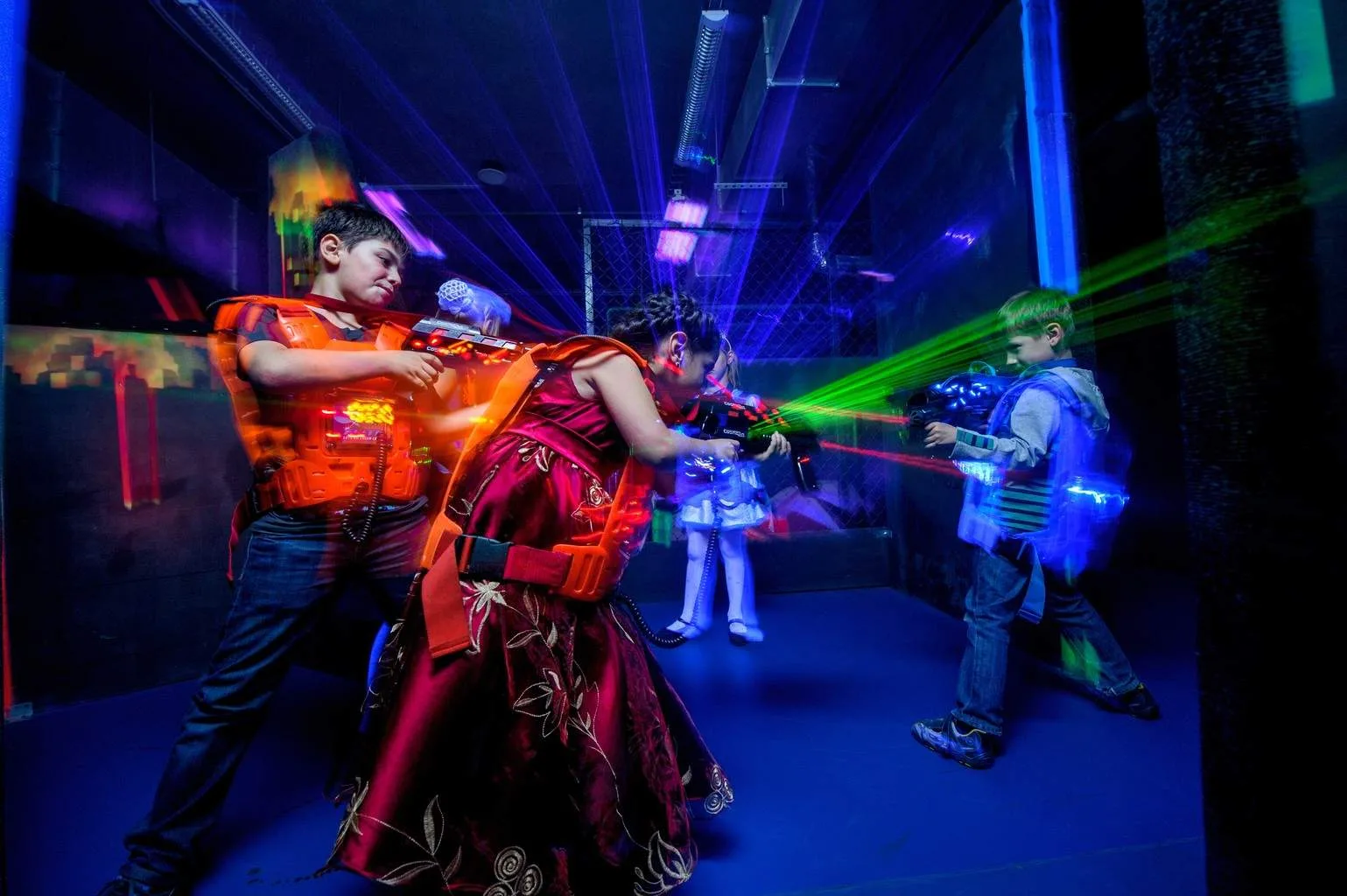
The operational cadence between both business models reveals fundamentally different monetization engines. Indoor arenas run high-frequency, arcade-style matches lasting 10 to 15 minutes, cycling cohorts of 16 to 30 players rapidly to maximize hourly turnover. Guests navigate high-density blacklight UV mazes where quick trigger responses, rapid respawns, and tight corridors drive immediate gratification. This rapid-turnover structure aligns directly with fixed-schedule birthday parties and fast family throughput.
Outdoor tactical fields operate on an extended, military-style session model with run times stretching between 30 and 60 minutes per mission. Games emphasize long-distance skirmishes, squad-level communication, structured objective captures, and deliberate terrain maneuvering. Because resetting outdoor groups across large acreage takes additional logistical labor, customer throughput per hour drops, requiring operators to charge higher upfront session tickets or mandate multi-hour private group bookings.

Staffing ratios diverge dramatically between an enclosed structure and a dynamic terrain field. An indoor arena functioning on automated game-management software can operate with two or three floor marshals handling check-in, safety briefings, vest tracking, and kiosk management. An outdoor field spanning three acres requires five or more field marshals equipped with radios to monitor physical safety, track boundary lines, manage heat exhaustion risks, and inspect obstacle integrity across the perimeter.
How Do Startup and Overhead Costs Compare?
Evaluating indoor vs outdoor laser tag requires calculating immediate capitalization alongside ongoing fixed obligations. An operator must weigh heavy upfront construction against lighter real estate with heavier field preparation.
- Indoor arena initial CAPEX. Building out an indoor maze requires significant construction, dry-walling, and professional carpentry to create durable labyrinths. Operators must fund specialized blacklight UV mazes, fluorescent scenic artwork, dynamic sound distribution, and automated DMX lighting grids. Heavy capital also goes toward commercial climate control and HVAC costs, industrial fog-generation systems, and comprehensive fire-suppression retrofits. Overall buildout costs for an indoor arena typically range from $120,000 to $350,000 before factoring in the cost of gaming gear.
- Outdoor field initial CAPEX. Setting up outdoor battlegrounds bypasses heavy interior structural construction and commercial building permitting. Initial expenses center on grading terrain, installing professional gravel drainage, deploying perimeter safety netting, and clearing scrub. Tactical covers such as treated timber bunkers, decommissioned vehicle hulls, cargo containers, or inflatable barricades can be phased in modularly over time. Operators must also invest in basic LED staging floodlights for twilight operations and secure outdoor staging sheds, requiring an entry capital spend between $30,000 and $90,000.
- Monthly operational OPEX. Indoor operators bear heavy structural fixed costs driven by prime commercial lease rates, triple-net charges, and continuous electrical consumption from HVAC units, server racks, and sound arrays. Monthly facility rent can easily absorb $8,000 to $22,000 depending on location, creating a high financial break-even line regardless of session volume. Outdoor fields enjoy minimal ground rent or modest land-share lease agreements, often under $2,500 monthly, shifting operating vulnerability from financial overhead to seasonal downtime.
What Specific Equipment Does Outdoor Laser Tag Require?
Outdoor tactical laser tag gear faces demanding environmental stressors that standard entertainment hardware cannot endure. Deploying standard indoor phasers under midday sun leads to rapid hardware failure and negative customer experiences.
- Sun resistant optical sensors. Solar radiation floods the infrared spectrum, which causes severe sunlight sensor interference on lower-grade entertainment devices. Commercial outdoor systems utilize specialized optical filters, custom sunshades, and high-frequency infrared pulses that filter out ambient solar noise. These engineering enhancements ensure headbands and body sensors register clean hits without ghost tags or signal blinding under full midday sunlight.
- Extended effective range. Outdoor battlegrounds require expansive engagement ranges where skirmishes take place across large clearings. Tactical optical systems use focused collimator lenses to deliver an optical range in direct daylight reaching 150 to 250 meters. Players must be equipped with red-dot sights, illuminated scopes, and adjustable emitter cones to enable precise long-range marksmanship rather than random infrared spray.
Durable weather-resistant shells. Outdoor gear is subjected to impact shocks, hard drops, grit, and sudden downpours. Manufacturers produce outdoor commercial hardware using durable weather-resistant shells constructed from high-grade polycarbonates or cast aluminum alloys. These chassis feature IP65-rated moisture gaskets, sealed button micro-switches, and scratch-resistant sensor lenses to protect internal electronics from mud, fine sand, and driving rain.

Battery technology represents another critical distinction for tactical gear. Outdoor games take players far from the staging clubhouse for extended multi-hour operations, making mid-game charging impossible. Outdoor hardware requires industrial lithium-ion batteries engineered for continuous duty cycles between 12 and 20 hours on a single charge. Furthermore, the firmware must deliver long-range RF or LoRa radio mesh connectivity, transmitting real-time player telemetry, game statistics, and objective-zone statuses back to the operator’s base computer across several acres.
What Hardware Features Matter Most for Indoor Arenas?
Indoor arenas rely on rapid identification, arcade game loops, and visual immersion. Enclosed environments require hardware optimized for close-quarters movement, high-volume sanitization, and sensory theater.
- Ultra lightweight design. The core indoor customer demographic consists of youth birthday parties, school trips, and casual walk-in families. Phasers and wearable body vests must feature compact, highly ergonomic designs that 7-year-olds can wear comfortably for back-to-back matches. Lightweight polyurethane builds eliminate neck fatigue and reduce liability risks from accidental collisions inside tight corridors.
- Bright RGB lighting and hit feedback. Darkness, blacklights, and theatrical haze obscure player positions inside an arena. Indoor vests and phasers feature high-intensity RGB LED clusters mapped across chest plates, shoulders, back units, and phaser barrels. These multi-color diodes change dynamically to indicate team affiliations, invulnerability windows, low-shield states, and VIP identities, accompanied by onboard haptic vibration motors for immediate tactile hit feedback.
- Short range precise optics. Confined spaces and hard maze surfaces cause infrared ricochet issues if optics are not calibrated properly. Quality indoor transmitters utilize wide-angle, short-range optical diffusers configured to max out between 15 and 35 meters. This controlled beam spread prevents infrared reflections from bouncing off painted walls, ensuring players hit only targets directly in their physical line of sight.
- Integrated arena interactive targets. Modern indoor spaces operate as fully interactive gaming engines rather than empty mazes. Hardware integrates directly with wall-mounted digital respawn stations, base targets, interactive sentry turrets, and dynamic digital capture pods. The central software communicates via 2.4 GHz or 5 GHz Wi-Fi, streaming live scores directly to arena flat screens, leaderboards, and parent observation lobbies.
Vest-to-phaser cable durability also demands strict evaluation during procurement. Traditional wired headsets and tethered phasers suffer strain at the cable anchor joints due to aggressive, rapid player maneuvers. Leading indoor systems now incorporate reinforced military-grade cabling or break-away wireless phasers linked directly to the chest rig via high-speed personal area networks, drastically cutting weekly bench repairs.
How Does Seasonality Impact Revenue in Both Models?
Weather exposure creates fundamentally different operational calendars and cash flow cycles for indoor and outdoor venues. Investors must evaluate geographic climate data to avoid structural revenue shortages.
Outdoor fields in northern or wet climates operate on an aggressive seasonal sprint. These operations typically rely on a compressed seven to nine-month calendar, generating the majority of their annual gross margins between late spring and early autumn. Rainouts, thunderstorms, and early winter freezes can trigger up to 40% to 60% seasonal downtime. Even during hot summer months, excessive heat indexes can suppress daytime bookings, forcing operators to pivot entirely toward evening twilight sessions.
To mitigate this volatility, mature outdoor operators deploy active offseason preservation plans. They target corporate team-building events, tactical paintball groups, and dedicated scenario clubs that enjoy all-weather, cold-climate operations. Forward-thinking owners also operate mobile laser tag units, transporting gear to private summer camps, corporate campuses, and school gymnasiums during inclement winter stretches. Some secure short-term winter leases inside agricultural warehouses or empty retail storefronts to maintain brand momentum.
Indoor arenas present the inverse seasonal dynamic, enjoying steady foot traffic consistency throughout all twelve months. Revenue lines peak directly alongside inclement conditions. Steady rain, extreme summer heat, and sub-zero winter temperatures drive families directly toward indoor, climate-controlled entertainment centers. Winter breaks, spring recess, and national holidays reliably yield record weekend grosses for indoor venues.
This environmental immunity provides substantial financial stability, allowing indoor operators to service commercial bank debt and ongoing lease agreements without liquidity crunches. The trade-off is a potential dip during pleasant summer weekends, when general foot traffic migrates toward natural parks and outdoor venues. Successful indoor operators hedge this seasonal dip by introducing weekday corporate packages, day camps, and arcade discount passes to preserve baseline volume.
Which Format Generates Higher Profit Margins?
Determining whether an open air vs indoor laser tag revenue model delivers superior returns requires separating top-line gross revenue from bottom-line capital efficiency. Both models achieve strong margins, but their capital return mechanisms look completely different.
An outdoor field provides a rapid cash-on-cash return profile because of its minimal initial CAPEX and fractional land overhead. An operator deploying $60,000 into gear and basic field layout can often recover their total initial investment within six to nine months of peak summer operation. Because fixed overhead remains minimal, every private group booking above the direct labor threshold deposits directly into net profit. For operators with access to low-cost land, outdoor setups represent an efficient, high-yield investment.
However, an indoor laser tag arena generates significantly higher absolute gross dollar volumes over an annual cycle. A well-placed 4,000-square-foot maze can comfortably host 20 to 30 birthday parties over a single Saturday and Sunday, billing between $300 and $550 per party package. That weekend booking flow operates uninterrupted regardless of local rainfall, freezing sleet, or excessive summer humidity.
MetricIndoor Laser Tag ArenaOutdoor Tactical FieldUpfront Capital Investment$150,000 – $400,000+$40,000 – $100,000Real Estate Footprint3,500 – 6,000 sq ft (Retail)1 to 5+ Acres (Acreage/Rural)Facility Overhead (Monthly)High ($8,000 – $22,000)Low ($1,000 – $3,500)Operational Days Per Year350 – 365 Days180 – 260 Days (Climate Dependent)Match Frequency12 – 15 Min Rounds30 – 60 Min MissionsAncillary Revenue PotentialHigh (Arcades, F&B, VR)Moderate (Event Tents, Catering)Breakeven Horizon18 – 30 Months6 – 12 Operating MonthsThe indoor business model achieves high cumulative returns through high-margin ancillary sales. Enclosed entertainment venues monetize wait times between rounds with redemption arcade games, which consistently produce gross margins above 70%. Adding branded pizza services, beverage concessions, and private party rooms dramatically increases the average spend per head beyond the initial ticket fee. Outdoor venues can partner with food trucks or deploy picnic pavilion rentals, but rarely match the cross-selling density of an integrated indoor family entertainment center.
How Can Operators Build a Hybrid Laser Tag Facility?
Modern multi-attraction operators increasingly bridge this divide by designing a hybrid laser tag facility. This format links an enclosed central facility directly to adjacent, secured outdoor tactical grounds, maximizing operational strengths across all twelve calendar months.

The operational heartbeat of a hybrid business model centers on an adaptable, unified hardware fleet. Forward-thinking manufacturers engineer tactical hardware capable of switching operating states directly through central game software. Floor marshals can configure gear for indoor operation with softened optical output, tight infrared spreads, and short-range engagement protocols. When moving players to outdoor fields, marshals switch the system to full sunlight amplification and max sensor sensitivity with a single tablet command.
This multi-zone capability unlocks flexible monetization strategies. During bright summer months, operators double throughput by running fast casual youth games in the indoor arena while hosting extended tactical scenario events across the outdoor field. During sudden rainstorms, outdoor groups can immediately migrate inside to complete their booked party packages, protecting customer goodwill and eliminating costly refund disputes.
During harsh winter stretches, the hybrid layout allows the business to mothball exterior field lighting and ground maintenance, retreating inside to operate as a standard retail FEC. The outdoor zone can also be repurposed during the winter as a seasonal holiday attraction or specialized obstacle course, ensuring year-round profitability.
Which Business Model Is Best for You?
Selecting between an indoor arena and an outdoor tactical field comes down to your capital resources, local real estate markets, and regional climate stability. Neither business model is universally superior; each solves a different market opportunity.
An outdoor field represents the best commercial path if your available liquid investment sits below $100,000 and you have access to low-cost land near an active population center. It fits regions with dry, predictable weather conditions that allow for an eight to ten-month operating season. This model thrives when targeted at older teens, bachelor parties, corporate retreats, and tactical milsim groups seeking immersive team challenges rather than quick arcade diversions.
An indoor arena setup is the ideal strategy for investors seeking predictable, year-round revenues with institutional scalability. If you have the capital to fund comprehensive leasehold buildouts and secure a location within a densely populated family demographic, an indoor facility delivers dependable cash flows. It unlocks premium birthday party pricing, captures impulse foot traffic, and functions as an all-weather community entertainment destination.
Evaluating your local competitive landscape, zoning bylaws, and personal risk profile will ultimately determine the right investment path. Pairing the appropriate real estate model with rugged, field-tested gaming equipment sets your operation up for reliable margins and sustained long-term growth.