
What Is the Size and Growth Forecast of the India Corporate Training Market?
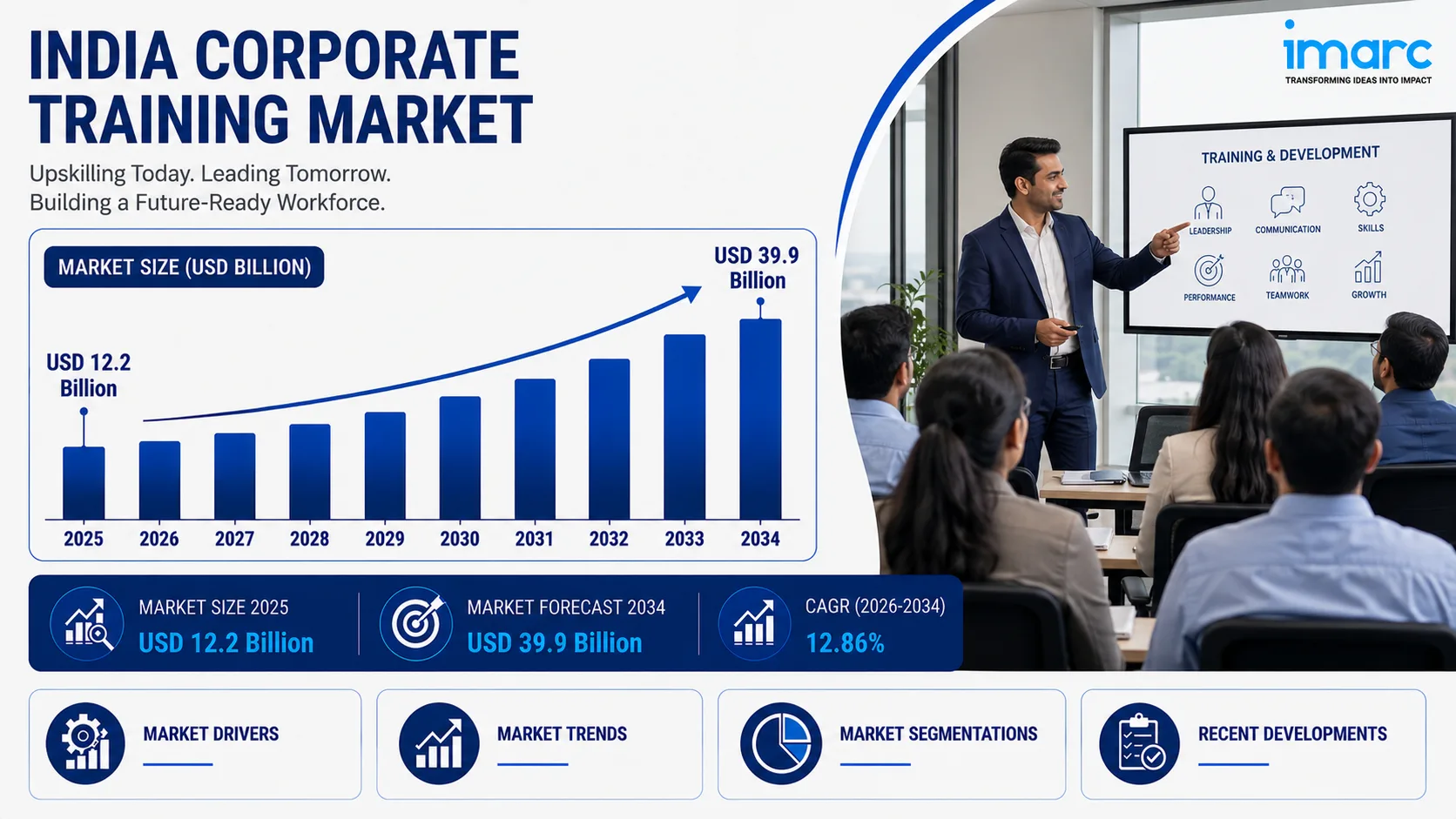
- Market Valuation (2025): USD 12.2 Billion
- Forecast Valuation (2034): USD 39.9 Billion
- CAGR (2026-2034): 12.86%
What Is Driving Growth in the India Corporate Training Market?
The India corporate training market recorded a valuation of USD 12.2 Billion in 2025 and is projected to reach USD 39.9 Billion by 2034, registering a CAGR of 12.86% during 2026-2034. Growth is underpinned by rising demand for upskilling and reskilling, accelerating digital transformation across industries, and expanding adoption of e-learning platforms, alongside increased organizational focus on employee productivity. Government initiatives, the shift toward hybrid work models, and continuous technological advancements in training delivery are further reinforcing market expansion, while growing emphasis on leadership development, compliance, and soft skills training continues to broaden the scope of corporate training programs. Rising demand for digital, customized, and outcome-focused training solutions is further encouraging new business models and strengthening partnerships between training providers and enterprises across the industry.
What Are the Key Growth Drivers and Restraints in the India Corporate Training Market?
Primary Growth Drivers
- Government-Led Skilling Initiatives:
Programs such as Skill India, Pradhan Mantri Kaushal Vikas Yojana (PMKVY), and the National Skill Development Mission, alongside digital skilling platforms like Swayam and FutureSkills Prime, are expanding access to structured, industry-relevant training in areas including AI, cybersecurity, data science, and business analytics.
- Adoption of Advanced Learning Technologies:
Learning Management Systems (LMS) are becoming central to delivering, tracking, and evaluating training outcomes through multimedia content, real-time assessments, and learner analytics, while dedicated platforms support scheduling, resource allocation, and cost management of virtual and in-person sessions. Virtual Reality (VR) and Augmented Reality (AR) based simulation training is expanding across manufacturing, healthcare, and aviation to improve skill proficiency and reduce operational risk, while mobile-based micro-learning apps enhance retention through short, focused modules.
- Shift Toward Hybrid and Remote Work Models:
The expansion of hybrid and remote work has increased demand for online training modules, webinars, virtual classrooms, and asynchronous learning platforms that ensure consistent workforce-wide access.
- Rising Demand for Personalized, Tech-Enabled Soft Skills Training:
AI-powered simulations, gamification, video-based coaching, and EQ assessments embedded within LMS dashboards are enabling personalized learning paths and higher engagement in leadership and soft-skills development.
- Emphasis on Original, Organization-Specific Training Content:
Growing focus on creating authentic, IP-compliant training materials, supported by responsible use of open educational resources, proper third-party licensing, and plagiarism checks, is fostering more customized and effective corporate learning environments.
- Expansion of Customized Digital Learning and Outcome-Focused Partnerships:
Rising demand for digital learning platforms and sector-specific customized training solutions is creating new business models, while partnerships between training providers and enterprises aimed at outcome-focused learning are improving productivity and retention in a competitive labor market.
Primary Market Restraints
- Budgetary and Infrastructure Constraints:
Limited training budgets, particularly among small and mid-sized enterprises, combined with inconsistent digital infrastructure, restrict consistent adoption of structured training programs.
- Outcome Alignment and Adoption Challenges:
Difficulty aligning training programs with measurable outcomes, employee resistance to new learning models, and a persistent skills mismatch between training content and real-world job requirements continue to limit training effectiveness across industries.
- Workforce Diversity Complexities:
Managing training delivery across a diverse workforce increases the complexity of content design and consistent implementation, particularly for organizations operating across multiple regions and employee segments.
➤ Request Sample Report (TOC & Charts)
Who Are the Key Players in the India Corporate Training Market?
The market features an active competitive landscape shaped by market structure, key player positioning, and company evaluation across strategy and capability dimensions. Providers are strengthening their offerings through digital platform launches and technology partnerships, including AI-driven and immersive training solutions, to expand reach across manufacturing, engineering, and technology-driven industries. In November 2024, the Government of Karnataka signed five strategic MoUs with global technology companies at the Bengaluru Tech Summit to deliver advanced skills training in AI, deep tech, cybersecurity, and data science, targeting the upskilling of 100,000 individuals with a 70% placement rate, reflecting active government-industry collaboration shaping the competitive landscape.
Key Market Participants:
- AutoVRse: In November 2024, the Bengaluru-based XR company launched VRseBuilder, an AI-powered, modular SaaS platform featuring a Creation Studio, a VR-native LMS, a deployment dashboard, and a no-code Unity SDK, enabling enterprises to build and scale immersive VR training programs across manufacturing, engineering, and heavy industry.
- Kairos: In May 2024, the company introduced a game-based corporate training platform focused on soft skills, combining digital and physical games and tools to support Learning & Development professionals in building collaboration, emotional intelligence, agility, and creative thinking capabilities.
Which Segments Are Covered in the India Corporate Training Market?
Regional Insights
The market by region is segmented into North India, West and Central India, South India, and East and Northeast India.
Technical Training Insights
The market by technical training is segmented into Soft Skills, Quality Training, Compliance, and Others.
End Use Industry Insights
The market by end use industry is segmented into Retail, Pharmaceutical and Healthcare, Financial Services, Professional Services, Public Enterprises, Information Technology, and Others.
Customization Note: If you require any specific information not covered within this report's scope, we will provide it as part of the customization.
Strategic Insight & Verdict
Through our analysis, we at IMARC Group observe that the India corporate training market is experiencing robust growth, driven by increasing demand for workforce upskilling and reskilling, rapid digital transformation, and the widespread adoption of AI-enabled learning platforms. Government-led skilling initiatives, hybrid work models, and the growing need for customized, outcome-focused training programs are further strengthening market opportunities. Companies focusing on immersive learning technologies, personalized training solutions, and strategic enterprise partnerships are expected to strengthen their competitive position over the forecast period.