Market Outlook
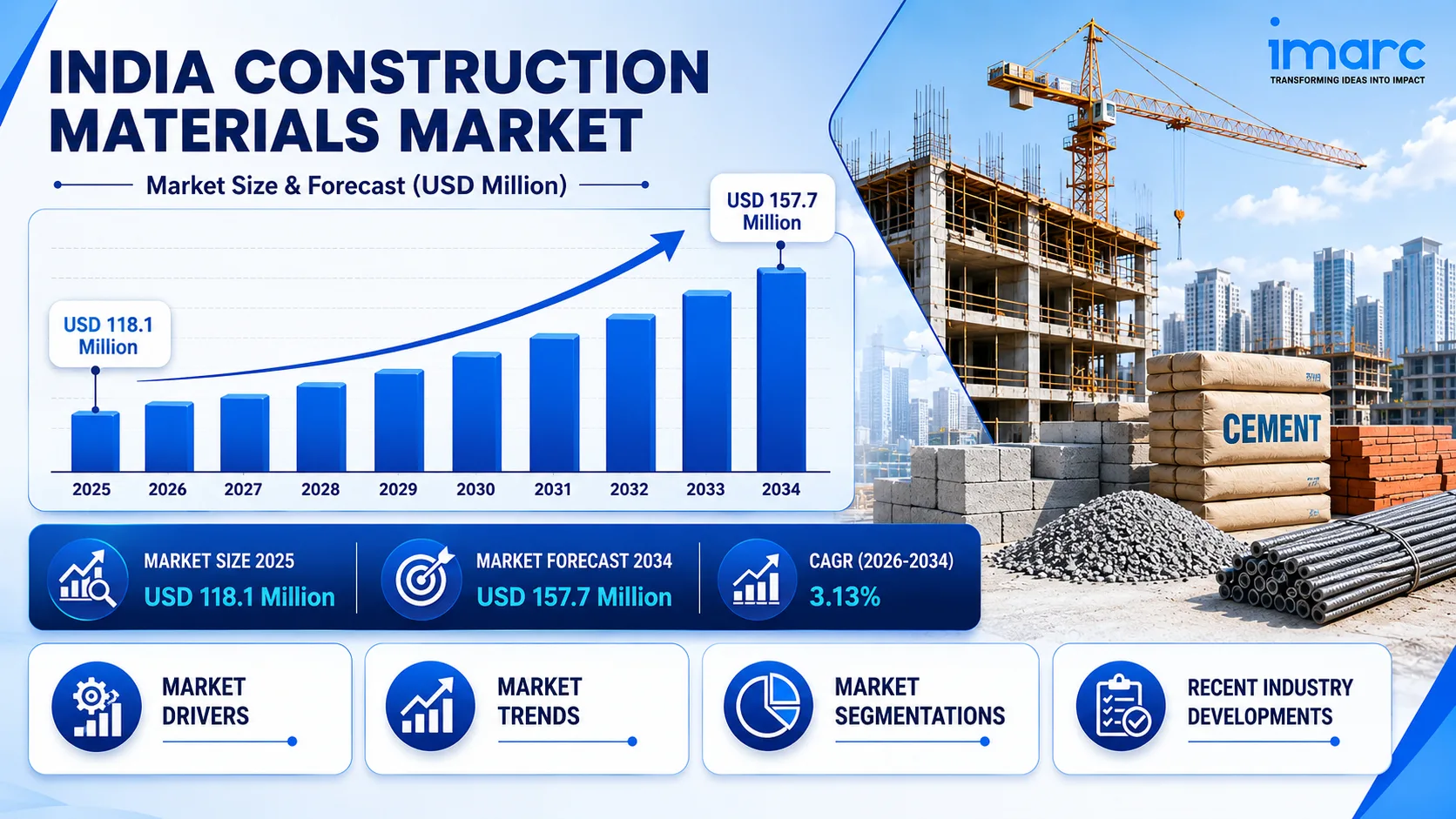
The India construction materials market was valued at USD 118.1 Million in 2025 and is projected to reach USD 157.7 Million by 2034, growing at a compound annual growth rate of 3.13% between 2026 and 2034. Growth is being shaped by continued urbanization, large-scale infrastructure investment, and a tightening regulatory push toward recycled and circular construction inputs. Demand across aggregates, cement, bricks and blocks, and metals continues to be underpinned by government-backed housing and infrastructure programmes, even as the industry adapts to new rules governing construction and demolition waste.
A significant regulatory shift is reshaping the materials landscape: the Environment (Construction and Demolition) Waste Management Rules, 2025, took effect on April 1, 2026, introducing India's first Extended Producer Responsibility framework for the construction sector. Under the rules, developers of projects exceeding 20,000 square metres must incorporate a rising share of recycled content, starting at 5% in 2026-27 and climbing to 25% for construction and reconstruction projects by 2030-31. This is expected to steadily formalise the market for recycled aggregates and processed construction waste alongside conventional materials over the forecast period.
Market Snapshot:
- Market Size (2025): USD 118.1 Million
- Forecast Market Size (2034): USD 157.7 Million
- CAGR (2026-2034): 13%
- Material Types Covered: Aggregate, Cement, Bricks and Blocks, Metals, Others
- End-User Segments Covered: Residential, Infrastructure (Roads, Bridges, Waste Management), Commercial, Industrial
- C&D Waste Recycled-Content Mandate: 5% in 2026-27, rising to 25% by 2030-31 for construction and reconstruction projects
What Are the Growth Factors of the India Construction Materials Market?
- Affordable Housing Push Under PMAY-Urban 2.0:
The Pradhan Mantri Awas Yojana-Urban 2.0, approved by the Union Cabinet in August 2024, aims to support the construction, purchase or rental of affordable housing for roughly one crore urban poor and middle-income families over five years, backed by a government subsidy of around Rs. 2.30 lakh crore against a total project investment of about Rs. 10 lakh crore. Programmes of this scale continue to generate sustained, broad-based demand for cement, bricks, aggregates and structural materials across residential construction.
- National Infrastructure Pipeline and Smart Cities-Led Demand:
India's National Infrastructure Pipeline, with a planned outlay of roughly Rs. 108 lakh crore for roads, railways and energy projects, continues to anchor long-term demand for construction materials, while the Smart Cities Mission's 100-city development programme sustains urban material consumption across roads, utilities and public infrastructure. Together, these multi-year public investment programmes provide a relatively stable demand base that is less sensitive to short-term real estate cycles.
- Steel Capacity Expansion Strengthening the Materials Supply Chain:
Domestic steel producers are expanding capacity to meet rising construction-sector demand for TMT bars and structural steel. Jindal Steel & Power is expanding its Angul facility from 6 to 12 million tonnes per annum with an investment of around Rs. 24,000 crore, while Steel Authority of India is deploying approximately Rs. 12,000 crore in FY26 capital expenditure as part of plans to expand capacity beyond 35 million tonnes per annum by 2030, reinforcing domestic availability of a core construction material.
- Regulatory Push Toward Circular and Recycled Construction Materials:
The Environment (Construction and Demolition) Waste Management Rules, 2025, effective April 1, 2026, mandate escalating use of recycled content in construction and road projects, backed by an Extended Producer Responsibility framework requiring large developers to register waste management plans with the Central Pollution Control Board. As enforcement scales up, demand for recycled aggregates, manufactured sand and processed construction waste is expected to grow as a distinct, policy-supported materials segment.
➤ Request Sample Report (TOC & Charts): https://www.imarcgroup.com/india-construction-materials-market/requestsample
What Are the Key Trends Shaping the Market?
- Mainstreaming of Recycled Aggregates and Circular Materials:
India generates over 100 million tonnes of construction and demolition waste annually, of which independent assessments suggest only a small fraction is currently recycled. The new EPR-based waste rules are expected to change this trajectory materially, with recycling targets for demolition and reconstruction projects starting at 25% in 2025-26 and scaling toward 100% by 2028-29, creating a structured, compliance-driven market for recycled aggregates and processed sand.
- Adoption of AAC Blocks and Modern Walling Materials:
Autoclaved Aerated Concrete blocks and similar modern walling materials are gaining share over traditional clay bricks, supported by their lighter weight, better thermal insulation and faster construction timelines. International building material groups have continued to enter the Indian market through joint ventures with domestic players to establish dedicated AAC manufacturing capacity, reflecting sustained investor interest in modern walling technology.
- Steel Industry Capacity Build-Out to Meet Structural Material Demand:
Large integrated steel producers are committing multi-thousand-crore investments to expand rolling and melting capacity dedicated to construction-grade steel. This capacity build-out, spanning both primary producers such as SAIL and JSPL and numerous secondary regional producers, is aimed at closing regional supply gaps and supporting India's target of expanding national crude steel capacity toward 300 million tonnes per annum by 2030.
- Growing Preference for Green-Certified Construction Materials:
Developer and corporate preference for materials that support green building certification continues to strengthen, with India retaining its position among the top countries globally for LEED-certified building space. This is gradually influencing specification choices across cement, aggregates and walling materials toward lower-embodied-carbon and recycled-content alternatives.
➤ Request Sample Report (TOC & Charts)
What Are the Major Market Challenges?
- Compliance Costs From New C&D Waste Regulations:
The Environment (Construction and Demolition) Waste Management Rules, 2025, require large developers to register projects, submit waste management plans and obtain Extended Producer Responsibility certificates, adding administrative and compliance costs. Smaller developers and contractors, in particular, may face challenges adapting procurement and site-management practices to meet escalating recycled-content requirements within the mandated timelines.
- Volatility in Raw Material and Input Prices:
Prices for core inputs such as steel and cement remain sensitive to global commodity cycles, energy costs and domestic supply-demand imbalances. Fluctuations in steel prices alone can materially affect construction budgets, given that reinforcement steel constitutes a significant share of total project material costs, creating planning uncertainty for both material producers and end-use developers.
- Fragmentation and Quality Inconsistency in Informal Segments:
Segments such as bricks, aggregates and small-scale metal fabrication remain served by a large number of small, informal producers with limited quality standardisation. This fragmentation can complicate efforts to enforce recycled-content mandates and consistent material specifications, particularly outside major metropolitan markets where formal sector penetration is comparatively lower.
➤ Explore the Full Report with Charts, Table of Contents, and List of Figures: https://www.imarcgroup.com/india-construction-materials-market
How Is the Market Segmented?
- By Material Type: Aggregate, Cement, Bricks and Blocks, Metals, and Others, reflecting the core inputs used across residential, commercial, industrial and infrastructure construction.
- By End User: Residential, Infrastructure (Roads, Bridges, and Waste Management), Commercial, and Industrial. Infrastructure remains a key demand anchor given sustained public capital expenditure on roads, bridges and urban waste-management facilities.
- Regional Insights: North India, South India, East India, and West India, with demand patterns shaped by the pace of urban development, infrastructure rollout and industrial activity across these zones.
Competitive Landscape:
The India construction materials market spans large, diversified cement and steel conglomerates alongside specialised regional manufacturers of aggregates, bricks and blocks. Competitive positioning increasingly reflects a combination of scale, supply-chain integration, and the ability to supply recycled-content and green-certified materials as regulatory and developer preferences shift, alongside continued investment in capacity expansion to meet sustained infrastructure and housing demand.
Recent News or Developments:
- In April 2026, the Environment (Construction and Demolition) Waste Management Rules, 2025 came into effect, introducing India's first Extended Producer Responsibility framework for the construction sector and mandating minimum recycled-content use in construction and road projects on an escalating schedule through 2030-31.
- In late 2025, Jindal Steel & Power announced an expansion of its Angul facility from 6 to 12 million tonnes per annum, backed by an investment of approximately Rs. 24,000 crore, aimed at strengthening domestic supply of construction-grade steel.
- In FY26, Steel Authority of India committed approximately Rs. 12,000 crore in capital expenditure as part of a broader plan to expand its production capacity beyond 35 million tonnes per annum by 2030, supporting long-term domestic availability of structural steel for construction.
Customization Note: If you require any specific information not covered within this report's scope, we will provide it as part of the customization.
➤ Request Report Customization: https://www.imarcgroup.com/request?type=report&id=32506&flag=E
Frequently Asked Questions (FAQ)
Q1. How big is the India construction materials market?
The India construction materials market was valued at USD 118.1 Million in 2025.
Q2. What is the future outlook of the India construction materials market?
The India construction materials market is projected to exhibit a CAGR of 3.13% during 2026-2034, reaching a value of USD 157.7 Million by 2034.
Q3. Which end-user segment holds significant demand in the market?
The infrastructure segment, covering roads, bridges and waste management, holds significant demand, supported by sustained public capital expenditure under programmes such as the National Infrastructure Pipeline.
Q4. What new regulation is reshaping the India construction materials market?
The Environment (Construction and Demolition) Waste Management Rules, 2025, effective April 1, 2026, mandate rising use of recycled content in construction and road projects, creating a structured demand segment for recycled aggregates and processed construction waste.
Q5. What are the key factors driving the India construction materials market?
The India construction materials market is driven by affordable housing programmes such as PMAY-Urban 2.0, sustained infrastructure investment under the National Infrastructure Pipeline, ongoing steel capacity expansion, and the regulatory shift toward recycled and circular construction materials.
Conclusion
The India construction materials market is set for steady, policy-supported growth through 2034, anchored by large-scale affordable housing programmes, sustained infrastructure investment, and continued capacity expansion across the domestic steel and cement industries. The new Construction and Demolition Waste Management Rules mark a structural shift, introducing accountability mechanisms that are expected to formalise and expand the market for recycled and circular construction inputs over the coming years.
At the same time, compliance costs associated with the new waste regulations, raw material price volatility, and quality fragmentation across informal market segments will require sustained attention from both regulators and industry participants. As urbanization, infrastructure investment and circular-economy mandates continue to converge, the India construction materials market is well-positioned to support a more resilient, resource-efficient built environment over the forecast period.