
Bentonite cat litter is widely used because of its ability to absorb moisture and form clumps when exposed to liquid. However, producing cat litter with consistent particle size, low dust, and reliable clumping performance requires careful control throughout the manufacturing process.
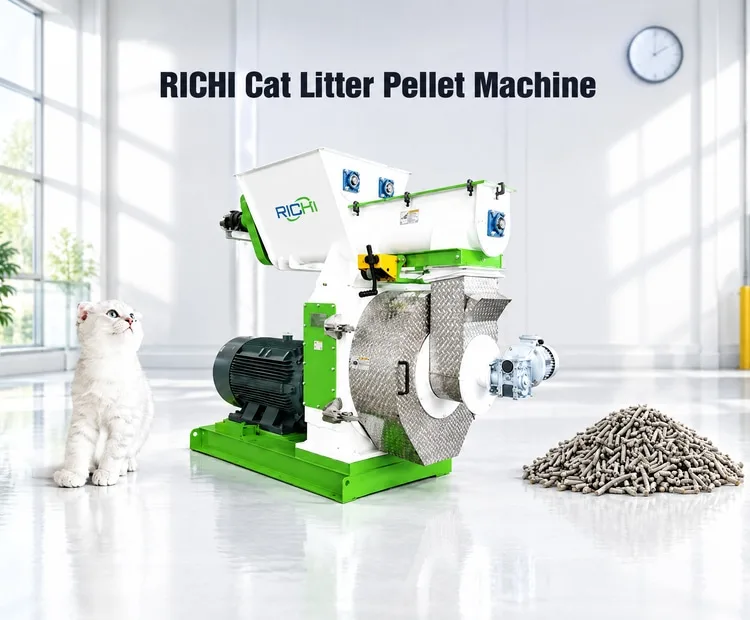
For manufacturers planning to enter this market or upgrade an existing facility, a cat litter pellet machine is a key piece of equipment. Its performance depends on the condition of the bentonite, the preparation process, and the required product specifications. Choosing machinery based only on its advertised capacity may overlook important factors that influence the finished litter.
1. Understand the Bentonite Before Processing
Bentonite is a clay material whose properties vary depending on its source and composition. Sodium bentonite is commonly used in clumping cat litter because of its swelling and liquid-absorption characteristics.
Before production, manufacturers should evaluate:
- Moisture content: Excessive moisture can affect feeding and forming stability.
- Particle size: Oversized material needs crushing, while uneven particles may affect product consistency.
- Impurities: Stones and other foreign materials should be removed.
- Clumping performance: The finished product should be tested for its ability to absorb liquid and form stable clumps.
These checks help determine the appropriate crushing, drying, screening, and pelletizing arrangements.
2. How Is Bentonite Cat Litter Manufactured?
A typical bentonite cat litter production process includes several stages.
Raw material feeding and cleaning: Bentonite is transferred into the production system, where foreign materials are removed when necessary.
Crushing and grinding: Large lumps are reduced to a suitable particle size. A consistent feed material makes subsequent processing easier to control.
Drying: If the raw material contains excessive moisture, drying may be required to achieve the desired processing condition.
Granulation or pelletizing: Prepared bentonite is formed into particles according to the target product specifications. The forming method should match the required litter shape and size.
Screening: The finished material is separated into different size ranges. Oversized particles and fines can be handled according to the production process.
Packaging: Qualified cat litter is weighed and packed for storage, distribution, and retail sales.
The exact process depends on the bentonite source and whether the manufacturer produces coarse granules, fine granules, or another specific product format.
3. What Should Buyers Consider When Selecting a Machine?
Production capacity is important, but it should not be the only selection criterion. Buyers should also consider the material characteristics and the final product requirements.
For example, a manufacturer targeting a high-volume retail market may need a continuous production system with suitable crushing, screening, conveying, and packaging equipment. A smaller producer may prefer a simpler configuration that can be expanded later.
It is also useful to clarify the expected particle size range, production hours, raw material moisture, and packaging weight before requesting a quotation.
For businesses comparing other agricultural and mineral material processing opportunities, a rice husk pellet machine is another type of pelletizing equipment worth understanding. Although both machines are used to form solid products from prepared materials, bentonite and rice husk have very different physical properties and require different equipment configurations.
4. How Can Manufacturers Improve Finished Product Quality?
Cat litter buyers generally pay attention to several practical product characteristics.
Consistent particle size: Uniform granules make the product easier to handle and help create a more consistent user experience.
Low dust: Excessive fines can create dust during packaging, transportation, and pouring. Appropriate screening and material handling help control loose particles.
Reliable clumping: For clumping products, liquid absorption and clump strength are important performance indicators. These should be verified through product testing.
Convenient packaging: Different markets may require different bag sizes. Automatic weighing and packaging equipment can improve consistency and reduce manual handling.
Quality control should cover both the raw bentonite and the finished product. A stable machine alone cannot compensate for unsuitable raw material.
5. Planning a Complete Cat Litter Production Project
Before investing in equipment, manufacturers should prepare a basic project specification. This should include the bentonite source, raw material condition, target capacity, finished particle size, product type, and packaging requirements.
RICHI provides pelletizing and processing equipment for different industrial applications. Depending on the material and production target, a customized solution may include crushing, drying, forming, screening, conveying, and packaging sections. Buyers can explore richimanufacture cat litter production line solutions and check this site out for more information about equipment and project services.
Conclusion
Consistent bentonite cat litter production begins with proper raw material evaluation and a well-designed processing system. Moisture control, particle size, screening, and finished-product testing all contribute to product quality. By defining the target litter specifications before selecting equipment, manufacturers can develop a production line that better matches their market requirements.