
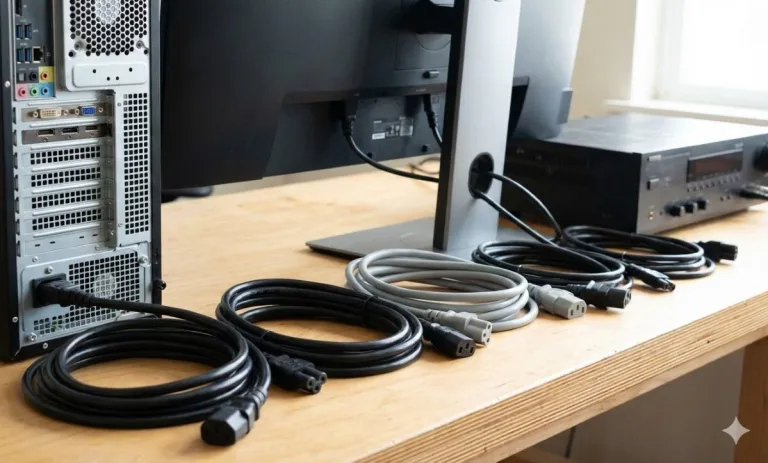
In a data center, the IEC C13 power cord is not just a convenience — it is a critical infrastructure component. A single failed power cord can take a server offline, impact hundreds of users, and cost thousands in downtime. Choosing the right IEC C13 power cord for data center use requires a different mindset than buying a cord for a home office. This guide covers the key considerations for data center power cord selection.
Data Center Power Cord Requirements
Data center IEC C13 power cords must meet higher standards than typical consumer cords. They need consistent contact resistance across thousands of mating cycles, tight dimensional tolerances to ensure secure retention in server C14 inlets, excellent flame retardancy to prevent fire propagation in dense rack environments, color coding options for circuit identification, and locking variants to prevent accidental disconnection during maintenance activities.
Locking C13 Cords: Essential for Server Rooms
In any environment where accidental disconnection of a power cord means downtime, locking IEC C13 power cords are a necessity, not a luxury. These cords feature a retention clip on the C13 connector that snaps into a corresponding feature on the device's C14 inlet, requiring deliberate release before the cord can be removed. Locking cords are available in both standard and right-angle configurations and are compatible with the same C14 inlets used by standard cords.
Color Coding for Circuit Management
Large data centers often distribute power across multiple circuits, phases, or power distribution units (PDUs) for redundancy. Color-coded IEC C13 power cords allow technicians to instantly identify which circuit a server is connected to without tracing cables. Common conventions use red for circuit A, blue for circuit B, with other colors for additional circuits or power sources. Establishing and documenting a color coding standard significantly reduces the risk of human error during maintenance.
Cable Length Optimization in Racks
In a server rack, cable management directly affects airflow, temperature, and accessibility. Over-long power cords create bundles of excess cable that block airflow and make it difficult to access equipment. Best practice is to measure each cable run from the PDU to each device and use the shortest cord that allows the connection without tension. Many data center operators stock a range of cord lengths from 1 foot to 6 feet to optimize each specific installation.
Power Cord Ratings and PDU Compatibility
IEC C13 power cords used in data centers must be rated for the load of the connected devices. A standard 10A C13 cord is appropriate for most 1U servers and network switches. For blade servers or storage arrays with higher power draws, verify that the cord gauge supports the actual current load with appropriate headroom. Also confirm compatibility with the PDU outlets — most PDUs use C13 outlets that accept standard C13 cords, but some high-density PDUs use C19/C20 connections for higher current capacity.
Procurement and Spare Inventory Best Practices
Data centers should maintain a spare inventory of IEC C13 power cords in each commonly used length and configuration. Standardizing on a small number of cord types from a single certified supplier simplifies procurement, reduces the risk of receiving substandard products, and speeds up maintenance and hardware swap procedures. Document cord specifications in your asset management system and include power cord replacement in hardware refresh cycles.
Original Article :- https://www.techcolite.com/top-uses-of-iec-power-cords-in-modern-electronics/