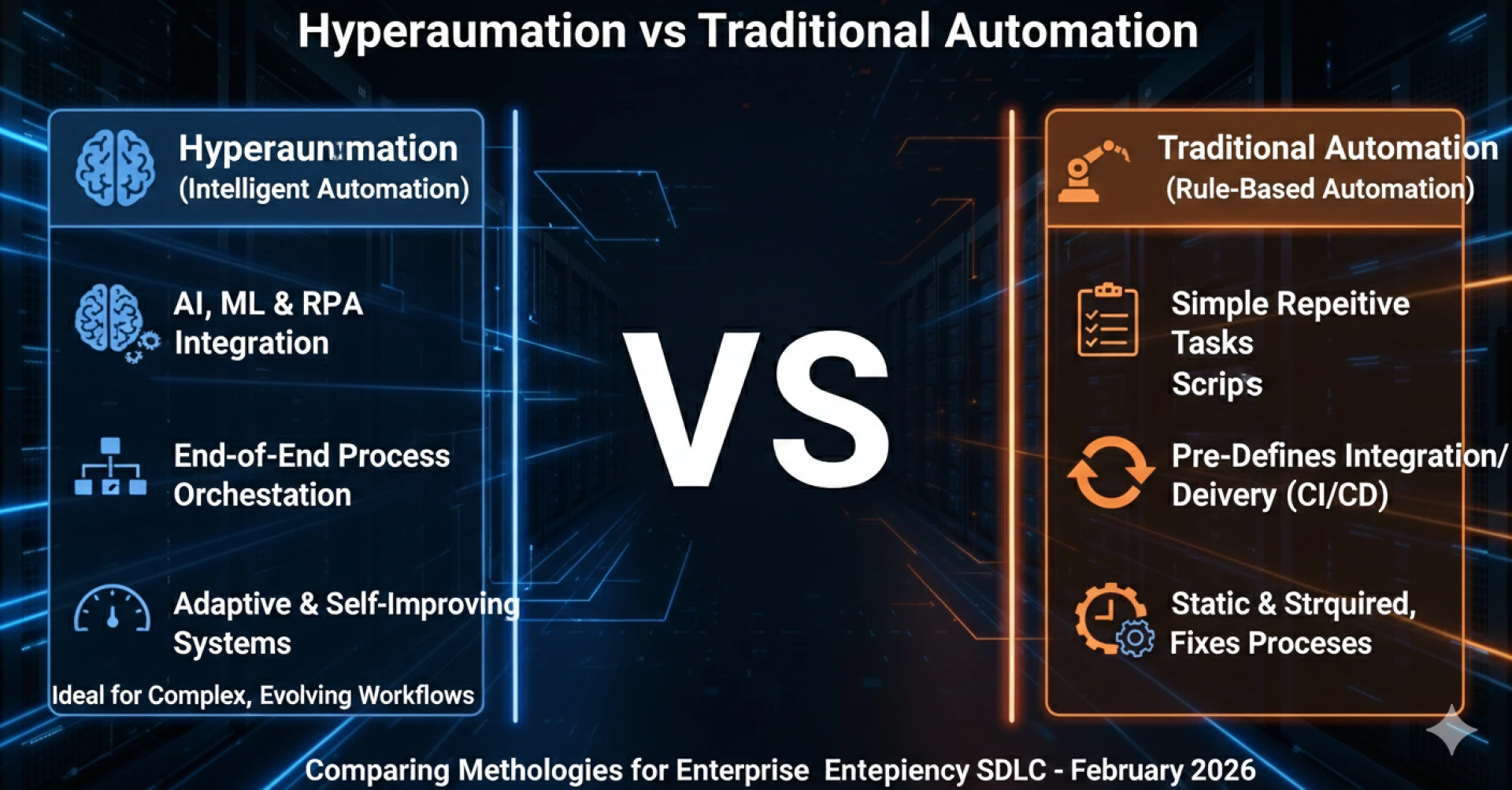
The confusion between hyperautomation and traditional automation usually starts because both promise efficiency. But in practice, they solve very different problems.
Let’s break this down clearly.
What Traditional Automation Really Means
Traditional automation is rule-driven. It follows instructions exactly as defined.
You configure it once. It runs the same way every time.
Examples include:
- Scheduled scripts
- Macros in ERP systems
- Workflow engines
- Basic RPA bots
- Integration triggers between two systems
It works best when:
- The process rarely changes
- Data is structured
- Decisions are binary
- Exceptions are limited
If you’re automating payroll calculations or moving data between systems nightly, traditional automation is perfectly sufficient.
But it has limits.
It doesn’t teach.
It doesn’t adapt.
It doesn’t question inefficiencies.
It executes instructions, nothing more.
What Hyperautomation Changes
Hyperautomation is not just “more automation.” That’s where most misunderstandings begin.
Hyperautomation connects multiple automation technologies into a unified ecosystem. It usually combines:
- RPA
- AI and machine learning
- Process mining tools
- Intelligent document processing
- APIs and orchestration platforms
The difference is intent.
Traditional automation improves tasks.
Hyperautomation improves systems.
Instead of automating a single step in invoice processing, hyperautomation maps the entire workflow, from receipt to reconciliation, and optimizes it continuously.
The Structural Difference
After writing extensively on enterprise automation and working closely with solution architects, I’ve noticed that the biggest difference is architectural.
Traditional automation is layered on top of existing systems.
Hyperautomation is integrated into the core process architecture.
That shift changes everything.
Where RPA Fits
RPA often sits in the middle of this debate.
RPA on its own is still traditional automation if it simply mimics human clicks and keystrokes.
But when RPA is combined with AI decision engines, analytics, and process discovery tools, it becomes part of hyperautomation.
So RPA is not the competitor here. It’s the bridge.
Scalability: The Real Business Factor
From an enterprise standpoint, scalability is where the gap becomes obvious.
Traditional automation scales by replication.
You add more bots. More scripts. More workflows.
Hyperautomation scales by orchestration.
You centralize control. Reuse components. Monitor performance across systems.
In large organizations with multiple departments and compliance layers, replication becomes messy. Orchestration becomes necessary.
That’s why scalable enterprise automation strategies are increasingly built around hyperautomation models.
Process Discovery and Visibility
Traditional automation requires someone to identify what should be automated.
Hyperautomation platforms often include process mining tools. They analyze logs, detect bottlenecks, and highlight inefficiencies automatically.
That visibility is powerful in enterprises where workflows are complex and undocumented.
You move from reactive automation to proactive optimization.
Enterprise Automation Use Cases in Practice
Let’s look at realistic enterprise automation use cases.
Finance Teams
Traditional automation:
- Automating data entry
- Running reconciliations
- Generating standard reports
Hyperautomation:
- Detecting invoice anomalies
- Flagging compliance risks
- Predicting payment delays
- Automatically routing exceptions
The second approach reduces decision friction, not just manual effort.
HR Operations
Traditional automation:
- Sending onboarding emails
- Updating employee records
Hyperautomation:
- Screening resumes with AI
- Identifying retention risks
- Forecasting workforce gaps
The difference lies in insight.
Customer Operations
Traditional automation:
- Ticket assignment rules
- Automated responses
Hyperautomation:
- Sentiment-based routing
- Predictive escalation
- Root-cause detection
This is where automation becomes strategic instead of operational.
Cost and Maturity
Traditional automation costs less upfront. It’s faster to deploy. It solves immediate inefficiencies.
Hyperautomation requires planning, integration, and governance. It’s not a quick fix. It’s a long-term automation strategy.
Most enterprises don’t jump directly to hyperautomation. They evolve toward it as process complexity increases.
I’ve seen this pattern repeatedly.
Teams start small.
They automate tasks.
They realize fragmentation creates new bottlenecks.
They consolidate into hyperautomation frameworks.
It’s rarely an overnight shift.
Hyperautomation vs Traditional Automation: The Practical View
If your business process is stable and repetitive, traditional automation is enough.
If your business process:
- Spans multiple systems
- Handles unstructured data
- Requires adaptive decisions
- Changes frequently
Then hyperautomation becomes necessary.
Not because it’s trendy but because complexity demands it.
RPA Hyperautomation Trends
From current enterprise discussions and implementation patterns, several rpa hyperautomation trends are clear:
- AI-driven decision layers are becoming standard
- Automation governance is becoming formalized
- Low-code platforms are reducing dependency on IT
- Automation analytics is now a leadership KPI
Organizations are no longer satisfied with automating isolated tasks. They want measurable, system-wide impact.
Final Perspective
After more than ten years writing in enterprise technology and studying automation strategy, I see hyperautomation not as a replacement for traditional automation, but as its next stage.
Traditional automation improves efficiency.
Hyperautomation improves intelligence.
Both have their place.
The real question isn’t “Which one is better?”
It’s “What level of complexity does your organization operate at?”
Automation should match that complexity, not exceed it, and not lag behind it.
That’s how scalable enterprise automation actually works in the real world.