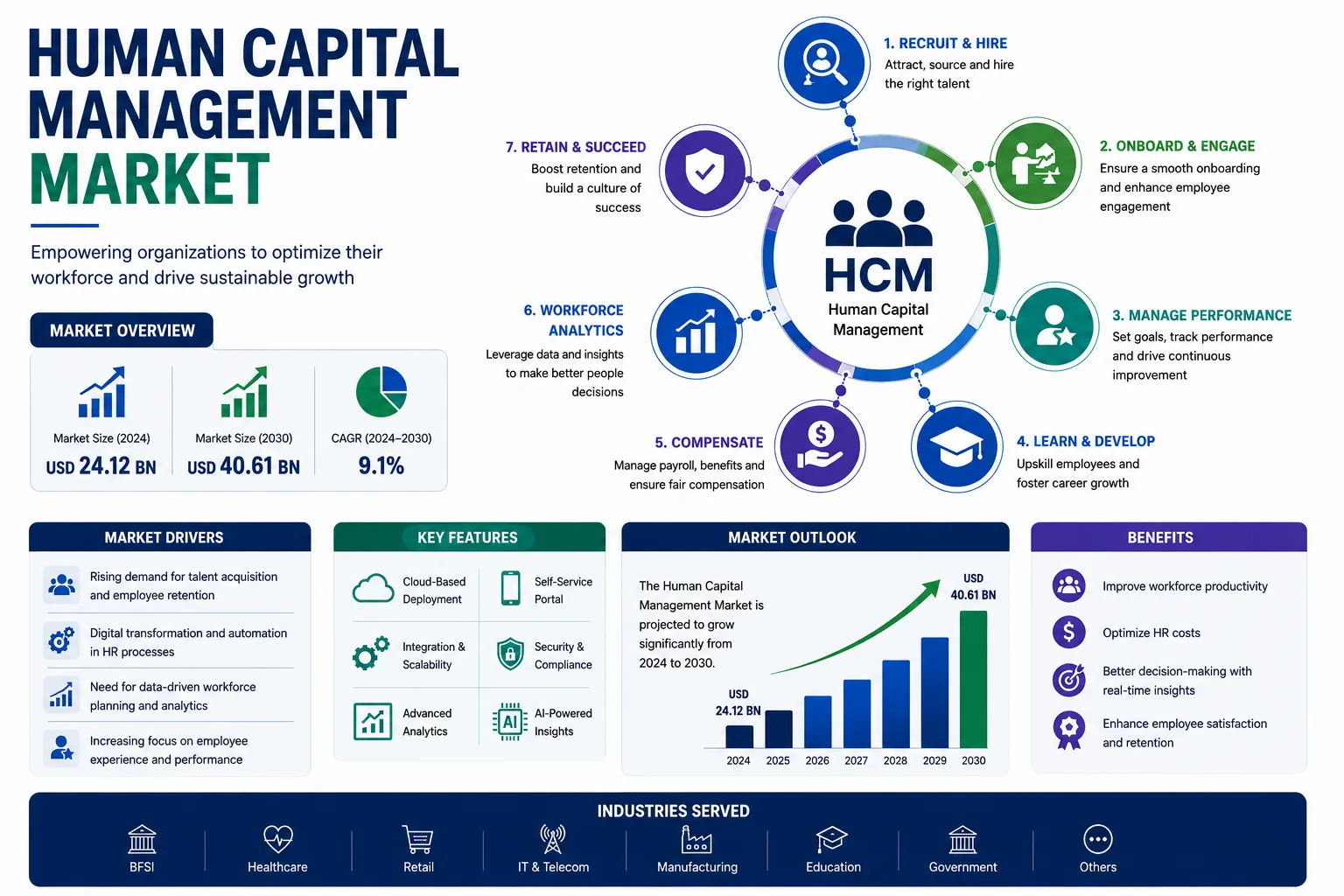
The Human Capital Management Market is entering a transformative phase as organizations increasingly recognize employees as their most valuable asset. Rapid digitalization, evolving workforce expectations, remote and hybrid work models, and advancements in artificial intelligence are driving enterprises to invest heavily in comprehensive Human Capital Management (HCM) solutions.
According to QKS Group, the Human Capital Management (HCM) suite market is expected to grow at a compound annual growth rate (CAGR) of 7.88% through 2030, reflecting the increasing importance of workforce optimization, talent development, and strategic HR decision-making. As businesses navigate a highly competitive talent landscape, HCM platforms are becoming essential for managing the entire employee lifecycle efficiently.
Understanding the Human Capital Management Market
Human Capital Management (HCM) software is a comprehensive suite of applications designed to manage various HR functions, including recruitment, onboarding, payroll, workforce planning, performance management, learning and development, talent management, and workforce analytics.
Modern HCM platforms provide organizations with a unified view of employee data, enabling HR leaders to make informed decisions based on real-time insights. By integrating HR processes into a centralized ecosystem, HCM solutions improve operational efficiency, employee engagement, and organizational productivity.
The growing demand for integrated workforce management solutions continues to fuel expansion across the global Human Capital Management Market.
Key Trends Shaping the Human Capital Management Market in 2026
1. AI-Powered Workforce Intelligence
Artificial intelligence is becoming a core component of modern HCM platforms. Organizations are leveraging AI-driven capabilities to automate repetitive HR tasks, identify skill gaps, predict employee turnover, and enhance workforce planning.
AI-powered analytics help HR teams forecast future talent requirements, optimize recruitment strategies, and improve employee experiences through personalized learning recommendations.
2. Skills-Based Talent Management
Traditional job-based workforce models are evolving into skills-based approaches. Organizations are focusing on identifying, developing, and deploying employee skills more effectively.
HCM platforms now include advanced skills intelligence capabilities that help businesses align workforce capabilities with organizational goals.
3. Enhanced Employee Experience
Employee experience has become a strategic priority for organizations worldwide. HCM vendors are incorporating engagement tools, wellness programs, career development frameworks, and personalized employee journeys into their platforms.
This focus helps organizations improve retention rates and attract top talent.
4. Workforce Analytics and Predictive Planning
Data-driven HR decision-making is gaining momentum. Organizations are increasingly utilizing workforce analytics to measure performance, identify workforce trends, and support strategic planning initiatives.
Predictive analytics enables HR leaders to proactively address workforce challenges before they impact business outcomes.
5. Cloud-Based HCM Adoption
Cloud deployment continues to dominate the market due to its scalability, flexibility, and lower infrastructure costs. Cloud-native HCM solutions support remote workforces and provide seamless access to HR services from anywhere.
What Is Driving Human Capital Management Market Growth?
Several factors are contributing to the robust growth of the Human Capital Management Market:
- Rising demand for workforce optimization and productivity improvement.
- Increasing adoption of AI and machine learning technologies.
- Growing focus on employee engagement and retention.
- Expansion of remote and hybrid work environments.
- Regulatory compliance requirements related to payroll and workforce management.
- Increasing investments in employee learning and development programs.
Organizations are realizing that effective workforce management directly impacts business performance, making HCM platforms a strategic investment rather than simply an HR tool.
How AI Is Revolutionizing the Human Capital Management Market
Artificial intelligence is fundamentally transforming how organizations manage talent.
AI-enabled HCM solutions can automatically screen resumes, recommend candidates, schedule interviews, and identify top talent based on predictive models. Beyond recruitment, AI assists in performance evaluations, workforce planning, succession management, and employee development.
Advanced AI capabilities also support knowledge management and conversational HR assistants, allowing employees to access information and complete routine tasks quickly.
As AI technologies continue to mature, they will become a key differentiator among leading HCM vendors.
Top HCM Platforms Transforming Workforce Management
Leading HCM providers continue to innovate by integrating AI, analytics, automation, and employee experience tools into their platforms. Organizations evaluating solutions often consider factors such as scalability, integration capabilities, analytics, compliance support, and user experience.
Insights from Market Share: Human Capital Management (HCM), 2025, Worldwide indicate that market leaders are focusing heavily on innovation, cloud-native architectures, and AI-driven workforce intelligence to strengthen their competitive positions.
Biggest Opportunities in the Human Capital Management Market
Several emerging opportunities are expected to accelerate market growth through 2030:
Global Workforce Management
As organizations expand internationally, demand for centralized workforce management solutions continues to rise.
Learning and Development
Continuous upskilling and reskilling initiatives are becoming critical as workforce requirements evolve rapidly.
Diversity, Equity, and Inclusion (DEI)
Organizations are increasingly leveraging HCM solutions to monitor and improve diversity initiatives while ensuring equitable workforce practices.
Employee Well-Being Programs
Mental health, wellness, and employee satisfaction metrics are becoming important components of workforce strategies.
Human Capital Management Market Outlook Through 2030
The outlook for the Human Capital Management Market remains highly positive. The combination of workforce transformation, digital HR modernization, AI innovation, and growing demand for employee-centric workplaces is expected to sustain strong market growth.
Organizations are increasingly shifting from administrative HR functions toward strategic workforce management. As a result, HCM platforms will continue evolving into intelligent systems that support workforce planning, employee development, and business growth.
According to QKS Group's analysis, the market's projected CAGR of 7.88% through 2030 reflects the growing strategic importance of human capital management across industries worldwide.
Conclusion
The Human Capital Management Market is undergoing significant transformation driven by AI, workforce analytics, employee experience initiatives, and cloud-based innovation. Businesses that invest in advanced HCM platforms will be better positioned to attract talent, optimize workforce performance, and achieve long-term organizational success.
As organizations continue adapting to changing workforce dynamics, HCM solutions will remain central to building agile, productive, and future-ready enterprises. The findings highlighted in Market Share: Human Capital Management (HCM), 2025, Worldwide further emphasize the critical role of technology-driven workforce management in shaping the future of HR.
FAQs
Q1. What is Human Capital Management (HCM) software?
HCM software is a suite of applications that helps organizations manage recruitment, onboarding, payroll, performance management, learning, workforce analytics, and employee development through a unified platform.
Q2. What is driving growth in the Human Capital Management Market?
Key growth drivers include AI adoption, workforce analytics, employee experience initiatives, remote work trends, regulatory compliance requirements, and increasing demand for talent optimization.
Q3. How is AI transforming Human Capital Management?
AI automates recruitment, workforce planning, performance evaluations, talent development, and predictive analytics, helping organizations make faster and more informed HR decisions.
#HumanCapitalManagement #HCMMarket #HRTech #WorkforceManagement #TalentManagement #ArtificialIntelligence #FutureOfWork #HRTransformation
Related Reports:
Market Forecast: Human Capital Management (HCM), 2026-2030, Worldwide
SPARK Matrix™: Human capital management (HCM) suite for Large Businesses, Q3 2025
SPARK Matrix™: Human capital management (HCM) suite for Small & Medium Sized Businesses, Q3 2025
Market Forecast: Employer of Record (EoR), 2026-2030, Worldwide
https://qksgroup.com/market-research/market-forecast-employer-of-record-eor-2026-2030-worldwide-8741