Google Ads has changed a lot over the years. Earlier, running ads was mostly manual work. Marketers had to adjust bids by hand, test ads one by one, analyze reports manually, and constantly monitor campaigns to avoid wasting budget. Today, artificial intelligence has completely transformed how Google Ads works.
AI is no longer optional in Google Ads. It is deeply integrated into bidding, targeting, ad creation, and performance optimization. Businesses that understand how to use AI tools properly are getting better results, lower costs, and higher return on investment compared to those who still rely on old-school methods.
In this in-depth guide, we will explain how AI tools can be used to optimize Google Ads campaigns in simple language. Whether you are a business owner, marketer, or agency professional, this blog will help you understand how AI improves performance and how you can use it the right way.
What Does AI Mean in Google Ads?
AI in Google Ads refers to machine learning systems that analyze huge amounts of data to make smart decisions automatically. These systems learn from user behavior, search patterns, device usage, location data, conversion history, and many other signals.
Instead of guessing what might work, AI uses real data to predict:
- Which user is most likely to convert
- Which keyword will perform better
- Which bid will generate the best result
- Which ad message will get more clicks
Google’s AI processes millions of signals in real time, something no human can do manually. When used correctly, AI helps campaigns become more efficient and profitable.
Why AI Is Important for Google Ads Optimization
Google Ads campaigns have become more competitive. Cost per click is increasing in many industries, and user behavior keeps changing. AI helps advertisers stay ahead by constantly learning and adapting.
AI tools help you:
- Reduce wasted ad spend
- Improve conversion rates
- Reach the right audience at the right time
- Scale campaigns without increasing workload
- Make data-driven decisions instead of assumptions
This is why most modern campaigns managed by a professional google ad agency rely heavily on AI-powered features.
Smart Bidding: The Foundation of AI Optimization
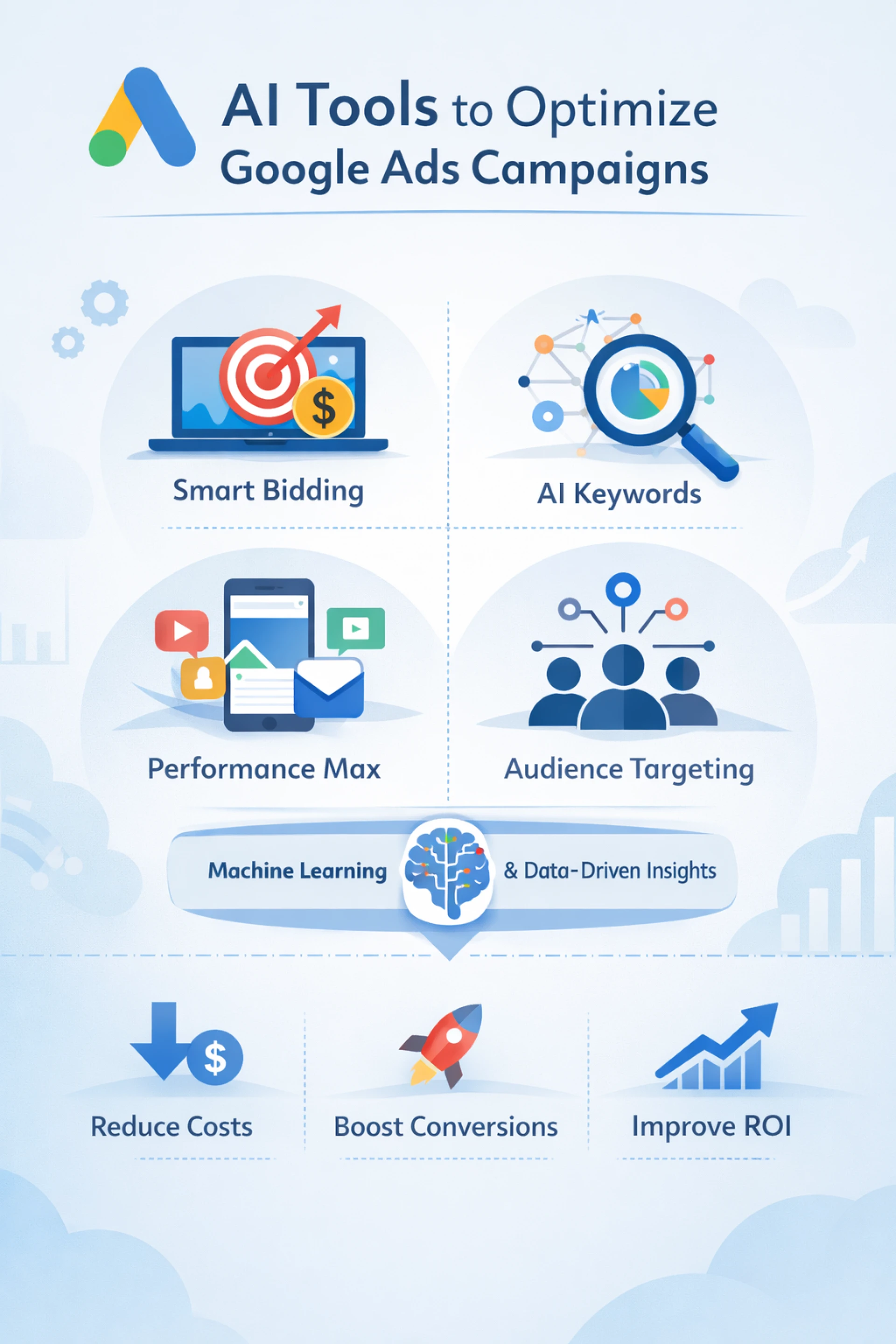
Smart Bidding is one of the most powerful AI tools inside Google Ads. It uses machine learning to automatically set bids for each auction based on the likelihood of conversion.
How Smart Bidding Works
Every time a user searches on Google, an auction happens in milliseconds. Smart Bidding analyzes multiple signals such as:
- User device
- Location
- Time of day
- Search intent
- Past behavior
- Conversion history
Based on these signals, it decides how much to bid for that specific user.
Types of Smart Bidding Strategies
Target CPA focuses on getting conversions at a specific cost.
Target ROAS aims to generate maximum revenue for a set return.
Maximize Conversions helps get the highest number of conversions within your budget.
Maximize Conversion Value focuses on high-value actions.
When used correctly, Smart Bidding can significantly improve campaign efficiency. However, it needs proper conversion tracking and enough data to work well.
AI-Powered Keyword Optimization
Keywords are still the backbone of Search campaigns, but AI has changed how keyword optimization works.
Broad Match with AI
Earlier, broad match keywords were risky because they triggered irrelevant searches. Today, AI-powered broad match uses intent-based targeting instead of just keyword matching.
Google’s AI understands:
- Search context
- User intent
- Semantic meaning
This allows broad match to discover high-performing search terms that manual keyword lists might miss.
Search Term Analysis Using AI
AI continuously analyzes search term reports and identifies patterns that lead to conversions. Over time, it automatically prioritizes better-performing queries and reduces exposure to low-quality traffic.
This helps campaigns scale without constantly adding and removing keywords manually.
AI in Responsive Search Ads
Responsive Search Ads are another strong example of AI in action. Instead of creating one static ad, you provide multiple headlines and descriptions. Google’s AI then tests different combinations to find the best-performing versions.
How AI Optimizes Ads
AI learns which headline works best with which description for different users. Over time, it shows the most effective combinations based on:
- Search intent
- Device
- Location
- Past performance
This results in higher click-through rates and better Quality Score.
Best Practice
To help AI perform well:
- Write clear, benefit-focused headlines
- Avoid repeating the same message
- Include keywords naturally
- Let AI test freely instead of over-pinning elements
Performance Max Campaigns and AI
Performance Max is one of the most AI-driven campaign types in Google Ads. It uses automation across Search, Display, YouTube, Discover, Gmail, and Maps.
How Performance Max Uses AI
AI decides:
- Where your ads should appear
- Which audience to target
- Which creative to show
- Which bid to place
It uses your conversion goals and signals to optimize performance across all Google platforms.
When to Use Performance Max
Performance Max works best when:
- You have clear conversion tracking
- You want to scale campaigns
- You have strong creatives and assets
- You want cross-channel visibility
Many advertisers see strong results when Performance Max is set up and optimized correctly, especially with guidance from the best google ad agency indore.
AI-Based Audience Targeting
Audience targeting has become smarter with AI. Instead of targeting only basic demographics, Google now uses predictive models.
Types of AI-Driven Audiences
In-market audiences identify users actively researching products or services.
Affinity audiences target users based on long-term interests.
Custom segments allow AI to build audiences based on keywords, URLs, and apps.
Remarketing audiences use past behavior to predict future actions.
AI continuously refines these audiences based on performance data, improving accuracy over time.
Using AI for Remarketing Optimization
Remarketing is one of the highest ROI strategies in Google Ads, and AI makes it even more powerful.
AI analyzes:
- Time since last visit
- Pages viewed
- Actions taken
- Device usage
- Conversion probability
Based on this, it decides when and where to show ads to bring users back.
This results in better conversion rates and lower cost per acquisition compared to cold traffic.
AI Tools for Conversion Tracking and Attribution
Accurate data is critical for AI optimization. Without proper tracking, AI cannot make good decisions.
AI-Powered Attribution Models
Google Ads uses data-driven attribution to assign value to different touchpoints in the customer journey. AI analyzes multiple conversion paths to understand what really contributes to a sale or lead.
This helps advertisers:
- Understand the role of each keyword
- Measure the impact of Display and YouTube ads
- Optimize budgets more effectively
Using AI Insights for Campaign Optimization
Google Ads provides AI-generated insights that highlight trends, performance changes, and opportunities.
These insights help you:
- Identify sudden drops or spikes in performance
- Discover new growth opportunities
- Understand changes in user behavior
- Adjust strategy proactively
Instead of digging through reports manually, AI highlights what matters most.
AI and Landing Page Optimization
AI does not stop at ads. It also affects landing page performance.
Google analyzes landing page experience to determine Quality Score. Pages that load fast, are mobile-friendly, and match ad intent perform better.
AI-driven tools can help test:
- Headlines
- Call-to-action buttons
- Page layouts
- Content structure
Better landing pages mean higher conversion rates and better ad efficiency.
Common Mistakes When Using AI in Google Ads
Many advertisers fail to get results from AI because they misuse it.
Common mistakes include:
- Not setting up conversion tracking properly
- Changing strategies too frequently
- Limiting AI with too many restrictions
- Expecting instant results without enough data
- Using automation without understanding goals
AI needs time, data, and clear objectives to perform well.
Human Control Still Matters
AI is powerful, but it is not fully automatic success. Human expertise is still required to:
- Set the right goals
- Choose the right strategy
- Create strong ad copy
- Analyze business-level results
- Make strategic decisions
The best results come from combining AI automation with human strategy and experience. This is why businesses working with a skilled google ad agency often outperform those who rely only on automation without direction.
How Small Businesses Can Use AI Effectively
Small businesses can benefit greatly from AI even with limited budgets.
They should:
- Start with Smart Bidding
- Focus on high-quality conversion tracking
- Use Responsive Search Ads
- Leverage remarketing
- Avoid over-complicating campaigns
AI helps small businesses compete with larger brands by making smarter decisions automatically.
The Future of AI in Google Ads
AI will continue to play a bigger role in advertising. Google is moving toward:
- Fewer manual controls
- More goal-based optimization
- Greater use of first-party data
- Deeper automation across channels
Businesses that adapt early will have a competitive advantage.
Final Thoughts
AI tools have changed how Google Ads campaigns are planned, executed, and optimized. From Smart Bidding and responsive ads to advanced audience targeting and attribution, AI helps advertisers get better results with less manual effort.
However, AI is not a shortcut. It works best when supported by strong strategy, accurate data, and continuous optimization. Businesses that understand this balance achieve long-term success and sustainable growth.
Companies that partner with the best google ad agency indore often see faster learning, better performance, and higher ROI because AI is used with clear goals and expert guidance.
By learning how to use AI tools properly, you can turn Google Ads into a powerful growth engine for your business.