Temperature control plays a critical role in modern manufacturing. From plastic processing and packaging machinery to industrial ovens and automated production lines, maintaining the correct temperature helps businesses achieve consistent product quality and dependable equipment performance. Even a small deviation from the required temperature can affect material properties, production efficiency, and operating costs.
For this reason, choosing suitable industrial temperature measurement equipment is an important engineering decision. A reliable temperature sensors manufacturer can help industrial buyers identify sensor configurations that match their operating conditions, measurement requirements, and equipment design.
However, selecting a sensor involves more than comparing prices or choosing a familiar product type. Engineers must consider temperature range, response time, measurement accuracy, installation conditions, and compatibility with industrial controllers.
Understanding these factors allows manufacturers to make informed purchasing decisions and build more reliable temperature monitoring systems.
Understanding the Role of Industrial Temperature Sensors
Industrial temperature sensors detect temperature changes and convert them into signals that measuring instruments or controllers can interpret. These measurements help operators monitor process conditions, regulate heating equipment, and identify unexpected temperature variations.
In an industrial heating system, for example, a sensor measures the temperature at a designated point. The controller compares the measured value with the required setpoint and adjusts the heating output according to its control strategy.
This relationship between sensing and control is essential in applications where temperature consistency affects production results.
Common applications include:
- Plastic injection moulding and extrusion equipment
- Industrial ovens and heating chambers
- Packaging and heat-sealing machinery
- Process heating equipment
- Manufacturing automation systems
- Equipment temperature monitoring
The effectiveness of a temperature monitoring system depends on the suitability of its components and the accuracy of the installation. Even a high-quality sensor may provide misleading readings if it is positioned incorrectly or connected to incompatible instrumentation.
Types of Temperature Sensors Used in Manufacturing
Different sensing technologies serve different industrial purposes. Understanding their characteristics helps engineers identify suitable solutions for specific processes.
RTD Temperature Sensors
Resistance Temperature Detectors, or RTDs, measure temperature through changes in electrical resistance. Platinum-based RTDs are commonly used where stable and repeatable measurements are important.
PT100 and PT1000 are two widely recognized RTD configurations. A PT100 has a nominal resistance of 100 ohms at 0°C, whereas a PT1000 has a nominal resistance of 1,000 ohms at the same temperature.
RTDs are frequently considered for process monitoring, controlled heating systems, and industrial equipment requiring consistent measurements.
Their performance depends on the sensing element, probe construction, wiring arrangement, and measuring instrument. Buyers should verify these factors before selecting an RTD for a particular application.
Thermocouple Sensors
Thermocouples generate a measurable voltage through the thermoelectric effect involving two dissimilar conductors. The resulting signal can be used to determine temperature when interpreted with the appropriate instrumentation.
Type K and Type J thermocouples are common examples in industrial temperature measurement. Their suitability depends on the required operating range, environment, materials, and installation conditions.
Thermocouples are used in many heating applications because they are available in a wide variety of configurations. They can be suitable for industrial ovens, heating equipment, and selected manufacturing processes involving elevated temperatures.
Correct thermocouple selection, polarity, extension wiring, and controller configuration are essential for dependable readings.
Infrared Temperature Sensors
Infrared sensors measure thermal radiation emitted by an object without requiring direct physical contact. This can be useful when the measured material is moving, difficult to reach, or unsuitable for contact measurement.
However, infrared measurement requires careful consideration of surface emissivity, viewing distance, angle, and environmental interference. The sensor must be suitable for the material and conditions being monitored.
Choosing between RTDs, thermocouples, and infrared sensors should therefore begin with the application requirements rather than a general assumption that one technology is always better.
Five Factors to Consider Before Choosing a Temperature Sensor
1. Operating Temperature Range
The first step is to determine the minimum, normal, and maximum temperatures expected during operation. Short-duration temperature peaks should also be considered.
A sensor selected without understanding the full operating range may produce unreliable measurements or experience premature failure.
Engineers should evaluate the complete assembly, including the sensing element, sheath, insulation, cable, and connection components. Each part must be appropriate for its exposure to heat and surrounding conditions.
2. Measurement Accuracy and Repeatability
Accuracy describes how closely a measurement corresponds to the actual temperature, while repeatability concerns the consistency of measurements under the same conditions.
These characteristics are important when manufacturing processes depend on closely controlled thermal conditions. For example, inconsistent temperature readings in a heat-sealing process may make it more difficult to maintain repeatable packaging results.
Buyers should review the sensor specifications alongside the capabilities of the measuring instrument and controller. The complete measurement system determines the practical result.
3. Response Time
Response time indicates how quickly a sensor reacts when the temperature changes. Applications involving rapid thermal fluctuations may require a different sensor design from processes where temperature changes gradually.
Probe dimensions, sensing element construction, sheath thickness, and contact with the measured material all influence response time.
Selecting a sensor solely because it is compact or inexpensive may not satisfy the response requirements of a fast-moving manufacturing process.
4. Installation and Environmental Conditions
The installation location can significantly influence measurement quality. A sensor positioned too close to a heat source, too far from the actual process, or in an unrepresentative location may not provide useful feedback.
Industrial environments may also expose sensors to vibration, moisture, chemicals, mechanical stress, or repeated heating and cooling cycles.
Before selecting a temperature sensor manufacturer in India, industrial buyers should establish the required probe dimensions, mounting method, connection type, and environmental protection requirements.
Providing these details during the enquiry process can help reduce compatibility problems.
5. Controller Compatibility and Maintenance
A sensor must communicate correctly with the connected controller or monitoring instrument. RTD inputs, thermocouple inputs, wiring configurations, and signal requirements are not universally interchangeable.
Maintenance requirements also deserve attention. Accessibility, replacement procedures, calibration needs, and inspection schedules can affect long-term operating costs.
A well-selected sensor should support the measurement objective while remaining practical to install, inspect, and maintain.
Why Temperature Measurement Matters in Industrial Heating
Industrial heating systems depend on accurate feedback to maintain suitable operating conditions. The heater provides thermal energy, while the sensing and control system helps regulate how that energy is applied.
Consider a plastic processing machine. If the measured temperature differs from the actual process temperature, the controller may adjust heating incorrectly. Depending on the application, this can contribute to inconsistent material flow, surface defects, or dimensional variation.
Similar challenges can occur in industrial ovens, packaging machines, and other thermal processing equipment.
Proper sensor placement, compatible controllers, and appropriate maintenance practices help reduce these risks. Engineers should also investigate unusual readings rather than immediately assuming that the sensor itself has failed. Wiring faults, poor connections, controller configuration, and installation issues can produce similar symptoms.
This systems-based approach helps businesses identify the underlying cause and make more effective maintenance decisions.
Choosing Temperature Sensor Manufacturers in India
When evaluating temperature sensor manufacturers in India, procurement managers should consider technical documentation, product suitability, quality processes, and supplier communication.
Product documentation should clearly identify the sensor type, operating limits, dimensions, connection arrangement, and other relevant specifications. Where the application requires calibration records or traceability documentation, buyers should confirm their availability before placing an order.
Customization may also be important when standard sensor dimensions do not match existing equipment. Depending on the manufacturer's capabilities, requirements may involve probe length, mounting arrangements, sheath materials, or connector configurations.
Industrial buyers should provide accurate application details and request clarification whenever specifications are incomplete.
A supplier's ability to understand the measurement objective is particularly valuable when a sensor must integrate with existing heating equipment or automation systems. Comparing suppliers on technical suitability, documentation, and lifecycle requirements can support a more informed purchasing decision.
Nexthermal and Industrial Temperature Solutions
Nexthermal provides industrial heating solutions, including temperature sensors, custom heating elements, and controllers. Based in Bengaluru, Karnataka, the company serves industrial requirements associated with thermal applications.
Temperature sensing and heating control work together to support consistent manufacturing processes. A suitable sensor provides measurement feedback, while the control system uses that information to regulate operation according to the application's requirements.
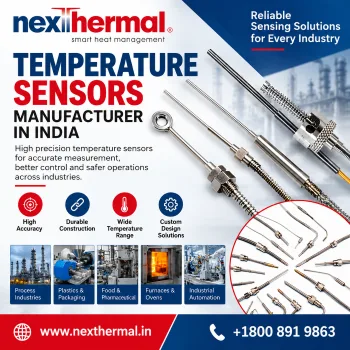
Businesses researching a temperature sensors manufacturer can explore Nexthermal's temperature sensors to review the available product information and assess its relevance to their equipment requirements.
For additional company information, visit the About Us page. Industrial buyers can also contact the team to discuss their application and clarify product specifications.
Frequently Asked Questions
What is the purpose of an industrial temperature sensor?
An industrial temperature sensor measures the temperature of equipment, materials, or processes. Its readings help operators monitor conditions and support temperature control.
Which temperature sensor is suitable for manufacturing equipment?
The appropriate sensor depends on the temperature range, accuracy requirements, response time, environmental conditions, and controller compatibility. RTDs and thermocouples are common options for industrial applications.
How can businesses select a suitable temperature sensor manufacturer?
Review product specifications, construction options, technical documentation, quality processes, and application support. Confirm that the proposed sensor matches the intended installation.
Why is sensor placement important?
Incorrect placement can cause the sensor to measure a temperature that does not represent the actual process. Proper positioning improves the usefulness of measurement feedback and temperature control.
Industry Perspective
As manufacturing processes become more automated, reliable temperature measurement remains an important part of production control and equipment monitoring. Choosing a suitable sensor requires attention to the entire application, including the measurement point, installation method, controller, and maintenance requirements.
For industrial businesses, a careful selection process can help reduce avoidable measurement problems and support more consistent operating conditions. Evaluating technical specifications before purchasing is a practical way to identify a solution that meets both current process requirements and long-term operational needs.
To explore available industrial temperature sensing options
Call: 1800 891 9863
Visit Our Website: https://www.nexthermal.in/
Request a quote: https://www.nexthermal.in/contact/
Product Page: https://www.nexthermal.in/temperature-sensors/
Connect With Us
Facebook: https://www.facebook.com/nexthermal.usa/
Instagram: https://www.instagram.com/nexthermal/
YouTube: https://www.youtube.com/@nexthermal
Pinterest: https://in.pinterest.com/nexthermal/
More Products:
Electric Heating Elements manufacturer | cartridge heating element | coil heaters manufacturer | temperature sensors manufacturer | tubular heaters manufacturer | temperature controller manufacturers | Engineering services provider in india | Ceramic Infrared Heater manufacturer |Temperature Control Panel manufacturer | Heating Coil Element manufacturer | Tubular Heater manufacturer | Temperature Sensors manufacturer | Temperature Controller manufacturer