
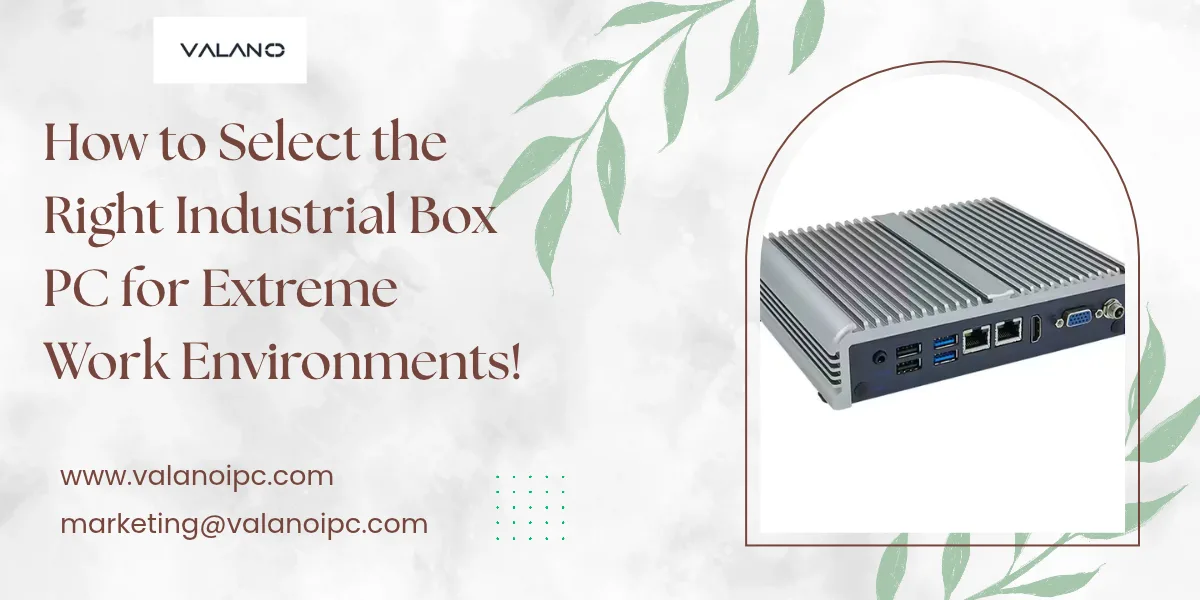
In manufacturing, energy, automation, and countless other sectors, the environment is far from forgiving. From blistering heat and bone-chilling cold to heavy dust, moisture, and shock, the harshest industrial settings demand technology that won’t let you down when the going gets tough. At the heart of today’s sophisticated control systems, monitoring networks, and automated machinery sits an unsung hero: the industrial box pc.
Selecting the right industrial box pc for these extreme work environments is more than choosing impressive specs; it’s a strategic decision with direct implications for uptime, productivity, safety, and total cost of ownership. Standard office computers and many consumer devices simply aren’t built for the challenge. They fail where rugged solutions thrive — costing you hours or even days of lost productivity and expensive emergency repairs.
How to Select the Right Industrial Box PC for Extreme Work Environments
1. Understanding the Demands of Extreme Work Environments
Before choosing an industrial box pc, it's crucial to define what “extreme” means in your context. For some, it’s temperatures dropping below -20°C or soaring above 60°C; for others, it’s persistent vibration, blowing dust, caustic chemicals, or humidity and direct water sprays.
- Oil and Gas Fields: Corrosive atmospheres, explosion risks, harsh weather.
- Mining and Heavy Industry: Massive shock, vibration, fine conductive dust, power surges.
- Food and Beverage: Frequent washdowns, high humidity, chemical cleaners, temperature swings.
- Outdoor and Transportation: Wide temperature ranges, rain, snow, UV exposure, electromagnetic interference.
- Factory Automation: Legacy connectivity needs, network integration, and mounting flexibility.
These environmental challenges aren’t just hypothetical — they’re daily battlefields for your hardware. That’s why success begins with an industrial box pc engineered for your real-world conditions.
2. What Makes an Industrial Box PC Different?
An industrial box pc stands apart from standard commercial computers in several ways:
- Rugged Construction: Housings made from durable metals or high-impact plastics, no moving parts, and sealed connectors.
- Thermal Management: Designed to dissipate heat passively (fanless) or survive with minimal airflow in tight spaces.
- Long Lifecycle Components: Parts with longer supplier availability, lower failure rates, and consistent performance.
- EMC and Safety Certifications: Compliance with industry-specific directives (CE, FCC, UL, RoHS, ATEX/IECEx, etc.).
- Flexible Mounting: DIN rail, panel, wall, or custom brackets for any installation.
Most importantly, an industrial box pc is not just tough — it’s reliable, withstanding years of continuous operation in places where maintenance windows may be rare.
Also Read - What Is an Industrial PC? A Complete Guide
3. Essential Selection Criteria for Extreme Conditions
Let’s break down the key technical factors that will guide your decision.
a. Environmental Ratings (IP, NEMA, etc.)
- IP Ratings (Ingress Protection): Defines dust and water resistance. For example, IP65 protects against dust and low-pressure water jets; IP67 is submersible.
- NEMA Ratings: Common in North America, also covers protection from elements and internal corrosion.
- ATEX/IECEx Certifications: Required in hazardous, explosive gas environments.
Match your box pc’s certification precisely to your deployment environment — under- or over-specification can cause cost and operational headaches.
b. Temperature Range & Thermal Design
- Standard box pcs may cope with 0–40°C; but in extreme locations, you’ll need guaranteed operation from -40°C up to +70°C.
- Fanless systems dissipate heat through chassis fins, eliminating dust ingress and moving parts.
- Heater or thermal pad options ensure cold starts in subzero environments.
c. Shock, Vibration, and Mechanical Stress
In heavy machinery, transportation, or outdoor installations, units may face repeated shocks and constant vibration.
- Look for MIL-STD-810G compliance for shock/vibration testing.
- Secure mounting kits and ruggedized enclosures safeguard against displacement or failures.
d. Dust & Moisture Protection
Industrial box pcs often operate where fine dust or water is present.
- Sealed connectors and glands keep contaminants out.
- Positive pressure venting prevents condensation.
e. Corrosion and Chemical Resistance
For food, pharma, or chemical plants, stainless or treated external finishes resist damage from cleaners and caustic agents.
4. Processing Power and Hardware Considerations
Fanless vs. Fan-cooled
- Fanless: Lower power, silent, no moving parts. Ideal for dusty, dirty, or vibration-prone sites.
- Fan-cooled: Necessary only for higher power CPUs or discrete GPU systems (AI, vision, inferencing).
Processor Choices
- Intel Atom/Celeron: Efficient, long lifecycle, modest power.
- Intel Core i3/i5/i7 or AMD Ryzen: More compute muscle for analytics, machine vision, or multiple applications.
- ARM: Low power, excellent for gateways and edge nodes.
RAM, Storage, and Expansion
- Sufficient RAM (4–32GB+) for application needs.
- SSD/HDD Choices: SSD (NVMe/SATA) for shock resistance and speed, larger HDDs for NAS, data logging, or video.
- Field-swappable options for maintenance.
- PCIe/mPCIe/M.2 slots for I/O, wireless, graphics, or custom expansion.
5. Connectivity and I/O Capabilities
Standard and Legacy Ports
- Multiple USB, Ethernet (1G/2.5G/10G), DisplayPort/HDMI/VGA.
- Serial COM (RS-232/422/485) for PLCs and legacy devices.
- Isolated digital I/O for sensors, relays, or alarms.
Fieldbus & Industrial Network Support
- Profibus, Modbus, CAN bus, EtherCAT, PROFINET, etc.
- Optional add-in cards for protocol flexibility.
Wireless Communications
- Dual-band WiFi, LTE/5G, Bluetooth, Zigbee, proprietary radios for remote or mobile uses.
- External antenna ports for maximum range.
Remote Monitoring & Control
- Out-of-band management for remote troubleshooting and firmware upgrades.
- Support for secure VPN or encryption.
6. Reliability, Serviceability, and Maintenance
Industrial downtime is costly, so your industrial box pc must maximize uptime.
- High MTBF: Units rated for 100,000+ hours.
- Tool-free maintenance panels for SSD or RAM swaps.
- Remote software updates to minimize on-site intervention.
- Long manufacturer warranties and global spares availability.
Also Read - Industrial Box PC: The Ultimate Solution for Rugged Computing Environments!
7. Power Supply and Energy Management
Extreme sites may have dirty, unstable, or non-standard power.
- Wide voltage input (e.g., 9-36V; 24/48VDC)
- Integrated surge and ESD protection
- Redundant power supplies for mission-critical apps
- Battery backup/UPS modules to ride out outages
8. Integrated Security Features
Industrial networks are increasingly targets for cyber threats.
- TPM modules and hardware encryption for device security.
- Secure Boot and BIOS-level protection.
- Physical port locks to prevent unauthorized access.
- Remote lock/wipe capability for mobile/deployed units.
9. Application-specific Considerations
Automation & Control
Real-time OS support, low-latency I/O for sequencing or process management.
Machine Vision & AI
Multiple GPUs or AI accelerator cards, high-throughput data buses, camera integration.
Edge Computing & IIoT
Data collection, protocol bridging, analytics before sending data to the cloud.
Hazardous Locations
Units certified for ATEX, IECEx, or UL Class 1 Division 2 installations.
10. Common Mistakes to Avoid
- Under-specifying environmental protection: Don’t trust office-grade hardware for field use.
- Ignoring maintenance access: Non-serviceable designs slow repairs.
- Failing to match network/protocol needs: Not all industrial box pcs support all fieldbus or legacy standards.
- Choosing based on price alone: True cost comes from downtime, failures, and replacements.
11. Why Trust ValanoIPC for Industrial Box PC Solutions?
ValanoIPC stands at the forefront of industrial computing, providing:
- Extensive experience with real-world deployments in harsh conditions
- Broad product range for every application—from compact gateways to AI-enabled platforms
- Deep support for legacy and cutting-edge protocols
- Rapid response technical support, customization, and long warranty terms
With ValanoIPC, you’re investing in peace of mind and world-class reliability.
Selecting the right industrial box pc for extreme work environments is foundational to reliable automation, monitoring, and data collection. The best solution is one matched precisely to your real-world operational risks and performance goals—balancing ruggedness, processor power, connectivity, and serviceability.
Frequently Asked Questions (FAQ)
Q1: What is an industrial box pc?
A: An industrial box pc is a rugged, purpose-built computer designed to perform reliably in harsh industrial environments. It typically features a tough housing, fanless thermal design, industrial-grade components, and extensive I/O options.
Q2: What environmental ratings should I look for?
A: Match your deployment to the appropriate IP (Ingress Protection) or NEMA rating, ensuring protection against dust, water, and, if needed, explosive atmospheres.
Q3: How do I ensure my industrial box pc will operate in extreme temperatures?
A: Choose units rated and tested for your temperature extremes—often achieved with fanless cooling, thermal pads, and cold-start heaters.
Q4: Can industrial box pcs run my existing applications?
A: Most support standard Windows or Linux operating systems and are backward-compatible with legacy software. Check hardware requirements to ensure compatibility.
Q5: What about support and upgrades in the field?
A: ValanoIPC offers global support, hot-swappable components, remote management tools, and long lifecycle spares for effortless maintenance.
Q6: Are industrial box pcs secure?
A: With features like TPM, secure boot, encrypted SSDs, and BIOS/UEFI passwords, security is built in from hardware up.
Q7: How do I choose between fanless and fan-cooled models?
A: Fanless is best for dusty, dirty, or vibration-prone environments; use fan-cooled only for very high-performance requirements where airflow is clean and controlled.
Q8: Do industrial box pcs support wireless communication?
A: Yes. Models are available with WiFi, 4G/5G, Bluetooth, Zigbee, and even LoRa support, with ruggedized external antenna options.