A pipe entry may look like a simple opening within a wall, foundation or structure, but it represents a critical connection point between external services and protected infrastructure.
Every project presents different conditions. A water treatment facility may require protection against groundwater exposure, while an industrial building may involve multiple pipes and cables passing through limited spaces. Underground utility connections may also face changing environmental conditions throughout their service life.
Because of these differences, selecting a sealing solution requires more than matching the pipe diameter. The surrounding structure, installation environment and future maintenance requirements all influence the most suitable approach.
A well-selected sealing system helps protect pipe and cable entries while supporting reliable infrastructure performance.
Understanding Pipe Entry Conditions Before Selecting a Seal
Pipe and cable penetrations are installed across a wide range of applications, including utility buildings, treatment facilities, industrial structures and infrastructure projects.
The conditions around each entry point can vary depending on the type of service, structural arrangement and environmental exposure.
A sealing solution needs to accommodate the actual installation situation rather than relying on a single standard approach.
During planning, teams need to understand:
- The type of pipe or cable passing through the entry
- The available installation space
- The surrounding structural conditions
- The level of protection required
Considering these requirements at the design stage helps reduce installation challenges and supports long-term sealing performance.
Modular Sealing for Flexible Pipe Entry Arrangements
Modern infrastructure projects often involve multiple services passing through structures. Pipe sizes, cable requirements and penetration layouts may change depending on the application.
A fixed sealing arrangement may not always provide the flexibility needed for different installation conditions.
Modular pipe sealing systems provide an adaptable solution by using configurable sealing elements that can be arranged according to the specific penetration requirements.
Modular pipe seals (GKD) support applications where flexible sealing arrangements are required for pipe and cable entries.
These systems are suitable where projects require adaptable solutions for:
- Different pipe dimensions
- Multiple service entries
- Changing installation requirements
- Future modifications
A modular approach allows sealing configurations to be developed around the actual site conditions rather than forcing the application into a fixed arrangement.
Mechanical Sealing for Standard Pipe Entry Applications
Many projects involve standard pipe and cable penetrations where dependable sealing performance is required.
Mechanical pipe seals use compression-based sealing methods to create a controlled connection around services passing through structural openings.
These sealing solutions help maintain protection against water and environmental exposure while supporting reliable service connections.
Hauff-Technik mechanical pipe seals (HSD) support applications where controlled sealing around standard pipe entries is required.
The selection of a mechanical sealing solution depends on the relationship between the pipe dimensions, installation conditions and structural requirements.
A suitable sealing approach helps maintain the integrity of the entry point while supporting easier installation.
Customised Sealing Where Standard Solutions Are Not Enough
Some projects involve penetration conditions that cannot be addressed through standard sealing arrangements.
Unusual pipe dimensions, limited installation space or specific construction requirements may require a solution designed around the individual application.
Customized pipe seals provide flexibility where standard configurations may not fully meet project needs.
Customised pipe seals (HRD) support applications where sealing requirements need to be adapted according to specific installation conditions.
Customised approaches help address complex situations by considering the actual requirements of the structure, service arrangement and surrounding environment.
Supporting New Utility Requirements Beyond Traditional Pipe Entries
Infrastructure development continues to introduce new applications that require reliable installation solutions.
Electric vehicle charging infrastructure is one example where foundation systems play an important role in supporting stable and consistent installation.
Universal charging station foundations provide a prepared installation approach for charging stations and charging pedestals, helping simplify construction activities and support future expansion.
These solutions demonstrate how infrastructure requirements continue to evolve beyond traditional pipe and cable applications.
Selecting Sealing Solutions Based on Real Project Requirements
The performance of a pipe entry sealing system depends on how effectively it matches the conditions of the installation.
A solution suitable for one project may not provide the same performance in another environment. Understanding the application before selection helps create a more reliable and practical installation.
As infrastructure projects continue to focus on durability, water protection and reliable utility connections, selecting the right sealing approach has become an important part of project planning.
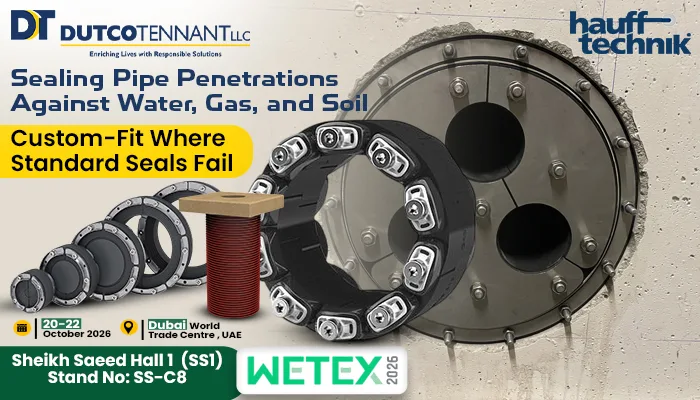
These considerations around pipe entry protection, sealing systems and infrastructure reliability will be part of the discussions at WETEX Exhibition 2026. Dutco Tennant LLC will participate at Sheikh Saeed Hall 1 (SS1), Stand SS-C8, with solutions supporting pipe entry sealing, utility connections and infrastructure applications.
Improving Infrastructure Reliability Through Better Sealing Decisions
Pipe entries may represent a small part of a construction or utility project, but their performance can influence the reliability of the complete structure.
From modular sealing systems to mechanical and customised solutions, selecting the correct approach helps address different installation conditions and long-term protection requirements.
By evaluating pipe entry conditions carefully, project teams can develop infrastructure connections that support durability, easier maintenance and reliable performance throughout the asset lifecycle.