Scalable data center infrastructure is no longer optional—it is essential for organizations operating in today’s digital-first world. Businesses now depend on AI workloads, cloud-native applications, real-time analytics, streaming platforms, and billions of connected IoT devices. These technologies create highly dynamic and unpredictable demand patterns that traditional data centers were never built to support. Infrastructure designed for static workloads can quickly become overwhelmed, leading to slow performance, outages, poor user experience, and rising costs. To stay competitive, organizations need data center environments that can grow efficiently, securely, and without disruption.
At its core, scalability refers to the ability of infrastructure to expand or contract resources such as compute, storage, and networking without requiring major redesigns or downtime. Instead of replacing entire systems whenever demand rises, modern scalable environments allow businesses to add capacity incrementally. This provides agility, reduces overprovisioning, and helps organizations respond quickly to growth opportunities.
Today, enterprises increasingly favor horizontal scaling over traditional vertical scaling. Vertical scaling means upgrading an existing server with more CPU, memory, or storage, but it has physical and financial limits. Horizontal scaling adds more servers or nodes into a distributed environment, improving resilience and flexibility. If one node fails, workloads can shift to another with minimal impact.
Key Benefits of Scalable Infrastructure
- Improved Performance: Resources can be added quickly to meet workload spikes.
- Cost Efficiency: Pay for what you need instead of overbuilding capacity.
- High Availability: Redundant systems reduce downtime risks.
- Future Readiness: Supports AI, analytics, and next-generation workloads.
- Operational Flexibility: Easier expansion into new markets or services.
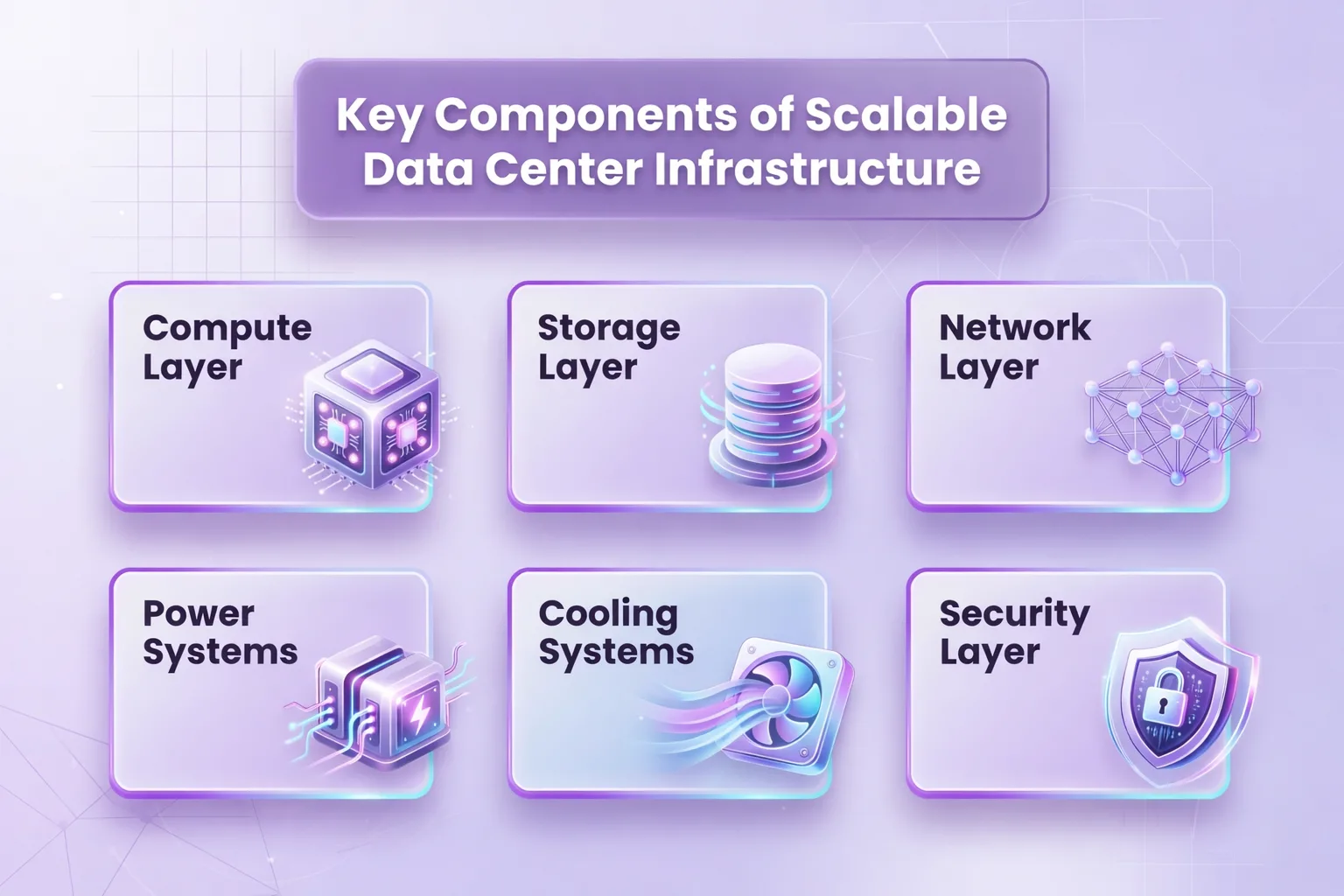
A scalable data center must be built across every layer of the stack:
Core Components of Scalability
- Compute: Virtualization, containers, and Kubernetes improve workload deployment and utilization.
- Storage: Software-defined and distributed storage systems expand on demand.
- Networking: SDN enables automation, bandwidth optimization, and low-latency performance.
- Power & Cooling: High-density racks, especially for GPU workloads, require advanced cooling systems.
- Security: Zero trust architecture protects expanding and distributed environments.
Successful scalability begins with strong capacity planning. Organizations must analyze current workloads, forecast growth, and understand peak versus average demand. Without planning, scaling can become reactive and expensive.
Many enterprises modernize using strategies such as:
- Lift-and-shift migration to newer infrastructure or cloud platforms
- Application refactoring for cloud-native performance
- Hyperconverged Infrastructure (HCI) for modular and simplified growth
A hybrid approach—combining on-premises data centers, colocation facilities, and public cloud—often delivers the best balance of scalability, cost control, and regulatory compliance. Businesses can keep sensitive workloads on-prem while using cloud resources for elasticity.
Automation also plays a major role. Infrastructure as Code (IaC), AI-driven monitoring, and predictive analytics help IT teams scale faster, reduce manual errors, and improve efficiency.
Ultimately, scalable data center infrastructure is not just about supporting growth—it is about building a resilient, adaptive, and innovation-ready foundation that can power business success for years to come. Read the full blog here.