You turn the key, and a new light glows on the dashboard. Or the brakes start to squeal. Or a mechanic hands you an estimate with a number that makes your stomach drop. Most drivers have been there, and most of us pay more than we need to because we feel rushed, uninformed, or unsure what to question.
Car repairs are rarely planned, which is exactly why they hurt. The good news is that the price on the first estimate is almost never the final word. With a clear process, you can cut real money from a repair bill without cutting corners on safety. Searching for car repair coupons is a smart first instinct, but coupons are only one piece of a bigger savings picture.
This guide walks you through the whole process in order: diagnosing the problem, comparing quotes, understanding what you're paying for, finding verified discounts, choosing parts wisely, and preventing the next big bill. Each step stands on its own, so you can jump to the one you need right now.
Step 1: Understand the Problem Before You Pay for a Fix
The most expensive mistake in car repair is paying to fix the wrong thing. Before you authorize any work, make sure you know what is actually wrong.
What to do:
- Write down the symptoms. Note when the problem happens (cold starts, braking, turning, highway speeds), what it sounds or feels like, and when it began. A specific description helps a technician diagnose faster, and time is money when labor is billed by the hour.
- Read the warning light correctly. A check engine light can mean anything from a loose gas cap to a failing catalytic converter. Many auto parts stores will read the trouble code for free, which gives you a starting point before you walk into a shop.
- Ask for the diagnosis in writing. A good shop will tell you what failed, how they confirmed it, and what the repair involves.
Why it saves money: A trouble code is a clue, not a verdict. Shops that replace parts by guessing can charge you for several fixes before finding the real cause. Knowing the symptom and the code lets you spot vague or inflated recommendations.
Step 2: Separate Urgent Repairs From Ones That Can Wait
Not every item on a repair list needs to be done today. Sorting the list by urgency is one of the fastest ways to lower a bill without taking risks.
Sort every recommended repair into three groups:
- Safety-critical (fix now): brakes, steering, tires with low tread or damage, suspension failures, fluid leaks that affect braking or engine cooling.
- Prevents bigger damage (fix soon): an overdue timing belt, a slow coolant leak, worn belts, low or dirty fluids.
- Comfort and cosmetic (can wait): a weak air conditioner in mild weather, minor trim damage, a worn interior piece.
Ask the technician directly: "What happens if I wait on this, and for how long is it safe?" An honest shop will give you a straight answer and will not pressure you.
Why it saves money: Spreading non-urgent repairs across several months lets you plan, shop around, and wait for discounts instead of paying everything at once at full price.
Step 3: Get at Least Three Written Estimates
Prices for the same repair can differ noticeably between a dealership, an independent shop, and a chain. Comparing quotes is the single most reliable way to avoid overpaying.
How to do it well:
- Call or visit three shops. Include at least one independent garage and, if your car is under warranty or very specialized, the dealership.
- Give each shop the same information: your car's year, make, model, mileage, and the exact diagnosis or symptoms.
- Ask for itemized, written estimates. A single lump-sum number makes comparison impossible.
- Compare the same job, not just the same price. Check whether quotes use the same type of parts and include the same warranty.
Why it saves money: A written estimate gives you leverage. It also protects you if the final bill drifts upward without your approval.
Step 4: Learn to Read an Estimate Line by Line
A repair estimate usually has four parts. Knowing what each one means helps you spot what is negotiable.
- Parts: The cost of replacement components. Shops often mark these up above what you would pay yourself.
- Labor: Typically billed using a standard time guide for each job multiplied by the shop's hourly rate. You can ask which rate and how many hours are being charged.
- Shop fees and supplies: Small charges for disposal, cleaners, or materials. They are normal in moderation, but ask for an explanation if they look high.
- Taxes and diagnostic charges: Some shops waive the diagnostic fee if you approve the repair there. It is worth asking.
Questions worth asking:
- Is this a flat fee or an hourly estimate?
- Are the parts new, remanufactured, or used?
- Does the quote include a warranty on parts and labor?
- Will you call me for approval if the cost changes?
Why it saves money: Most bill inflation happens in the gray areas, such as vague "misc" charges and unspecified parts. Clear line items remove that room.
Step 5: Find Verified Discounts Before You Book
This is where coupons and promo codes help. The key word is verified. An expired or fake code wastes your time and can push you toward a shop you would not otherwise choose.
Where to look:
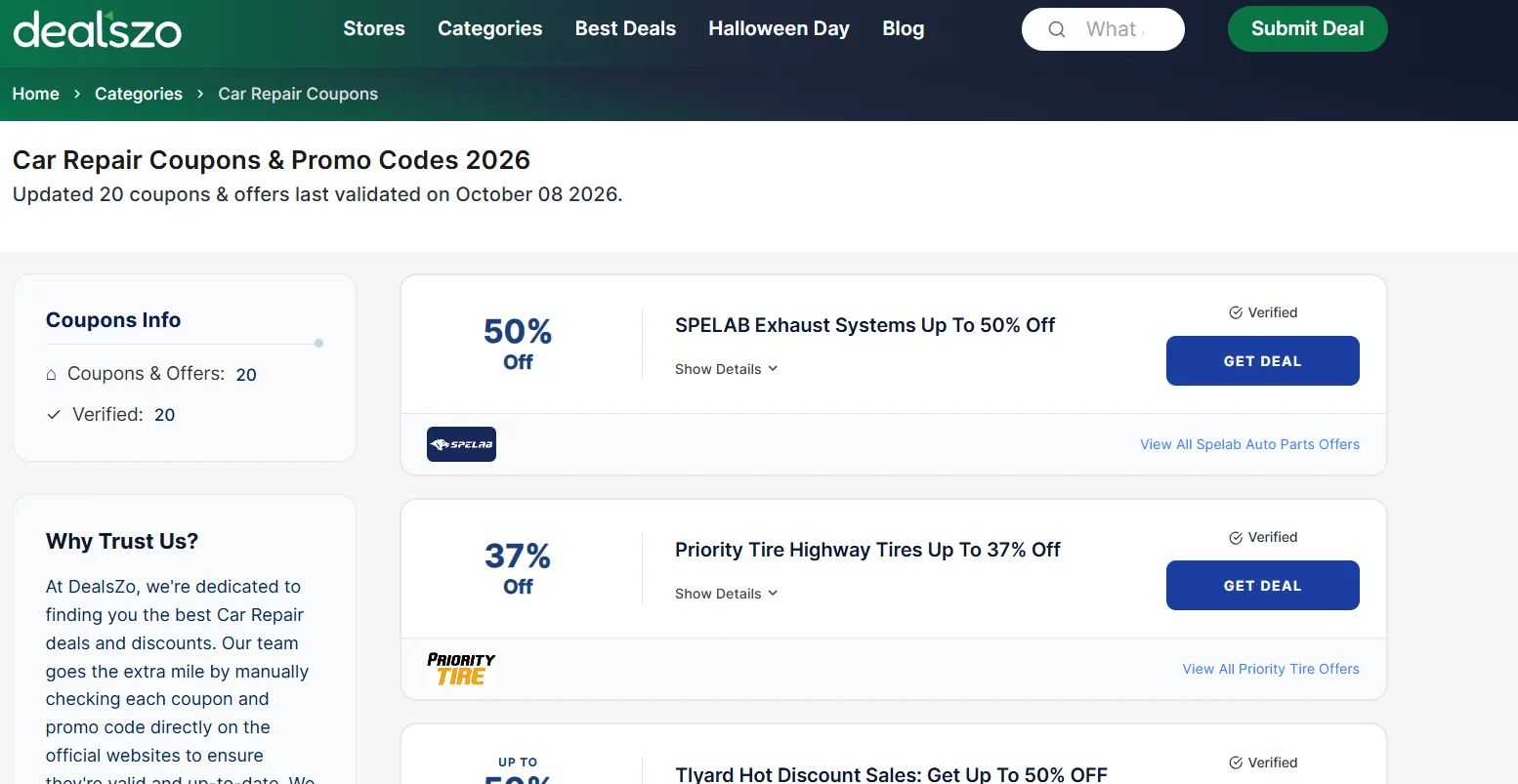
- Coupon sites that check offers manually. DealsZo, for example, states that its team verifies each offer on the official retailer site, and its auto section was last validated on October 8, 2026, with 20 verified offers listed.
- The shop's or retailer's own website. Many list seasonal specials, first-visit discounts, or email sign-up offers directly.
- Email sign-up welcome offers. Some retailers give a discount on your first order when you subscribe. One listing on DealsZo, for instance, offers $10 off a $75 order after an email sign-up.
- Free shipping thresholds. Parts retailers often waive shipping above a set order value, which can matter when you order heavy items.
Know what the deals actually cover. Many listings in the auto category are for parts, accessories, tires, and tools rather than labor at a repair shop. For example, current offers include discounted BMW replacement parts, highway tires, and a jump starter with a tire inflator, as well as free shipping on qualifying orders at an auto accessories retailer. Those deals help most when you buy parts yourself, do a repair yourself, or prepare an emergency kit. Always read the offer details before you click.
Before you pay, check three things:
- Does the offer need a code, or is the discount automatic at checkout?
- Are there exclusions (certain brands, sale items, or vehicle types)?
- Is the expiration date still ahead of you?
Why it saves money: A verified discount stacked on a fair price beats a discount on an inflated one. Always compare the final price after discounts and shipping, not the headline percentage.
Step 6: Decide Whether to Buy the Parts Yourself
Shops add a markup to parts, so supplying your own can lower the total. It is not always allowed or wise, so handle it carefully.
When it can work:
- The part is simple, standard, and easy to identify (filters, wiper blades, batteries, brake pads for many models).
- The shop agrees in advance to install customer-supplied parts.
What to confirm first:
- Ask whether the shop installs customer-supplied parts. Many do, some do not.
- Ask about the warranty. Shops often will not warranty labor on parts they did not supply. If the part fails, you may pay for the work twice.
- Verify fitment. Use your vehicle identification number (VIN) or exact year, make, model, and trim to match the part. A wrong part costs you time and return shipping.
- Keep the receipt. You will need it for returns and warranty claims.
Why it saves money: On parts-heavy jobs, the markup alone can be a meaningful share of the bill. On labor-heavy jobs, the savings are small and the risk may not be worth it.
Step 7: Choose the Right Type of Part
The type of part you choose can change the price dramatically. Each option has a place.
- OEM (original equipment manufacturer): Made by or for your car's manufacturer. Best fit and consistency, usually highest cost.
- Aftermarket: Made by other companies. Quality ranges from excellent to poor, so stick with well-reviewed brands. Often noticeably cheaper.
- Remanufactured: Used parts rebuilt to specification. Common for alternators, starters, and transmissions. A solid middle ground if backed by a warranty.
- Used or salvage: Taken from another vehicle. Lowest price, but the part's history is unknown. Best for body panels and non-critical components.
A practical rule: Spend more on parts tied to safety and reliability, such as brakes, tires, and steering components. Save on parts where a lower-cost option performs equally well, such as many filters, trim pieces, and body parts.
Why it saves money: Matching the part tier to the job avoids both overspending on premium parts you do not need and underspending on parts that fail early.
Step 8: Handle the Simple Jobs Yourself
Some maintenance tasks need only basic tools and a short video tutorial. Doing them yourself removes labor from the bill entirely.
Good beginner jobs:
- Replacing the engine air filter and cabin air filter
- Swapping wiper blades
- Replacing a headlight or taillight bulb
- Topping off washer fluid and checking tire pressure
- Replacing a dead battery on many vehicles
Basic tools worth owning: a tire pressure gauge, a portable inflator, a jump starter, a socket set, and a code reader. These pay for themselves the first time they spare you a tow or a service call.
Know your limits. Leave brakes, airbags, fuel systems, and anything involving high-voltage hybrid or electric components to professionals unless you are trained. A mistake there can cost far more than the labor you saved, and can put you at risk.
Why it saves money: Labor is often the largest part of a small repair. Handling the simple ones yourself frees up budget for the jobs that truly need a technician.
Step 9: Negotiate and Ask the Right Questions
Polite, informed questions often lead to better pricing. You do not need to be confrontational. You only need to be prepared.
Try these approaches:
- Mention a competing quote. "Another shop quoted this lower. Can you match it or explain the difference?"
- Ask about a price break for several repairs. Bundling jobs sometimes reduces overlapping labor, since a technician may already have the area disassembled.
- Ask about discounts. Some shops offer savings for first-time customers, seniors, students, military members, or members of auto clubs.
- Request your old parts back. This keeps everyone honest and confirms the part was actually replaced.
- Get the final price in writing before work starts. Ask to be contacted before any additional charges are approved.
Why it saves money: Many shops have flexibility they will not offer unless asked. A calm question costs nothing.
Step 10: Check for Warranties, Recalls, and Service Bulletins
Sometimes the best discount is a repair that costs you nothing.
Check these before you pay:
- Manufacturer warranty or extended warranty. Look at your coverage terms and your mileage.
- Open recalls. Enter your VIN on the official government recall lookup. Recall repairs at authorized dealers are free.
- Technical service bulletins (TSBs). These are manufacturer notes about known issues. Some manufacturers extend coverage or goodwill assistance for common problems even outside the warranty period.
- Previous repair warranties. If a prior shop repaired the same part recently, their warranty may cover the redo.
Why it saves money: A single phone call to a dealer or warranty provider can sometimes erase a bill entirely.
Step 11: Prevent the Next Big Repair
The cheapest repair is the one you avoid. Routine maintenance costs a fraction of what major failures cost.
A simple prevention routine:
- Follow the maintenance schedule in your owner's manual for oil changes, fluids, belts, and filters.
- Check tire pressure monthly and rotate tires on schedule. Properly inflated tires last longer and improve fuel economy.
- Act on small warnings. A faint noise or minor leak usually grows into a bigger problem.
- Keep service records. They help with diagnostics, warranty claims, and resale value.
- Keep an emergency kit with a jump starter, a tire inflator, and basic tools.
Build a repair fund. Even a small monthly transfer into a dedicated account turns a financial emergency into a manageable expense.
Why it saves money: Preventive care catches small issues while they are still cheap, and a repair fund keeps you from making rushed, expensive choices.
Quick Checklist: Before You Approve Any Repair
- I know what is wrong and how it was diagnosed.
- I have sorted the repairs into urgent and can-wait.
- I have at least three written, itemized estimates.
- I checked for verified coupons, promo codes, or free shipping.
- I know whether the shop uses OEM, aftermarket, or remanufactured parts.
- I checked for recalls, warranties, and service bulletins.
- I have the final price and warranty terms in writing.
Frequently Asked Questions
Can coupons really lower the cost of car repairs?
Yes, but how much depends on what the coupon covers. Many offers apply to parts, tires, tools, and accessories, while others apply to specific services at participating shops. Read the terms so you know whether the discount applies to parts, labor, or both.
Is it cheaper to go to a dealership or an independent shop?
Independent shops are often less expensive for routine work. Dealerships may be the better choice for warranty repairs, recalls, and complex model-specific issues. Compare written quotes to be sure.
Are aftermarket parts safe?
Reputable aftermarket brands can be as good as original parts. Choose well-reviewed brands, confirm fitment, and avoid the cheapest option for safety-critical components.
How do I know if a coupon is real?
Check the expiration date, read the exclusions, and look for a source that states it verifies offers on the retailer's official site. If the discount does not apply at checkout, compare the final price before you buy elsewhere.
What if I cannot afford a repair right now?
Ask the shop whether the repair can be split into stages, whether a lower-cost part is available, or whether a payment plan exists. Do not delay safety-critical repairs.
Final Thoughts
Saving money on car repairs is not about finding one magic trick. It comes from a repeatable process: understand the problem, rank what is urgent, compare written quotes, read the estimate carefully, use verified discounts, choose parts wisely, and prevent future problems. Each step trims a little from the bill, and together they can add up to substantial savings.
The next time a warning light comes on, you will not have to panic. You will have a plan.