
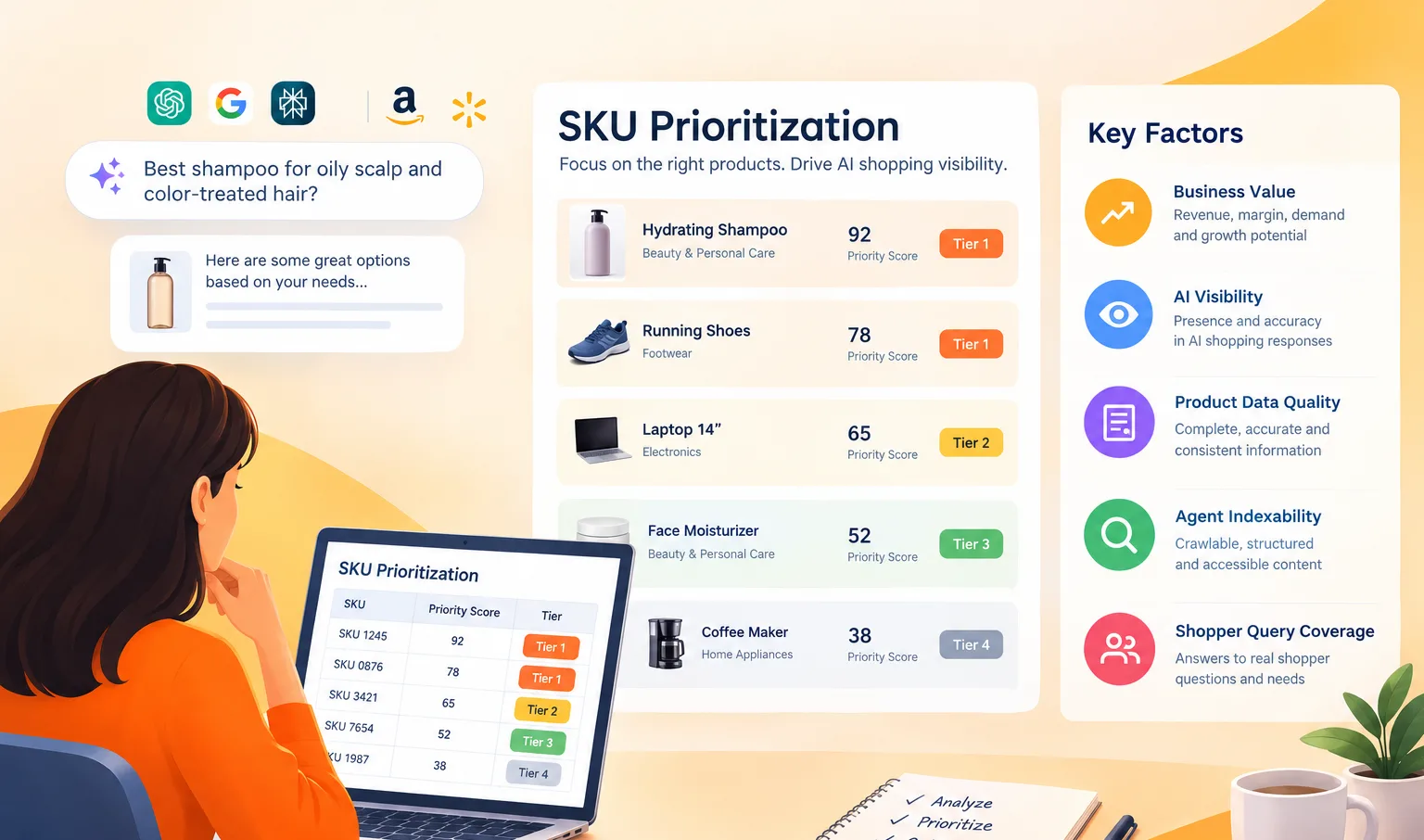
Prioritize SKUs for AI Shopping Optimization
As AI-powered shopping experiences become more common, brands face a new challenge: making sure their products can be discovered, understood, and recommended by AI shopping assistants.
From ChatGPT and Google AI Mode to Perplexity and retail-specific shopping assistants, these experiences are changing how shoppers research products and make purchase decisions. Instead of browsing through dozens of product pages, shoppers can describe what they need and receive recommendations based on their requirements.
For brands with hundreds or thousands of SKUs, optimizing every product at once can be expensive and time-consuming. Product descriptions, specifications, attributes, FAQs, and other content may all need improvement before products are ready for AI-driven discovery.
The solution is to prioritize SKUs based on business opportunity and AI shopping readiness.
A structured prioritization strategy helps brands identify which products need attention first, where optimization can have the greatest impact, and how to scale AI shopping optimization across their catalog.
Why SKU Prioritization Matters in AI Shopping
Traditional ecommerce optimization often focuses on search rankings, product page traffic, conversion rates, and marketplace performance. These metrics remain important, but AI shopping introduces another consideration: whether product information helps an AI system understand why a product is relevant to a shopper's needs.
Consider a shopper asking an AI assistant to recommend a shampoo for an oily scalp, frequent washing, and color-treated hair.
A product page that only says "advanced cleansing shampoo" provides limited information about whether it meets those needs. A page that clearly explains its intended hair type, cleansing properties, usage instructions, ingredients, and relevant limitations provides more useful information for evaluating the product.
The same principle applies across categories, from electronics and home appliances to food, beauty, and personal care.
However, not every SKU has the same commercial opportunity. Some products already perform well, some have incomplete product information, and others may have strong demand but limited visibility in AI shopping experiences.
Prioritization helps brands focus their resources where improvements are most worthwhile.
5 Factors to Consider When Prioritizing SKUs
1. Business Value and Sales Potential
Start with the products that matter most to the business.
SKUs with strong revenue contribution, healthy margins, growing demand, or strategic importance may deserve early attention. Improving the information available for these products can support existing commercial priorities while helping brands prepare for AI-driven discovery.
Review the following metrics:
- Revenue and units sold
- Conversion rate and product page engagement
- Profit margin, where available
- Sales growth and seasonal demand
- Strategic importance to the brand
Do not automatically prioritize only your best-selling products. A high-performing SKU may already have complete information and little need for immediate optimization. A product with strong growth potential and identifiable content gaps could offer a better opportunity.
2. Current AI Shopping Visibility
Identify which products are already appearing in relevant AI-generated shopping responses and which are missing.
Test a representative set of shopper questions across the AI shopping experiences relevant to your category. For example, a skincare brand could test questions about sensitive skin, lightweight moisturizers, ingredient preferences, and daily skincare routines.
Track whether products are mentioned, whether the product information is accurate, and whether the recommendations match the shopper's stated requirements.
Look for patterns such as:
- High-value products that rarely appear in relevant responses
- Products that appear but have incorrect or incomplete details
- Competitors that are repeatedly recommended for the same needs
- Important shopper questions for which your products are not being considered
AI shopping responses can vary by platform, query, location, and time. Treat these checks as directional evidence rather than a complete measure of visibility or a guarantee of future recommendations.
3. Product Data Quality and Completeness
AI shopping optimization depends partly on the quality of the information available about a product.
A product page may look polished but still leave important questions unanswered. Missing specifications, vague descriptions, inconsistent attributes, and conflicting details across channels can make it harder to assess whether a product fits a particular need.
Audit each SKU for:
- Accurate product titles and descriptions
- Complete category-specific attributes
- Specifications, ingredients, dimensions, or compatibility details, as relevant
- Clear product benefits supported by evidence
- Usage instructions, limitations, and care information
- Consistent information across product pages and other relevant data sources
Prioritize products where missing information affects important shopper decisions. A laptop missing memory, storage, or compatibility details may have a more significant information gap than a product missing a minor descriptive detail.
The goal is not to make every product description longer. It is to make the information more complete, accurate, and useful.
4. Agent Indexability
Agent Indexability concerns how clearly product information can be accessed, interpreted, and processed by relevant AI systems.
Brands should review whether important product details are available in accessible page content, whether the page structure is understandable, and whether technical barriers could interfere with discovery or interpretation.
Depending on the website and sales channel, checks may include:
- Search engine crawlability and indexability
- Clear page structure and descriptive headings
- Consistent product attributes and terminology
- Appropriate product structured data where supported
- Accessible, descriptive content rather than essential details hidden exclusively in images
- Unintended blocking, rendering issues, or conflicting product information
Technical checks should be tailored to the platform. A brand-owned ecommerce site and a third-party marketplace do not necessarily offer the same level of control.
A product can have excellent content and still face discoverability problems if important information is inaccessible to relevant systems. Equally, a technically accessible page may still be unhelpful if its product information is incomplete.
5. Shopper Query Coverage
Shopper Query Coverage measures how well the available product information addresses the questions, needs, and conditions shoppers use when evaluating products.
People rarely search using only product names. They describe problems, preferences, intended uses, constraints, and desired outcomes.
For example, shoppers looking for running shoes may ask for shoes suitable for long-distance running, wider feet, wet conditions, or daily training. A product page that provides relevant, accurate details about cushioning, fit, grip, and intended use can answer more of these questions.
To assess coverage, identify the main questions shoppers ask before buying and compare them against the information available for each SKU.
Consider:
- Who is the product designed for?
- What problem or need does it address?
- What are its key features and limitations?
- How should it be used?
- What specifications help shoppers compare alternatives?
- Which compatibility, ingredient, size, or usage questions remain unanswered?
Use customer reviews, customer service questions, search queries, marketplace questions, and category research to identify genuine information gaps.
The priority is to answer relevant questions accurately, not to insert every possible keyword into the product description.
How to Group SKUs Into Priority Tiers
Once the scoring is complete, divide the catalog into manageable groups.
Tier 1: High opportunity, high optimization need
These products have meaningful business potential and clear gaps in AI visibility, product data, or shopper question coverage. Start here, provided the issues can be addressed and the product remains commercially relevant.
Tier 2: High business value, relatively strong readiness
These SKUs already have good product information or visibility but may benefit from targeted improvements. Focus on specific missing attributes, unanswered questions, or inconsistencies instead of rewriting everything.
Tier 3: Emerging opportunities
These products may have growing demand, seasonal relevance, or strategic importance but less immediate evidence of an optimization opportunity. Monitor them and prioritize when the business case strengthens.
Tier 4: Lower-priority or limited-opportunity products
Products with low current commercial relevance, limited demand, or substantial constraints may be scheduled later. Reassess them periodically rather than assuming they will never warrant optimization.
Set the tier thresholds based on your catalog size and resources. A small brand may work with a simple high-, medium-, and low-priority list, while a large portfolio may need category-level scoring and automated reporting.
A Step-by-Step Process for Prioritizing Hundreds of SKUs
Step 1: Build a SKU Inventory
Create a single working sheet containing product IDs, product names, categories, URLs or marketplace identifiers, revenue, units sold, conversion metrics, and existing content status.
Use a consistent SKU identifier to prevent duplicate records and ensure that the same product is compared across data sources.
Step 2: Identify Priority Categories
Group products by category, brand, customer need, or business unit. This makes comparisons more meaningful because the information shoppers need for a television differs from the information they need for a face cleanser.
Set category-specific expectations for product attributes and shopper questions.
Step 3: Audit Product Information
Check descriptions, specifications, attributes, FAQs, and consistency across relevant channels. Record missing or inaccurate information instead of relying on a subjective overall impression.
Step 4: Test Relevant Shopper Queries
Develop a representative set of real shopper questions for each category. Check relevant AI shopping experiences and record product mentions, factual accuracy, and the extent to which the available information addresses the stated need.
Repeat important checks over time because AI responses are not static.
Step 5: Calculate Priority Scores
Apply your chosen scoring criteria and weights. Document the reason for each score so that product, content, and SEO teams can review the results.
Step 6: Optimize the Highest-Priority SKUs
Address the most important gaps first. This could involve improving product descriptions, completing attributes, clarifying benefits and limitations, adding relevant FAQs, or resolving technical discoverability issues.
Avoid making unsupported claims simply to increase coverage.
Step 7: Measure and Reprioritize
After implementation, review changes in content completeness, technical health, relevant AI shopping visibility, organic performance, and business metrics.
Compare results against a baseline and account for other factors that can influence performance. Use what you learn to refine the scoring framework and expand optimization to the next group of SKUs.
Common SKU Prioritization Mistakes to Avoid
Optimizing Every SKU at Once
Attempting to optimize an entire catalog immediately can stretch content and technical teams too thin. A phased approach allows teams to test processes, learn from results, and scale more consistently.
Focusing Only on Best-Selling Products
Top sellers are important, but some may already be well optimized. Ignoring products with growing demand or clear information gaps can leave valuable opportunities unexplored.
Treating AI Visibility as a Fixed Ranking
AI shopping responses can differ between prompts and platforms. A single test does not establish a product's overall visibility or guarantee that future recommendations will remain the same.
Adding Content Without a Clear Purpose
Longer descriptions do not automatically provide better answers. Every addition should improve accuracy, clarify a product attribute, address a genuine shopper question, or help users make an informed comparison.
Ignoring Measurement
Without a baseline and a repeatable process, it is difficult to determine whether optimization has improved product information or changed visibility. Track implementation and outcome metrics separately.
How Enaiblex Helps Brands Prioritize SKUs for AI Shopping
Ecommerce brands need a repeatable way to identify product information gaps and decide which SKUs should be optimized first.
Enaiblex helps brands improve product content and prepare their catalogs for AI-driven shopping experiences. Its Agentic Commerce Optimization (ACO) approach focuses on two important dimensions: Agent Indexability and Shopper Query Coverage.
The Enaiblex ACO Score provides a way to assess product AI readiness and identify areas for improvement. When combined with commercial data, product information audits, and relevant AI shopping visibility checks, this assessment can help brands develop a more focused SKU optimization roadmap.
Rather than treating every product equally, brands can use these insights to prioritize work, address important information gaps, and expand optimization in a structured way.
Final Thoughts
AI shopping optimization is not simply about updating product descriptions or adding more keywords. It requires brands to understand which products matter most, what information shoppers need, and whether that information can be discovered and interpreted by relevant AI systems.
Start with a clear SKU inventory, evaluate business opportunity, identify AI visibility and product information gaps, and apply a consistent scoring framework. Then optimize in phases and measure the results.
The objective is simple: prioritize the right products, fix the most important gaps, and make your catalog more useful for both shoppers and AI shopping experiences.