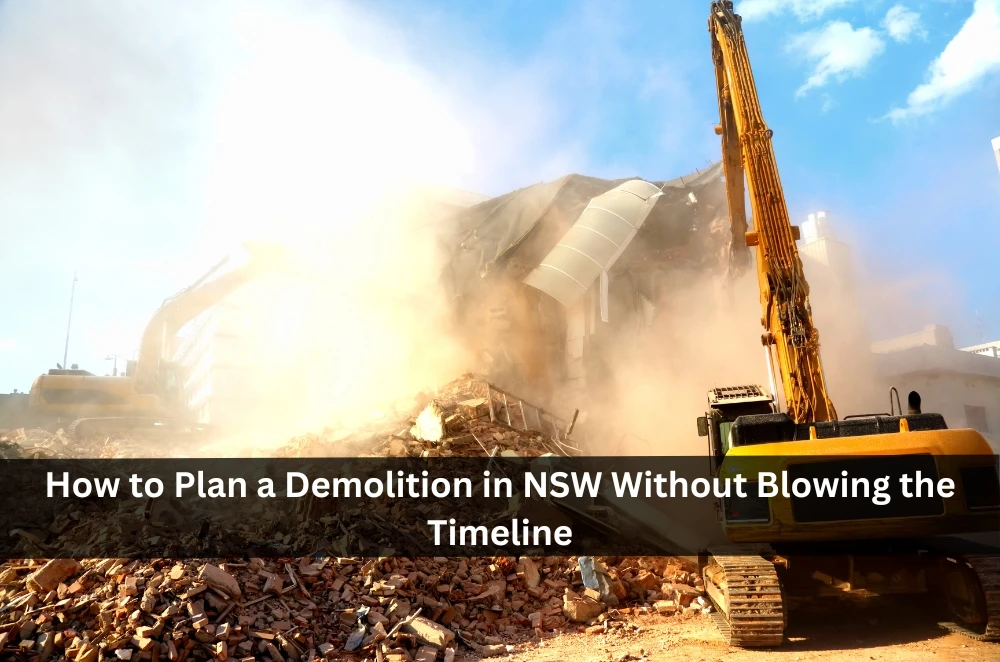
Demolition looks simple from the outside. Book a crew, knock it down, cart it off, move on.
In NSW—especially around Sydney—most of the pain happens earlier. The job drifts when the scope is fuzzy, services aren’t properly confirmed, or access is assumed to “just work out”, which is why professional demolition and site preparation in Newcastle NSW starts with clear planning long before anyone turns up with machines.
If you get the first decisions right, the site work is usually the easy part.
What actually happens before the first machine turns up
Long before anything comes down, someone needs to decide what “done” looks like. Is it a clean block? Are slabs staying? Does the fence need to remain? Are you keeping a garage, a wall, or a stretch of paving?
Then it becomes coordination: approvals, isolations, access, waste, neighbours, and a plan for how trucks and bins are getting in and out without turning the street into a mess.
If it’s a renovation, not a full knockdown, that coordination matters even more. Pulling something out is rarely the tricky bit. Leaving what stays in good nick is.
The decision factors that quietly change the price
Scope is the first lever. Two people can say “demolish the house” and mean two completely different outcomes.
Access is the next one. A tight driveway, a steep block, limited turning room, overhead lines, or nowhere to stage bins can stretch a job that “should be quick” into something slower and fiddlier.
Utilities often decide the real start date. Even when a place looks empty, services can still be live—or shared—or not where you expect. That’s not a moral failing; it’s just how older streets and piecemeal upgrades play out over time.
Waste handling is another lever people undercook. If you want more separation, salvage, or you’re trying to minimise what goes to landfill, that’s doable—but it changes the labour and the flow on site.
If you want a quick way to sanity-check scope, approvals, and site constraints before you start collecting quotes, use the Watson Demolition & Site Services planning guide.
Neighbours and the street context matter too. In some pockets, noise, dust, access hours, and general “don’t make it everyone’s problem” expectations are very real constraints.
And don’t forget what happens next. If earthworks, drainage, or a slab is booked, the demolition handover should match what the next contractor needs—not just “it’s mostly cleared”.
Common mistakes that cause delays (and the awkward phone calls)
Getting quotes before the scope is clear is the classic one. If each quote assumes a different finish, you’ll get a neat spreadsheet and a confusing outcome.
Another is leaving access and logistics to the week-of. If trucks can’t get in, if bins can’t be placed, or if there’s a parking restriction you didn’t notice, the schedule gets eaten fast.
Services are the quiet trap. People assume disconnections are quick, then they discover they’re the long pole. “We’ll sort it on the day” is how jobs end up with a cancelled start and a crew rebooked.
Selective demolition gets mis-scoped all the time. You can’t price “careful” properly if nobody has written down what needs protecting, what needs to stay operational, and what condition it needs to be left in.
And finally: the handover condition. “Cleared” is a slippery word. Does it mean levelled? Grubbed? Free of rubble but still rough? Ready for formwork? If you don’t define it, someone else will—usually at the worst possible moment.
A practical 7–14 day plan that keeps things moving
Start with a one-page scope. Keep it boring and specific: what’s being removed, what stays, and what the site should look like when the demolition is finished.
Do a quick access walk like you’re driving a small truck, not a hatchback. Where does it stop? Where does it turn? Where do bins go? What’s the plan if it’s wet?
Confirm service realities early. List what’s connected and what might be shared, and treat disconnections/isolation as a milestone, not an admin task.
Decide your waste approach up front. If you want separation or salvage, say so now—not after the first load is already in the bin.
Then line up the handover with the next trade. If a builder wants a clean start, ask what “clean” means in their language.
Once you’ve done those steps, request quotes using the same scope and constraints, and ask each contractor to state assumptions in writing. That one habit alone removes a lot of drama.
Operator Experience Moment
On suburban blocks, the demo crew rarely loses time on the actual knocking down. It’s the little things: the gate that’s narrower than remembered, the street that’s busier than expected, the service that wasn’t quite dead. When the scope and access plan are written down properly, those “little things” stop being surprises and start being part of the day.
Local SMB mini-walkthrough (Sydney, NSW)
Write a scope note that fits on one page: full knockdown or selective works, and what stays.
Scan the street: parking rules, narrow lanes, school zones, and where trucks can realistically sit.
Walk the boundaries: shared fences, close neighbours, and anything fragile you’re trying to keep.
Measure access points: driveway width, gate clearance, overhead lines, turning room.
Confirm services: power, gas, water, and any telecom lines still connected.
Define “site-ready”: cleared only, or levelled and ready for early works.
Leave time for the boring bits: disconnections and waste removal are often the critical path.
Practical Opinions
If you can’t describe the finish, you can’t lock the price.
Access planning beats last-minute heroics every time.
Agree on “site-ready” before you agree on the date.
Key Takeaways
- Demolition runs smoother when scope, access, and service status are confirmed early.
- Quotes only mean something when everyone is pricing the same finish and assumptions.
- Define the handover condition so the next trade can start without backtracking.
- A short 7–14 day plan prevents the most common delays.
Common questions we hear from businesses in Sydney, NSW, Australia
Q1) How early should demolition planning start before construction begins?
In most cases, as soon as there’s even a rough build timeline, because services and access can dictate the real start. A practical next step is to draft the one-page scope and do an access walk before you request quotes. In Sydney, tight streets and limited staging space can add constraints that don’t show up on a plan.
Q2) What details should be included when requesting demolition quotes?
Usually, the more “boring” the brief, the more accurate the price. A practical next step is to give every contractor the same scope, access notes, and desired handover condition, then ask them to list assumptions. In most Sydney suburbs, parking and truck movements can materially affect duration and cost.
Q3) Why do timelines change even after a start date is set?
It depends on what wasn’t confirmed—most often services, access logistics, or the real definition of “site-ready”. A practical next step is to set disconnections and site logistics as checklist items that must be ticked off before the start date. In denser parts of Sydney, neighbour proximity and working-hour expectations can also limit staging and sequencing.
Q4) Is selective demolition harder than a full knockdown?
Usually, yes, because you’re paying for control, not just removal. A practical next step is to specify exactly what must remain and what condition it needs to be left in, so it can be priced and planned properly. In NSW renovation corridors with older housing stock, unknowns behind linings are common, so allow a bit of buffer in coordination.