
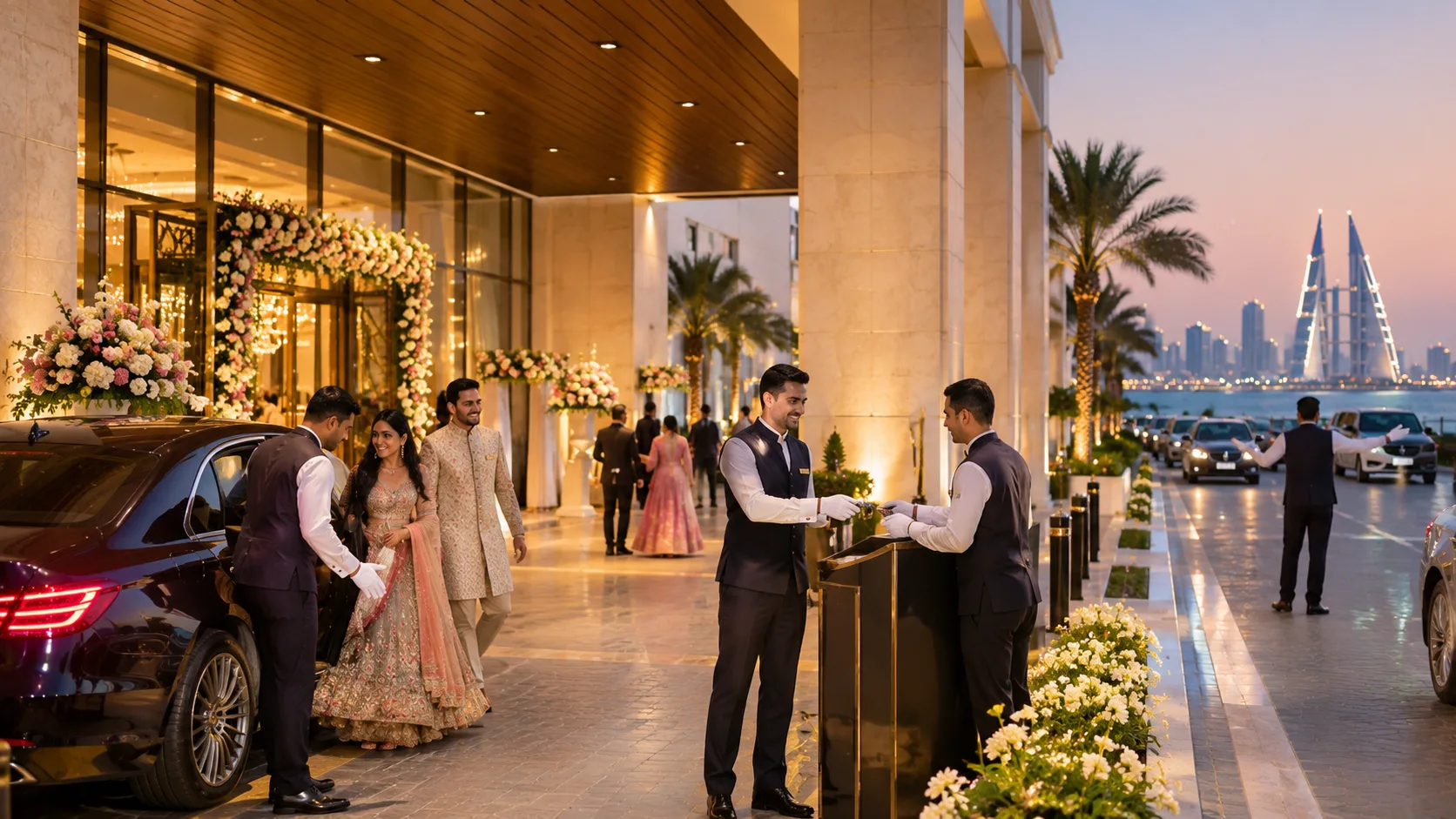
A smooth wedding experience begins before guests enter the celebration. When comparing Bahrain Wedding Venues, couples should consider parking capacity, vehicle access, valet arrangements and designated drop-off points alongside the ballroom and décor facilities.
A large Indian destination wedding may bring together hundreds of guests, family members, VIP visitors and service providers. Many may arrive within the same 30–60-minute period, particularly before the Sangeet, wedding ceremony or reception. Without proper vehicle management, queues can build up near the entrance, guests may struggle to find parking and drivers can become confused about where to wait.
The solution is to prepare a parking and vehicle-movement plan for every function. It should cover guest arrivals, valet collection, accessible drop-offs, parking allocation, vehicle security and departure arrangements.
Here is how to organise these facilities for a large wedding celebration in Bahrain.
1. Check the Venue's Actual Parking Capacity Before Booking
Do not assume that a large ballroom automatically comes with enough parking for every invited guest.
Before confirming the venue, ask its event management team to explain the available parking arrangements and any restrictions on their use.
Check:
- Total number of available parking spaces.
- Whether parking is shared with hotel residents or restaurant visitors.
- Availability of reserved parking for wedding guests.
- Distance between parking areas and the ballroom entrance.
- Access for larger vehicles and chauffeur-driven cars.
- Availability of valet parking.
- Possibility of using approved overflow parking.
- Operating hours and any parking restrictions.
Ask whether the venue can provide a written parking layout showing entry points, exit points, designated parking areas and guest walking routes.
For outdoor venues or properties with multiple entrances, inspect the vehicle access arrangements in person.
A venue that works well for a small family function may require a different parking strategy for a large reception.
2. Estimate the Number of Vehicles Instead of Counting Only Guests
The guest count is important, but it does not directly tell you how many parking spaces are required.
Some guests may arrive together in one vehicle, while others may use taxis, hired cars, hotel shuttles or chauffeur-driven transport.
Prepare a vehicle-estimation sheet using the confirmed RSVP information and available transport details.
Separate the expected arrivals into groups:
- Families travelling together.
- Guests using private vehicles.
- VIP guests with personal drivers.
- Guests using hired taxis or chauffeur services.
- Elderly guests requiring closer drop-off access.
- Wedding suppliers and production teams.
- Venue and catering staff.
Also ask guests or family representatives to update the planner if their transport arrangements change.
Avoid applying one fixed car-to-guest ratio to every wedding. The actual requirement depends on the guest profile, shared travel arrangements, venue location and availability of alternative transport.
Use the estimated vehicle count to discuss parking requirements with the venue before finalising the arrangement.
3. Prepare a Separate Parking Plan for Every Wedding Function
A multi-day Indian wedding may use the same ballroom for different functions or move between separate properties.
The vehicle arrangement should be reviewed for each event rather than copied automatically from the previous day's plan.
| Function | Parking and vehicle considerations |
| Welcome dinner | Guest arrivals, family vehicles and restaurant access |
| Mehendi | Short-duration arrivals and convenient guest drop-offs |
| Haldi | Family vehicles, accessible access and ceremony-area proximity |
| Sangeet | Concentrated arrivals, performance schedules and late departures |
| Wedding ceremony | Family and VIP parking, Baraat arrangements and guest movement |
| Reception | Larger arrival volume, valet operations and organised vehicle collection |
| Post-wedding brunch | Daytime parking and guest departures |
Consider whether two functions will overlap.
For example, if reception guests begin arriving while another event is still using the same parking area, the parking supervisor needs to know which spaces are available and which remain occupied.
4. Separate Guest Drop-Off and Pick-Up Zones From Parking Entrances
One of the simplest ways to reduce congestion is to separate temporary guest drop-offs from vehicles entering the parking area.
A vehicle stopping for a few seconds should not block cars waiting to enter the car park or interrupt the valet collection line.
Ask the venue to identify suitable locations for:
Guest drop-off: A designated point where guests can leave the vehicle and enter the venue comfortably.
Valet handover: A separate location where authorised staff receive vehicles for parking.
Pick-up point: An area where guests can wait for their vehicles after the function.
Supplier access: A route for catering deliveries, décor teams and production equipment.
Use clearly visible signs and staff members to guide drivers.
Keep the entrance and exit arrangements consistent with the venue's approved traffic circulation plan.
Never use a public road, pedestrian crossing, emergency access route or neighbouring property's private parking area as an informal waiting zone.
5. Hire a Professional Valet Parking Service
Valet parking can make arrivals more convenient when a large number of guests are expected and the venue has a suitable vehicle-handling arrangement.
A professional team can receive vehicles, issue collection references and park them in the approved parking area.
Before hiring a provider, ask about:
- Experience with weddings and large events.
- Number of trained valet attendants.
- Supervisor availability.
- Vehicle handover procedures.
- Key storage and control.
- Parking location and vehicle movement arrangements.
- Insurance and liability arrangements.
- Procedures for damage, accidents or lost keys.
- Peak-time vehicle collection capacity.
Also clarify whether the service covers the entire event or only a specified arrival and departure period.
Do not select a provider based only on the number of attendants promised. Check whether its staffing and parking arrangements can handle the expected arrival pattern.
6. Create a Clear Vehicle Handover and Key-Control Procedure
The valet collection process should be organised so that every vehicle can be identified and returned to the correct guest.
A practical procedure includes:
- An attendant receives the vehicle at the approved handover point.
- The attendant follows the provider's vehicle-condition recording procedure.
- The vehicle is assigned a unique claim reference.
- The guest receives a matching collection ticket or digital confirmation.
- The key is stored in an authorised, controlled location.
- The vehicle is parked in the assigned area.
- The collection reference is checked when the guest requests the vehicle.
- The return is recorded after the vehicle is handed back.
For larger events, use a digital or numbered ticketing system rather than relying on handwritten names alone.
Avoid displaying guest names, room numbers or sensitive contact information on publicly visible key tags.
The valet supervisor should know exactly where keys are stored and who is authorised to access them.
7. Arrange Reserved Parking for the Couple, Families and VIP Guests
Some vehicles may need special parking arrangements because of the people travelling in them or their operational responsibilities.
Discuss reserved spaces with the venue before the invitations are distributed.
Possible categories include:
- Bride and groom's immediate family.
- Elderly parents and relatives.
- Guests requiring accessible parking.
- Authorised VIP visitors.
- Official wedding vehicles.
- Designated family representatives.
- Wedding emergency and operational vehicles, where applicable.
Do not allocate reserved spaces informally on the event day.
Prepare a small allocation sheet showing the authorised category, parking location and responsible coordinator.
For family vehicles with special requirements, share the correct entrance and parking instructions in advance.
Avoid reserving large sections of parking without confirming that the spaces are actually available.
8. Provide Accessible Drop-Off and Parking Arrangements
Elderly guests, pregnant guests and people with disabilities may have difficulty walking long distances from the parking area to the ballroom.
Plan their arrival separately without making the process unnecessarily complicated.
Consider:
- A drop-off point close to an accessible entrance.
- Suitable accessible parking spaces, where available.
- Step-free routes to the event area.
- Clear directions to lifts or ramps.
- Seating close to the entrance.
- Assistance from a designated guest-support representative.
- A convenient pick-up point after the function.
Ask the venue to confirm which facilities are available and whether they can be reserved for the event.
Do not place decorative installations, signboards or temporary equipment in these access routes.
Also brief valet attendants and traffic marshals so that guests needing assistance are not directed to distant parking areas unnecessarily.
9. Organise Separate Vehicle Movement for the Baraat
A traditional Indian Baraat may involve a procession, dancing, musicians and a large group of guests.
It should therefore have its own vehicle and pedestrian movement plan.
Before the ceremony, confirm:
- Where the Baraat will assemble.
- The approved procession route.
- Where the groom's vehicle will arrive.
- Where family vehicles should park.
- Where musicians and support vehicles can stand.
- How guests will move from the procession to the ceremony entrance.
- Who will manage vehicle and pedestrian movement.
If the procession involves a decorated vehicle or another special entrance arrangement, obtain permission from the venue and confirm the necessary operational and safety arrangements.
Do not assume that a vehicle used during a Baraat can be driven through any hotel entrance or public area.
The wedding planner should coordinate the procession with the venue's event manager and relevant security personnel.
10. Manage Parking During Simultaneous Guest Arrivals
The busiest parking period may be the 30–60 minutes before a major function begins.
When several hundred guests arrive during a short period, even sufficient parking spaces can become difficult to access if vehicles are not guided properly.
Consider dividing the arrival operation into three responsibilities.
Entrance coordinator
Directs vehicles towards the correct parking or drop-off location.
Valet supervisor
Monitors the number of vehicles received and the available parking spaces.
Guest assistance coordinator
Guides arriving guests towards the ballroom and helps with special access requirements.
Use walkie-talkies or an agreed communication channel between team leaders.
If parking starts reaching capacity, the supervisor should immediately inform the planner rather than continue sending vehicles into an already congested area.
The wedding team should have a pre-approved alternative before overflow becomes a problem.
11. Prepare an Overflow Parking and Shuttle Arrangement
Some venues may not have enough parking for every guest vehicle during a large celebration.
Discuss overflow options before the wedding rather than searching for additional spaces at the last minute.
Possible arrangements include:
- An additional approved parking area.
- A venue-operated shuttle between parking and the event entrance.
- A pre-arranged arrangement with an authorised nearby facility.
- Group transport from designated guest accommodation.
- Additional taxis or chauffeur-driven services.
Before using an external parking area, confirm that the property owner has permitted its use and that access, security and collection arrangements are suitable.
If a shuttle is required, confirm:
- Pick-up and drop-off locations.
- Vehicle capacity.
- Departure frequency.
- Operating hours.
- Accessibility requirements.
- Contact details of the transport supervisor.
Do not direct guests to informal roadside parking or private property without permission.
12. Create a Waiting Area for Drivers and Chauffeurs
Some guests may arrive with personal drivers or hired chauffeurs who remain at the venue while the function continues.
If drivers are expected to wait for several hours, provide a clearly identified waiting location where the venue permits it.
Check whether the venue can offer:
- Designated seating.
- Drinking water.
- Access to suitable restroom facilities.
- Clear instructions about permitted vehicle parking.
- A contact person for departure coordination.
- A suitable waiting area away from guest entrances.
Drivers should not use guest drop-off spaces or block the valet collection route while waiting.
For a very large reception, the venue may need a separate driver holding area.
Confirm its availability and capacity before including it in the guest transportation instructions.
13. Maintain Vehicle Security and Damage-Reporting Procedures
Valet service involves receiving and handling guests' vehicles, so security and accountability must be clearly established.
Ask the provider how it records vehicle condition, manages keys and handles any reported damage.
Useful precautions include:
- Recording the vehicle registration number.
- Issuing a unique collection reference.
- Documenting visible pre-existing damage where necessary.
- Restricting key access to authorised staff.
- Using controlled parking locations.
- Confirming vehicle collection against the issued ticket.
- Recording incidents immediately.
- Providing a clear process for reporting damage or lost keys.
Clarify insurance coverage and responsibility for incidents in the written service agreement.
Do not assume that the venue's general event insurance automatically covers every vehicle handled by a separate valet operator.
Guests should also be told where to report a vehicle-related concern before leaving the property.
14. Coordinate With Venue Security and Event Authorities Where Required
Vehicle arrangements may need additional coordination when a wedding has a large guest count, a public-facing entrance, an outdoor procession or complex arrival and departure movements.
Bahrain's Government Services Catalogue describes an event-arrangement service through the Ministry of Interior. Its listed coordination responsibilities include organising safe entrance and exit routes and monitoring event-site parking areas. Whether this service or additional coordination is applicable depends on the specific event and its arrangements, so the organiser should check with the venue and relevant authorities rather than assume every private wedding requires the same process.
The venue should also confirm where security staff need to be positioned.
Keep emergency access and vehicle movement routes clear throughout the function.
15. Plan Vehicle Collection After the Wedding Function
Vehicle collection can become as busy as guest arrival, particularly after a late-night reception.
Avoid allowing every guest to request their vehicle at the same time without an organised collection process.
The valet supervisor should monitor collection requests and arrange vehicles according to the available collection space.
Useful arrangements include:
- A clearly marked vehicle collection point.
- Adequate waiting space for guests.
- A supervisor monitoring pending tickets.
- Separate collection arrangements for authorised family vehicles.
- Clear pedestrian access away from moving vehicles.
- Coordination with taxis and chauffeur services.
- A final collection procedure for vehicles left after the function.
For large events, a digital ticket system can help the team identify which vehicles are ready for collection.
Keep the valet operation running for the agreed service period and make sure guests know how to request assistance if they leave later than expected.
16. Prepare a Parking and Valet Checklist Before Event Day
A final checklist helps the wedding planner confirm that every vehicle-related arrangement is ready.
Before the wedding:
- Confirm venue parking capacity.
- Estimate guest vehicle numbers.
- Agree on guest drop-off and pick-up points.
- Appoint the valet provider, if required.
- Confirm commercial registration and relevant approvals.
- Reserve accessible and family parking spaces.
- Approve overflow arrangements.
- Share parking instructions with guests.
During guest arrivals:
- Position entrance and drop-off staff.
- Monitor vehicle queues.
- Issue valet collection references.
- Keep entrances and exits unobstructed.
- Guide guests towards the event area.
- Monitor parking availability.
After the function:
- Organise staggered vehicle collection where needed.
- Keep pedestrian routes clear.
- Record any incidents or missing claim tickets.
- Return vehicles to verified claimants.
- Confirm the valet service has completed its duties.
- Review parking issues before the next wedding function.
Frequently Asked Questions
1. How should couples estimate parking requirements for a large Indian wedding in Bahrain?
Start with the confirmed guest list and ask about likely shared transport arrangements, private vehicles, taxis and chauffeur services. Combine this with the venue's actual parking capacity before deciding whether additional parking is needed.
2. Should couples hire a separate valet parking company for their wedding?
It depends on the venue's existing arrangements, expected vehicle arrivals and available parking. A professional valet provider may be useful when the event has a concentrated arrival period or when guest convenience requires vehicle handling.
3. What should be checked before booking a wedding valet service in Bahrain?
Check the provider's relevant commercial registration, experience, staffing, vehicle handover procedure, key control, insurance arrangements and collection process. Confirm the venue's permission and any applicable site approvals.
4. How can wedding planners avoid traffic congestion near the venue entrance?
Separate guest drop-off, valet handover, parking entry and vehicle collection areas where the venue permits. Use trained attendants, visible signage and coordinated communication between the entrance and parking teams.
5. How should parking be arranged for elderly guests and people with disabilities?
Provide suitable accessible parking or a convenient drop-off point near an accessible entrance. Confirm step-free routes, seating and assistance arrangements with the venue before the event.
6. What happens if the wedding venue does not have sufficient parking?
Discuss an approved overflow parking area, shuttle service or alternative transport arrangement with the venue. Confirm permission, security, operating hours and guest instructions before announcing the arrangement.
Final Thoughts
Parking may not be the most visible part of a wedding celebration, but it can strongly influence the experience guests have when arriving and leaving.
A well-organised parking plan combines accurate vehicle estimates, clear entry and exit routes, trained personnel and a reliable collection system.
When the venue, wedding planner and valet team work from the same plan, guests can arrive comfortably, enjoy the celebrations and leave without unnecessary delays.