It is surprisingly common to own a home on septic and have no idea where the tank actually is. Maybe the previous owners never mentioned it. Maybe the lid has been buried under grass for twenty years. Either way, you only start wondering when the system needs attention, and suddenly you are looking at a big yard and a shovel.
Before you start digging holes, slow down. With a few clues and a careful approach, you can usually find the tank in a small area and leave the rest of the lawn alone.
Start Inside the House
The tank is almost always connected to the house by a fairly short, straight run of pipe. So the first clue is where the main sewer line leaves your home.
If you have a crawlspace or basement, look for the large drain pipe, usually three or four inches across, that runs toward a wall and exits the foundation. On a slab home, look for a cleanout cap near the foundation outside, often near a bathroom. That cap gives you the direction the line heads.
Most tanks sit somewhere between ten and twenty five feet from the house along that line. Codes and older practices varied, so treat that as a starting range, not a rule.
Check the Paperwork
Before you probe anywhere, look for records. Your closing documents may include a septic inspection or a drawing. The county health department may have a permit on file showing the tank and drain field layout, especially for homes built in the last few decades. It does not hurt to call and ask.
If a septic company has serviced the system before, they may have notes on the location. Neighbors who have lived in the area a long time sometimes remember too, especially in smaller communities.
Read the Yard
Your lawn often gives the tank away if you know what to look for.
Look for a rectangular patch where the grass grows differently. Over a shallow tank, grass may brown out first in a dry spell because there is less soil to hold moisture. In other cases, it may look a little greener. A slight depression or a low mound can also mark the spot where soil was disturbed during installation.
Check for anything that looks like a cleanout pipe or a small cap sticking up from the grass. Some systems have risers that bring the lid closer to the surface. Also notice where nobody ever planted anything. Builders and earlier owners often kept trees and gardens away from the tank on purpose.
Probe Gently
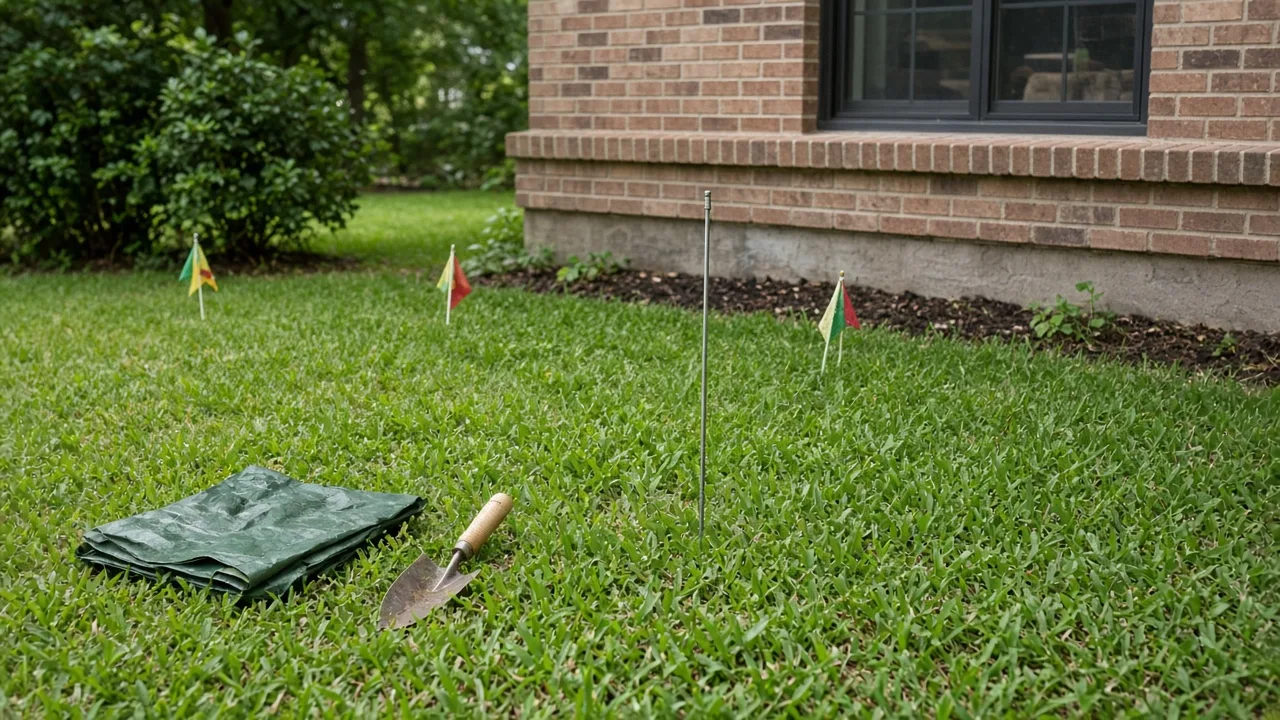
Once you have narrowed the area, use a thin metal rod or a long screwdriver. Push it into the soil every foot or so along the line from the house. Go slowly and do not force it. You are feeling for a firm, flat surface a few inches to a couple of feet below the grass. Rocks feel different. They are usually rounded and irregular, and you can often work around them.
When you hit something flat, probe around it to find the edges. Most residential tanks are rectangular, and the lids are usually near the ends.
Never probe aggressively over the drain field, and do not use a power auger or post hole digger to search. You can crack a lid, puncture a pipe, or damage the distribution box.
Dig Small and Neat
Once you think you have found the lid, cut the sod in a square and set it aside on a tarp. Dig carefully with a hand shovel. Keep the hole only as large as you need. When the work is done, put the soil back in and replace the sod. The patch will usually blend in within a few weeks.
If the lid is cracked or crumbling, stop. Old concrete lids can be weaker than they look, and an open tank is a serious hazard for kids and pets. Leave it covered and call a professional.
Make It Easier Next Time
After you find the tank, take photos and measure from two fixed points, like a corner of the house and a fence post. Write those measurements down somewhere you will not lose them. Some homeowners add a riser to bring the lid up to ground level, which makes future pumping faster and avoids digging altogether.
When to Call for Help
If you have tried the obvious places and come up empty, it is time to bring in someone who does this every week. Tanks are sometimes much farther from the house than expected, buried deeper than usual, or placed on an unusual side because of the slope. Experienced crews can often find them quickly with less damage to the yard.
CSRA Site Work and Septic is a family owned company based at 720 B North Liberty St. in Waynesboro, with more than 20 years of experience across Hephzibah, Augusta, Blythe, McBean, Evans, Martinez, Girard, Keysville, and Waynesboro. Our office is open from 7 AM to 10 PM every day, and we offer emergency service 24/7 at (706) 871 3955 or (706) 814 0189.
A Little Detective Work Goes a Long Way
Finding your septic tank is mostly about following the pipe, checking the records, and reading the yard. Take your time and you can usually avoid a lawn full of holes. If your property is south of Augusta and you would rather have someone else do the searching, our team provides septic help for Hephzibah homeowners and can locate, open, and service the tank in one visit.