How to Invest in Nifty 50 for Long-Term Wealth Creation
Investing in the share market can be an effective way to build long-term wealth, provided you have a clear financial goal, a suitable investment strategy, and the patience to stay invested through market fluctuations. For investors looking for a simple way to participate in India's equity market, the Nifty 50 is a popular starting point.
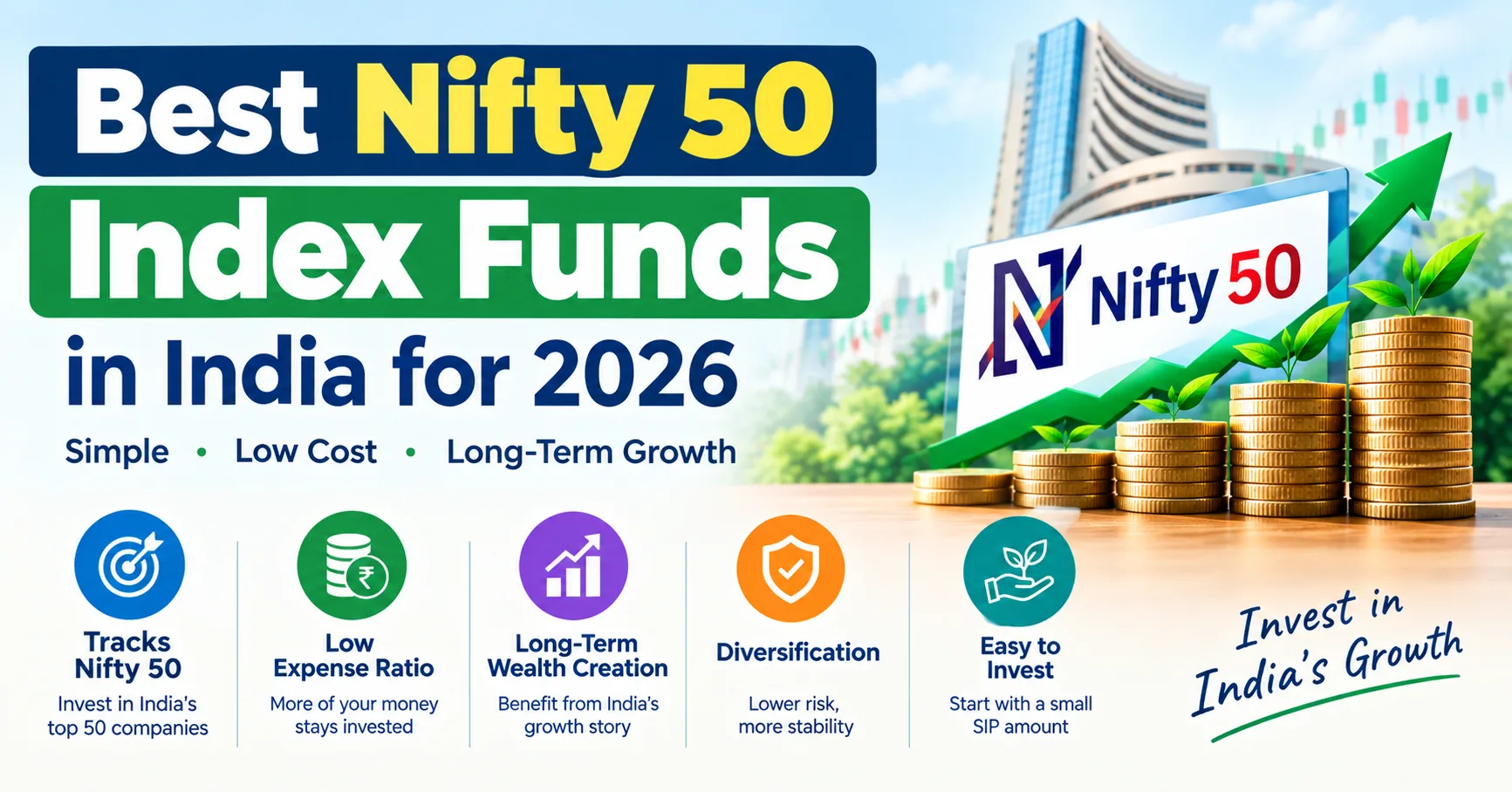
The Nifty 50 is a benchmark stock market index that tracks 50 major companies listed on the National Stock Exchange of India (NSE). It covers companies across several sectors, offering investors exposure to different parts of the Indian economy through a single index.
Instead of selecting individual stocks, investors can gain exposure to the Nifty 50 through index mutual funds or exchange-traded funds (ETFs). These options can make long-term share market investing more accessible, especially for beginners.
In this article, we explore how to invest in the Nifty 50, the available investment options, and the factors to consider when building a long-term investment strategy.
What Is the Nifty 50?
The Nifty 50 is a free-float market-capitalisation-weighted index comprising 50 eligible companies listed on the NSE. Its constituents represent a range of sectors, including financial services, information technology, energy, automobiles, consumer goods, and healthcare.
The index is designed to reflect the performance of a significant segment of India's large-cap equity market. Its constituents and weightings can change over time as companies meet the index's eligibility criteria.
For investors, the Nifty 50 serves two important purposes:
- Market benchmark: It helps investors understand how a major segment of the Indian share market is performing.
- Investment reference: It provides the underlying benchmark for several index mutual funds and ETFs.
However, the Nifty 50 is not a guaranteed-return investment. Its value can rise or fall depending on market conditions, company performance, economic developments, and investor sentiment.
Why Consider the Nifty 50 for Long-Term Wealth Creation?
Long-term investing involves remaining invested through different market cycles rather than attempting to predict every short-term price movement. The Nifty 50 can be one way to participate in the potential long-term growth of India's equity market.
Here are some reasons investors consider it.
1. Exposure to Established Companies
The Nifty 50 includes large, established businesses across multiple sectors. Investing through a Nifty 50 index fund or ETF provides exposure to these companies without requiring you to purchase shares of each company individually.
However, index investing does not eliminate market risk, and the index may be concentrated in certain sectors or companies.
2. Diversification Through One Investment
Selecting individual shares requires research into each company's financial performance, valuation, management, and growth prospects. A Nifty 50 index investment spreads exposure across 50 constituent companies.
This reduces dependence on the performance of a single stock, although it does not protect investors from a broad market decline.
3. A Rules-Based Investment Approach
Nifty 50 index funds and ETFs aim to track the index rather than select stocks based on a fund manager's market predictions. This approach can be useful for investors who prefer a straightforward, rules-based investment strategy.
Actual returns may differ from the index because of expenses, tracking error, and other factors.
4. Suitable for a Long-Term Investment Horizon
Equity investments can experience substantial short-term fluctuations. Investors with long-term financial goals may have more time to withstand market volatility, although recovery is never guaranteed within a specific period.
The Nifty 50 may suit investors seeking equity exposure for goals such as long-term wealth accumulation or retirement planning, depending on their risk tolerance and overall asset allocation.
How to Invest in Nifty 50 in India
There are two common ways to invest in the Nifty 50: through an index mutual fund or through an exchange-traded fund (ETF).
Option 1: Invest Through a Nifty 50 Index Mutual Fund
A Nifty 50 index mutual fund aims to replicate the performance of the Nifty 50 by investing in its constituent stocks in proportions designed to track the index.
Investors can generally choose between a lump-sum investment and a Systematic Investment Plan (SIP), subject to the fund's available options.
How to get started:
- Compare available Nifty 50 index funds.
- Review the expense ratio, tracking error, tracking difference, and fund size.
- Complete the required KYC and mutual fund account formalities.
- Choose a lump-sum investment or set up a SIP.
- Review your portfolio periodically rather than reacting to every market movement.
A SIP allows you to invest a fixed amount at regular intervals. It can help build investment discipline, but it does not guarantee profits or protect you from market losses.
Option 2: Invest Through a Nifty 50 ETF
A Nifty 50 ETF is an exchange-traded fund designed to track the performance of the index. Its units trade on the stock exchange, similar to shares.
To invest in a Nifty 50 ETF, you generally need a demat account and a trading account with a broker.
How to get started:
- Compare Nifty 50 ETFs based on expense ratio, tracking difference, liquidity, and bid-ask spread.
- Open and activate your demat and trading accounts if you do not already have them.
- Search for the chosen ETF using its name or trading symbol on your broker's platform.
- Decide how many units to purchase based on your investment budget.
- Place an order after reviewing the price and applicable charges.
ETF prices can fluctuate during market hours. A low expense ratio alone does not guarantee better tracking or execution, so compare the overall cost and liquidity before investing.
Nifty 50 Index Fund vs Nifty 50 ETF
Both investment options provide exposure to the same underlying index, but their buying and selling processes differ.
Feature Nifty 50 Index Fund Nifty 50 ETF How you invest Through a mutual fund platform or AMC Through a stockbroker on an exchange Demat account Generally not required for a regular mutual fund investment Generally required Pricing Based on the applicable mutual fund NAV Market price during trading hours Investment method Lump sum or SIP, depending on the fund Purchase ETF units through exchange orders Costs to compare Expense ratio and tracking difference Expense ratio, tracking difference, spread, and brokerage or other charges Best suited for Investors who prefer a mutual fund-based process Investors comfortable with exchange-based investingNeither option is automatically better for every investor. Your choice should depend on convenience, investment habits, costs, and the features of the specific fund or ETF.
How Much Should You Invest in the Nifty 50?
The right investment amount depends on your income, expenses, financial goals, emergency savings, existing investments, and ability to tolerate losses.
For example, an investor who wants to invest ₹5,000 per month could consider a Nifty 50 index fund SIP if it fits their financial plan. Another investor may prefer periodic ETF purchases. These are examples of investment methods, not personalised recommendations.
Before deciding how much to invest, consider the following:
- Set a financial goal: Identify whether you are investing for retirement, long-term savings, or another objective.
- Maintain emergency savings: Keep sufficient accessible funds for unexpected expenses before committing money to equity investments.
- Review your time horizon: Money needed in the near term may not be suitable for equity exposure.
- Assess your risk tolerance: Be prepared for market declines and periods of negative returns.
- Avoid overconcentration: Consider how a Nifty 50 investment fits alongside your other equity funds, stocks, debt investments, and savings.
Your investment amount should be sustainable, rather than based on the returns you hope to earn.
The Role of SIP in Long-Term Nifty 50 Investing
A Systematic Investment Plan allows you to invest a fixed amount in a mutual fund at regular intervals, such as monthly. It is one way to invest in a Nifty 50 index mutual fund without needing to decide when to invest the entire amount.
SIPs offer several practical benefits:
- Investment discipline: Regular contributions can make investing part of your monthly financial routine.
- Reduced dependence on timing: You invest across different market levels instead of relying on one entry point.
- Gradual portfolio building: You can start with an amount that fits your budget and increase contributions as your finances permit.
However, SIPs do not guarantee positive returns. If markets decline, your investment value may fall, and returns depend on the fund's performance and the prices at which units are purchased.
Investors using ETFs can also make periodic purchases, but these are exchange transactions rather than mutual fund SIPs unless their platform offers a specific automated facility.
Important Factors to Check Before Investing
Before investing in a Nifty 50 index fund or ETF, review the following factors.
Expense Ratio
The expense ratio represents the annual operating expenses charged by a fund as a proportion of its assets. Lower costs can benefit long-term investors, all else being equal, but the expense ratio should not be the only selection criterion.
Tracking Error and Tracking Difference
Tracking error measures the variability of a fund's return differences relative to its benchmark. Tracking difference indicates how much the fund's returns differ from the index over a particular period.
Review both where data is available. A fund's returns may not exactly match the index because of expenses, cash holdings, rebalancing, and other operational factors.
Liquidity and Bid-Ask Spread
For ETFs, check trading volume, market depth, and the difference between buying and selling prices. A wider bid-ask spread can increase the cost of entering or exiting an investment.
Investment Costs
Consider the full cost of investing, including applicable transaction charges, brokerage, taxes, and other fees. The exact costs depend on the product, platform, and transaction.
Your Existing Portfolio
If you already own several large-cap mutual funds or shares of Nifty 50 companies, another Nifty 50 investment may overlap substantially with your existing holdings. Review your overall portfolio rather than evaluating each investment in isolation.
Common Mistakes to Avoid When Investing in Nifty 50
Even a straightforward index investment requires careful planning. Avoid these common mistakes:
- Expecting guaranteed returns: The Nifty 50 can decline, and long-term returns are not assured.
- Investing money needed soon: Equity investments may be unsuitable for short-term financial commitments.
- Stopping investments out of panic: Emotional decisions during market corrections can disrupt a long-term plan.
- Ignoring costs: Expenses, tracking differences, and ETF trading spreads can affect your realised returns.
- Assuming diversification removes all risk: The Nifty 50 covers multiple companies, but it remains an equity index exposed to market-wide risks.
- Chasing recent performance: Strong past returns do not guarantee future performance.
- Checking the portfolio too frequently: Short-term price movements may distract you from your goals and investment horizon.
Is Nifty 50 a Good Choice for Beginners in the Share Market?
The Nifty 50 can be a useful starting point for beginners who want broad exposure to large-cap Indian equities without researching and selecting individual stocks.
An index mutual fund may be convenient for someone who prefers automated monthly investing, while an ETF may appeal to an investor who is comfortable placing exchange orders through a trading platform.
However, beginners should understand the risks of equity investing, maintain emergency savings, and avoid investing money they cannot afford to keep invested through market volatility. Depending on their goals and risk profile, they may also need debt investments or other asset classes rather than putting all their money into the Nifty 50.
Investors should compare products carefully and choose an option that fits their financial circumstances.
Conclusion
Investing in the Nifty 50 can provide a straightforward way to participate in the Indian share market through index mutual funds or ETFs. Its broad exposure to large-cap companies makes it worth considering as part of a long-term investment strategy.
The key is to select a suitable investment product, understand its costs and risks, invest in line with your financial goals, and remain disciplined through market fluctuations. A well-planned approach can help you work towards long-term wealth creation, although no equity investment guarantees a particular outcome.
Before investing, compare available Nifty 50 products and review how they fit into your overall financial plan.