we will delve into the world of Odoo development and equip you with the essential strategies needed to hire the right developer the first time, whether you are a non-techie or a tech enthusiast.
You've then decided that you want to use Odoo—or perhaps you need to expand your current system. Excellent choice. This is one of the most powerful and flexible ERP platforms available today: Odoo. However, there is a truth here: an ERP system is as good as the developer who sets it up.
Numerous companies invest in Odoo for its promise of seamless workflows, but ultimately find that the journey to implementation is plagued by setbacks, cost overruns, or outright failures. It's not always the software, it's a matter of having the right talent.
A specialized Odoo Developer is not the same as a regular web developer, or even a general Python coder. Odoo is a self-contained environment with specific database rules, architecture restrictions and logic.
If you are a business owner, project manager or HR professional who finds yourself with the challenge of hiring an Odoo expert, then this guide is for you! We are taking out jargon, and providing you with a practical, step-by-step approach to finding, screening and selecting the right developer for your business.
---
1. The reason why a "Python Developer" is Not an "Odoo Developer"
When looking for Odoo help, many hiring managers search for general Python developers. From a theoretical perspective, it seems logical. Odoo is written in Python programming language.
This is, however, a formula for disaster!
Imagine Python is a language and Odoo is a very detailed and complicated legal document in that language.Imagine, Python is a language and Odoo is a very detailed and complicated legal document in that language. Learning to write and speak Python, does not imply that you understand the complexities of ERP logic, database constraints, double-entry bookkeeping, or Odoo's internal logic.
A typical Python programmer will probably:
They may take 40 hours coding a feature from scratch, while Odoo already has it built and can inherit in 10 lines of code.They could be coding in 40 hours a feature which is already present in Odoo, or can be inherited in 10 lines.
They may write raw SQL queries, which skip Odoo's security rules (ir.model.access.csv) and inbuilt caching, leading to security issues and performance problems.
Odoo use a lot of relational fields such as `Many2one`, `One2many`, and `Many2many`. The mismanagement of these may lead to data corruption in your business data.
By hiring a dedicated ODOO Developer, you're hiring someone who knows the ODOO framework inside out, understands the principles of ERP, and respects the standards of ODOO.
---
2. Some of the key technical and functional skills to be considered are:
A good Odoo Developer possesses a blend of technical coding proficiency and business acumen. This is a check list of what you should expect to see:
The Technical Stack
They'll need to understand how Python is used to define Odoo models, build APIs, override existing methods, such as create, write, unlink, and manage the Object-Relational Mapping (ORM) layer.
Odoo uses PostgreSQL & Database Optimization. Your developer should know how to transform Python models into database tables, write neat database constraints and optimize slow running queries.
Odoo uses XML for defining the user interface, and also generates XML-based reports through the QWeb module. To change existing views while avoiding modifying the core code, a developer should understand how to use inheritance (xpath expressions). They also want to have QWeb skills to create and edit PDF reports (e.g., purchase orders, invoices).
The modern and interactive features on the front end are powered by the OWL (Odoo Web Library) framework, a custom JavaScript framework added to Odoo with Odoo 14 and elaborated even more with Odoo 16, 17, and 18. Kanban views and custom dashboards, as well as custom POS modifications, all require a developer who is familiar with OWL.
5. API & Integration Experience: You'll probably have to integrate Odoo with other platforms such as Shopify, Amazon, custom shipping APIs, or payment gateways. Seek the experience in XML-RPC, JSON-RPC, and REST APIs.
The Functional Mindset
An ERP is not just an application for blogging, it's an application that runs your business. A developer who writes perfect code without realising that a Sales Order needs to create a Delivery Order, a Journal Entry will cause head aches for ever.
Basic business workflow knowledge: Basic accounting, inventory valuation (FIFO, AVCO), warehouse routing and CRM funnels.
Upgrade/Migration Awareness: Ask them to upgrade/migrate in code writing. Do they use clean overrides to customise modules or do they edit core files? Core files cannot be edited and future Odoo upgrades will not be possible. They will need to adhere to OCA (Odoo Community Association) coding standards.
---
3. The 3-Step Vetting Process
Do not only use resumes and pleasant talking during an interview. Produce candidates through a formal screening system.
Review their contributions and portfolio to assess their growth.Review their contributions and portfolio to evaluate their growth.
Request their GitHub profile. Look for:
The Odoo Community Association (OCA) has very strict coding requirements. A developer who has contributed to OCA modules; it is a big gold star. That is to say, a number of the top minds in Odoo have done a review of this code.
Is there a clear structure in the custom modules?
Are their security files (security/ir.model.access.csv), data files, views and models separated?
The second step consists of the Practical Technical Test.The second step is the
Practical Technical Test.
Never give them an algorithmic test (such as sorting an array). Rather, assign them a small task for Odoo.
Create a custom module that adds a 'Loyalty Tier' field to the Customer model (res.partner) and displays this tier on the Sales Order form. If a customer is 'Gold' then apply a 10% discount to all order lines automatically, but in a way that can be overridden manually by Sales Managers.
Write security access rules so that only Sales Managers can override the 10% discount for any order line.
Look for: Did they use Odoo's inheritance (_inherit) to modify the models res.partner, sale.order?
Have they created clean XML views with xpath?
Did they provide security access rules? Were they able to write clean, commented code?
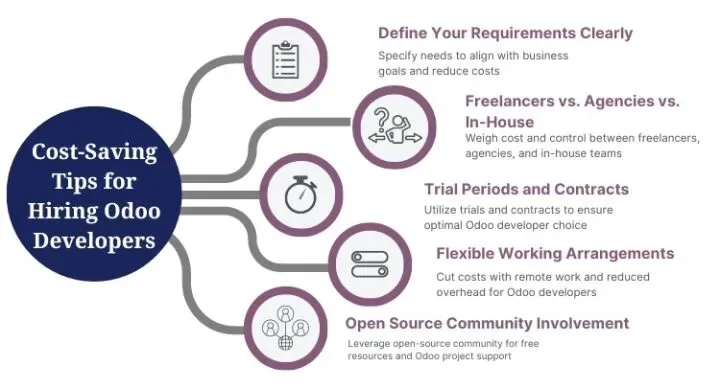
4. Freelancer, Agency, or In-House: Which is Right for You?
Freelance Odoo Developer | Cost-effective, direct communication, flexible. | High risk of disappearing, limited bandwidth, quality varies. | Smaller customizations, bug fixes, budget-conscious projects. |
Odoo Agency / Partner | Team of experts (developers + functional consultants), reliable, structured project management. | Expensive, slower communication channels. | End-to-end implementations, complex multi-app setups, long-term support. |
In-House Developer | Dedicated focus, deep understanding of your business, instant availability. | High overhead (salary, benefits), hard to recruit and retain. | Large enterprises with constant customization and maintenance needs. |
5. Summary and Next Steps
Hiring the right odoo developer is a strategic investment in your business’s infrastructure. SerpentCS prioritizing developers who understand Odoo’s specific architecture and respect business workflows, you’ll save thousands of dollars in technical debt and wasted development hours.
Remember:
1. Don't hire a generalist Python developer for specialized ERP work.
2. Test candidates with real-world Odoo scenarios, not abstract coding puzzles.
3. Look for developers who follow OCA standards to ensure your system remains upgradable.
Ready to take your business processes to the next level? Start by drafting a clear job description using the skills outlined above, and put your candidates to the test. Your ERP's success depends on it.