
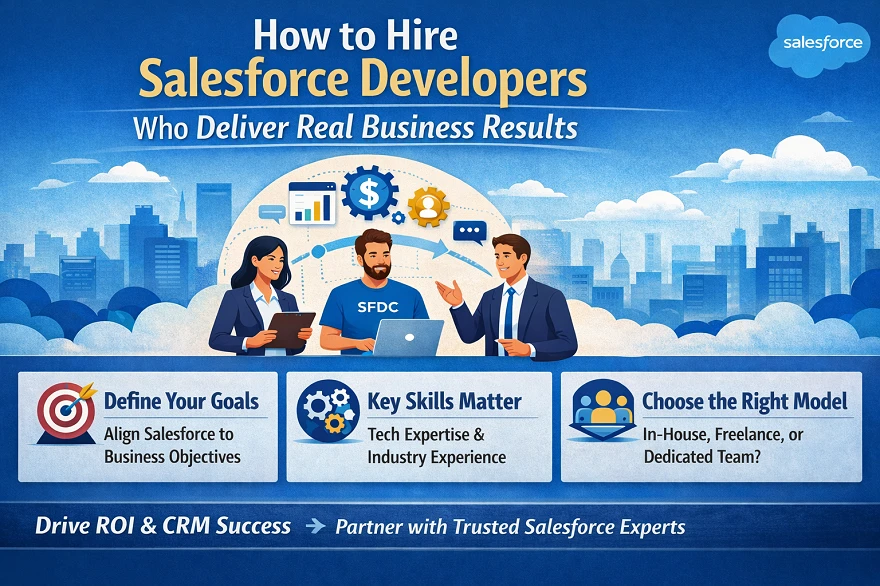
Making Salesforce developers a hiring choice does not qualify as a technical choice anymore, but a business strategy choice. In the case of U.S. firms in any industry, Salesforce is at the heart of sales, marketing, customer service, and analytics. When done properly, it fosters growth, efficiency and customer satisfaction. When not done well, it is a costly CRM that is shunned by the teams.
The difference is in who you are hiring.
The desire to hire Salesforce developers according to the certifications, price, or availability is a common mistake of many organizations. However, the true success will be in the ability to recruit developers who can relate to business objectives, acceptance of the product by the users, scalability, and ROI in the long term. This guide will assist you to hire Salesforce developers that will not simply build systems, rather provide you with quantifiable business outcomes.
Define Your Business Goals Before You Hire
Before you even begin screening the applicants figure out your reason to hire a Salesforce developer.
Ask yourself:
- Is it the first time you are using Salesforce?
- Is the existing set up something you need to optimize?
- Do you have a goal of automation of sales, better customer service, or using AI tools?
It is without clearly established targets that an able developer can develop features that do not match your business requirements. Specific goals assist you in determining the level of experience, technical expertise and industry knowledge needed to occupy the position.
Aligning the business strategy and technical implementation at Salesforce projects is the first step to success.
Key Skills to Look for in Salesforce Developers
Not all Salesforce developers are the same. To deliver real business value, look beyond surface-level skills.
Technical Skills That Matter
- Apex & Lightning Web Components (LWC) for custom development
- Salesforce integrations with third-party tools and APIs
- Automation tools like Flow, Process Builder, and AI-driven features
- Data security and performance optimization
Business & Industry Understanding
A strong Salesforce developer understands how sales pipelines work, how service teams operate, and how executives use dashboards for decision-making. Industry experience in healthcare, finance, SaaS, or retail is a major plus.
Certifications (Useful, Not Everything)
Certifications validate knowledge—but hands-on experience and problem-solving ability matter more.
Experience Over Cost: Why Cheap Hiring Often Fails
One of the most common hiring mistakes is choosing developers based on the lowest hourly rate. While cost control is important, underqualified developers often lead to:
- Poor system performance
- Low user adoption
- Security risks
- Expensive rework and delays
In many cases, companies end up paying twice—once for the cheap hire and again to fix the problems.
Hiring experienced Salesforce developers ensures scalable architecture, cleaner automation, and solutions that grow with your business. The initial investment pays off through long-term stability and ROI.
In-House, Freelance, or Dedicated Team: What’s Best for Your Business?
There’s no one-size-fits-all hiring model. The right choice depends on your business size, project scope, and growth plans.
In-House Salesforce Developers
Best for large organizations with ongoing Salesforce needs and internal teams.
Freelance Developers
Suitable for short-term tasks or minor enhancements—but risky for complex or long-term projects.
Dedicated Salesforce Teams
Increasingly popular among U.S. businesses, dedicated teams provide flexibility, scalability, and access to certified experts without the overhead of full-time hiring.
Many companies now use hybrid models, combining internal leadership with external Salesforce specialists.
How to Evaluate Salesforce Developers Effectively
A resume alone doesn’t tell the full story. To hire Salesforce developers who deliver results, focus on real-world evaluation.
What to Look For
- Past Salesforce project examples
- Problem-solving approach, not just technical answers
- Clear communication and documentation skills
- Ability to translate business needs into Salesforce solutions
Red Flags
- Over-reliance on certifications with limited experience
- Lack of understanding of business workflows
- Poor communication or vague project explanations
Strong Salesforce developers think like consultants, not just coders.
Importance of Ongoing Support and Optimization
Salesforce is not a “set it and forget it” platform. Business needs evolve, customer expectations change, and Salesforce releases frequent updates.
To maintain performance and ROI, companies need:
- Continuous optimization
- Automation improvements
- AI and analytics enhancements
- Ongoing monitoring and support
This is where Salesforce Managed Services become critical, ensuring your CRM keeps delivering value long after implementation.
Collaborating with the Right Salesforce Consulting Company.
For most companies, to have an effective Salesforce consulting firm with experience is the least amount of time and risk to reach an outcome.
A reliable partner provides:
- Availability of Salesforce certified developers.
- Proven delivery frameworks
- The implementation timelines should be shortened.
- Development is not the only strategic guidance.
The firms such as Melonleaf Consulting assist U.S. firms in recruiting and growing Salesforce development assets and maintaining the high-level results-oriented attitude to automation, adoption, and quantifiable expansion.
Summary: Hire based on Results, Not Skills.
Recruiting Salesforce developers that can produce tangible business outcomes cannot be achieved without performing technical screening. It must be clear, strategic and value-oriented in the long term.
Further refining your objectives, making experience a priority, selecting an appropriate hiring model, and collaborating with reliable specialists, you will be able to make Salesforce not only a powerful growth engine but also a simple CRM.
Regardless of whether you are starting fresh or working on an existing system, Salesforce developers are the difference, as is the partners.