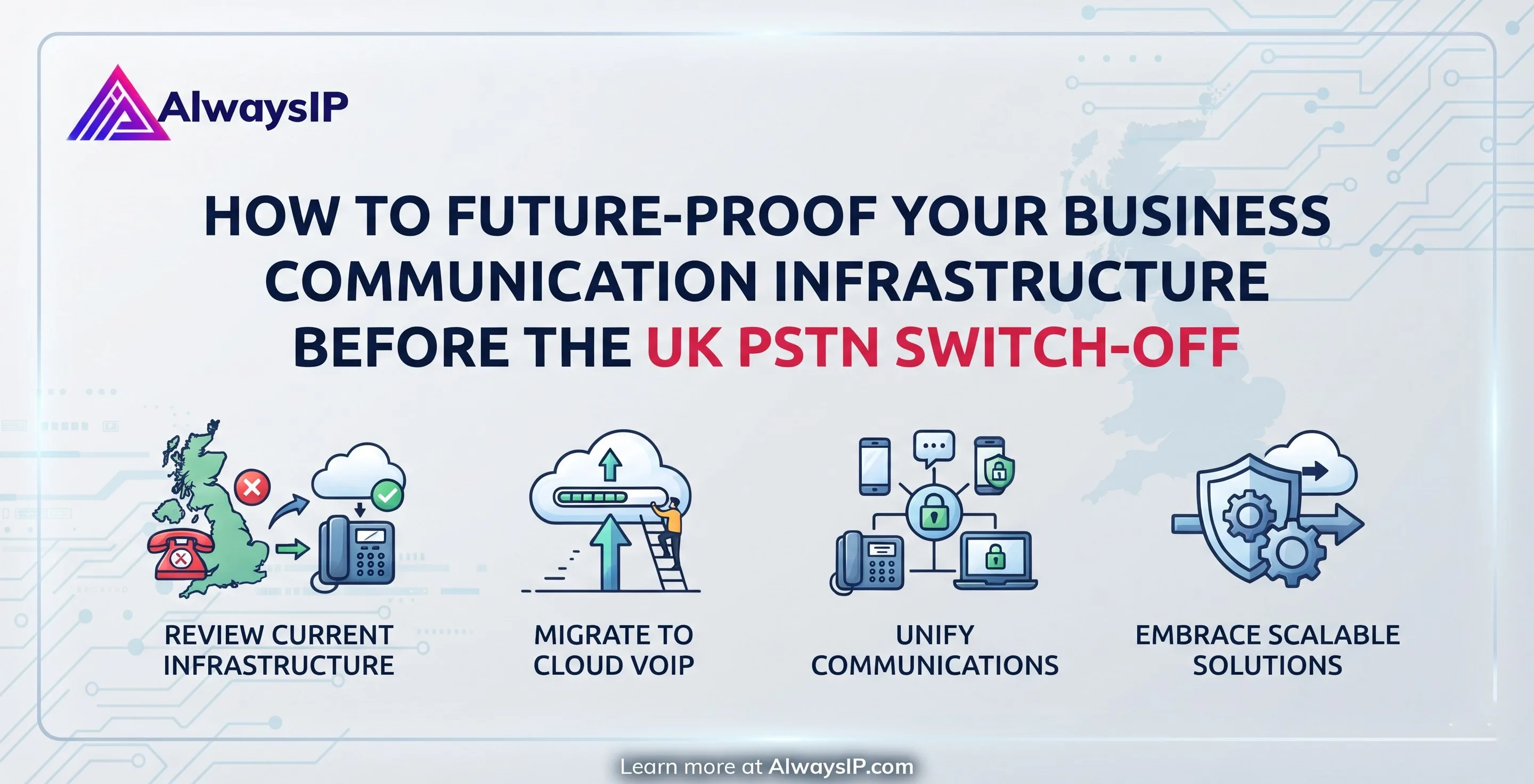
The way businesses communicate is changing rapidly. Traditional telephone systems that have supported UK businesses for decades are gradually being replaced by modern digital communication technologies. With the UK's PSTN switch-off approaching in January 2027, businesses need to start preparing for a future where traditional analogue telephone services are no longer available.
For many organisations, this transition involves more than simply replacing an old telephone system. It is an opportunity to improve customer communication, support remote working, reduce operational costs and introduce smarter technologies such as cloud telephony and artificial intelligence.
Choosing the right Business Communication Solutions UK businesses can rely on is becoming increasingly important. A modern communication infrastructure should be flexible, scalable, secure and capable of supporting changing business requirements.
In this guide, we explore how UK businesses can prepare for the PSTN switch-off and future-proof their communication infrastructure with the right technologies.
Understanding the UK PSTN Switch-Off
The Public Switched Telephone Network (PSTN) is the traditional telephone network that has connected homes and businesses across the UK for many years. It relies on analogue technology and copper-based infrastructure to deliver traditional landline telephone services.
However, as communication technology advances, maintaining this ageing infrastructure has become increasingly difficult and expensive.
The UK telecommunications industry is moving towards digital, internet-based alternatives, with the planned withdrawal of traditional PSTN and associated ISDN services by January 2027.
This change will affect businesses that still depend on traditional telephone lines for everyday operations.
Some of the services and equipment that may be affected include:
- Traditional business landlines.
- ISDN telephone systems.
- Analogue telephone handsets.
- Fax machines connected to traditional lines.
- Alarm and security systems using analogue connections.
- EPOS and payment terminals that rely on older telephone connections.
- Lift emergency communication systems.
- CCTV and monitoring equipment using legacy connections.
Businesses should speak to their telephone provider and equipment suppliers to understand which services need to be migrated and what alternative arrangements are required.
Why Businesses Should Upgrade Their Communication Infrastructure Now
Waiting until traditional telephone services are withdrawn can create unnecessary pressure. Businesses that leave migration until the last minute may face limited installation availability, unexpected costs and avoidable disruption.
Preparing early gives organisations more time to assess their requirements and choose suitable communication technologies.
Here are some important reasons to upgrade.
1. Avoid Communication Disruption
Telephone communication remains essential for many businesses. Sales enquiries, customer support, supplier discussions and internal coordination all depend on reliable communication.
An outdated telephone system can become a business risk when the underlying network is withdrawn.
Moving to a modern cloud-based phone system allows businesses to manage calls through an internet connection rather than depending on traditional telephone lines.
With the right planning, businesses can migrate their numbers, configure call routing and test their new system before making the full transition.
2. Improve Customer Experience
Customers expect businesses to be accessible and responsive. Missed calls, long waiting times and poorly managed call transfers can create frustration and damage customer relationships.
Modern communication systems provide features that help businesses manage incoming calls more effectively.
These may include:
- Intelligent call routing.
- Automated attendants and IVR.
- Call queues and waiting announcements.
- Call recording.
- Voicemail-to-email.
- AI-powered call transcription.
- Real-time call monitoring.
These features help businesses respond to customers more efficiently while giving employees better tools to manage conversations.
3. Support Remote and Hybrid Working
Modern workplaces are no longer restricted to a single office location. Employees may work from home, travel between locations or operate from different branches.
Traditional telephone systems can make flexible working more complicated, particularly when calls need to be transferred between office-based and remote employees.
Cloud-based communication platforms allow employees to make and receive business calls using supported desktop applications, mobile apps and compatible IP phones.
This helps businesses maintain a consistent communication experience regardless of where their teams are working.
5 Ways to Future-Proof Your Business Communication Infrastructure
Upgrading your telephone system should not be treated as a simple equipment replacement. Businesses should use the opportunity to build a communication infrastructure that supports their long-term goals.
Here are five practical steps to consider.
1. Move from Traditional Landlines to Cloud Phone Systems
One of the most effective ways to prepare for the PSTN switch-off is to replace traditional telephone services with a modern cloud phone system.
A cloud phone system uses internet connectivity to manage business calls. Instead of relying on physical telephone exchanges and traditional lines, call management is handled through a hosted platform.
This provides several advantages:
- No requirement for traditional PSTN telephone lines.
- Flexible user and extension management.
- Support for multiple office locations.
- Access through compatible desktop and mobile applications.
- Easier system expansion as the business grows.
- Centralised call management.
For growing businesses, cloud telephony offers greater flexibility than many traditional telephone systems.
When choosing a provider, consider call quality, service availability, security, technical support and the flexibility of its pricing structure.
2. Invest in VoIP Technology
Voice over Internet Protocol (VoIP) allows businesses to make and receive telephone calls over an internet connection.
It is a key technology behind modern digital business communication.
Unlike traditional landline services, VoIP can support employees across multiple locations without requiring every employee to have a separate physical telephone line.
Businesses can use VoIP with compatible IP desk phones, softphones and mobile applications.
Important VoIP features to consider include:
- Call forwarding and call transfer.
- Call recording and archiving.
- Call waiting and call parking.
- Conference calling.
- Business voicemail.
- Call reporting and analytics.
- CRM integration.
- Multi-device access.
Before implementing VoIP, businesses should assess their internet connection, network capacity and internal infrastructure to ensure they can support the expected call volumes.
A properly configured VoIP solution can improve communication flexibility while helping businesses manage their telephone costs.
3. Introduce AI-Powered Communication Features
Artificial intelligence is becoming an important part of modern business communication.
Rather than relying entirely on manual processes, businesses can use AI-powered features to simplify call management and improve access to important customer information.
For example, AI call transcription can convert conversations into written text, making it easier for employees to review discussions and find important information.
Other useful features include:
- AI Call Transcription: Converts telephone conversations into searchable text, helping employees review customer interactions.
- AI Call Summaries: Creates concise summaries of conversations, helping teams identify key discussion points and follow-up actions.
- AI-Powered IVR: Helps direct incoming callers towards the appropriate department or service.
- Voicemail-to-Text: Converts voicemail messages into readable text so employees can review messages without listening to every recording.
- Call Analytics: Helps managers understand call activity, identify trends and monitor communication performance.
When introducing AI features, businesses should also consider data protection, access controls, recording consent and their responsibilities under applicable UK privacy regulations.
The right AI tools can reduce repetitive administrative work and help employees focus on more valuable customer interactions.
4. Integrate Your Phone System with Business Software
A modern communication system should work alongside the other tools your business already uses.
For example, integrating your phone system with a Customer Relationship Management (CRM) platform can make it easier for employees to manage customer conversations.
With suitable CRM integration, businesses may benefit from:
- Click-to-call functionality.
- Automatic customer record pop-ups.
- Call activity tracking.
- Contact synchronisation.
- Call history and journalling.
- Improved visibility of customer interactions.
When a customer calls, an employee can quickly access relevant customer information rather than searching through multiple systems.
This can improve response times, reduce manual administration and help teams deliver a more consistent customer experience.
Before choosing a communication provider, check which CRM platforms and business applications it supports.
5. Strengthen Your Internet and Network Infrastructure
Moving to digital communication means that your internet connection becomes an important part of your telephone infrastructure.
Poor network performance can affect voice quality, cause delays and interrupt important business conversations.
Businesses should review their connectivity before migrating to VoIP or cloud telephony.
Consider the following areas:
- Internet speed and available bandwidth.
- Network stability and reliability.
- Router and firewall configuration.
- Quality of Service (QoS) settings.
- Network security.
- Backup internet connectivity.
- Power backup for essential communication equipment.
For organisations with high call volumes or multiple locations, a business-grade broadband connection or leased line may be worth considering.
The objective is to ensure that voice traffic receives appropriate network priority and that employees can communicate without unnecessary interruptions.
Common Mistakes Businesses Should Avoid During the PSTN Migration
Although the PSTN switch-off creates an opportunity to modernise business communications, rushing the migration can lead to problems.
Here are some common mistakes to avoid.
Leaving the Migration Until the Last Minute
Delaying the process can make it difficult to arrange installations, test equipment and resolve compatibility issues. Start planning early.
Ignoring Connected Equipment
Not every device connected to a traditional telephone line is a standard telephone. Alarms, lift phones, payment terminals and other equipment may need separate assessment.
Choosing a Solution Based Only on Price
The cheapest package may not provide the features, support or reliability your business requires. Consider long-term value rather than installation cost alone.
Overlooking Employee Training
Employees should understand how to use the new system, transfer calls, access voicemail and use mobile or desktop applications.
Failing to Plan Number Porting
If your existing business telephone numbers are important, discuss number portability with your new provider before migration. Confirm the process and avoid cancelling existing services before the transfer is completed.
How to Choose the Right Business Communication Solutions UK Providers Offer
Selecting the right provider is one of the most important decisions when upgrading your communication infrastructure.
Not every business has the same requirements. A small office may need a straightforward cloud phone system, while a larger organisation may require advanced call routing, contact centre functionality and integrations.
When comparing Business Communication Solutions UK providers, consider these factors:
- Scalability: Can the system support additional users, extensions and locations as your business grows?
- Advanced Features: Does it offer call recording, AI transcription, call analytics, IVR and CRM integration?
- Device Compatibility: Can employees use desk phones, mobile applications and desktop softphones?
- Customer Support: Is technical assistance available when your communication system experiences problems?
- Security: Does the provider offer appropriate security controls, encryption and account protection?
- Flexible Pricing: Are there clear costs for users, features, installations and additional services?
- Migration Support: Can the provider help assess your existing infrastructure, plan number porting and manage the transition?
A reliable provider should understand your business requirements rather than simply recommend a standard package.
How AlwaysIP Can Help Your Business Prepare for the PSTN Switch-Off
Preparing for the PSTN switch-off is an opportunity to move beyond traditional telephone systems and adopt a more flexible approach to business communication.
AlwaysIP provides modern business communication services designed to help organisations improve the way they connect with customers and employees.
Whether you operate a small business, manage multiple offices or handle a high volume of customer calls, the right communication solution can make everyday operations easier.
With AlwaysIP, businesses can explore solutions and features such as:
- Cloud Phone Systems: Manage business calls through a flexible cloud-based platform.
- VoIP Solutions: Make and receive business calls over an internet connection.
- Cloud PBX: Manage extensions, departments and incoming calls through a centralised phone system.
- AI Call Transcription: Turn conversations into searchable written records.
- Smart IVR: Direct callers to the right department.
- Call Monitoring: Access call activity and monitoring tools to support team performance.
- CRM Integration: Connect business calling with supported customer management platforms.
- Mobile and Desktop Softphones: Allow employees to communicate from different locations.
AlwaysIP can help businesses assess their communication requirements and explore suitable solutions for their next stage of digital transformation.
Don't wait until your existing telephone services become a problem. Start planning your migration today.
Visit AlwaysIP to explore modern business communication solutions.
Conclusion
The UK PSTN switch-off is an important milestone for businesses that still depend on traditional telephone infrastructure. However, it should not be viewed simply as a challenge or a replacement exercise.
It is an opportunity to improve how your organisation communicates.
By moving to cloud telephony, adopting VoIP, introducing AI-powered features, integrating business applications and strengthening internet connectivity, businesses can create a communication infrastructure that is ready for future demands.
Choosing the right Business Communication Solutions UK providers offer can help your organisation reduce communication limitations, improve customer experiences and support long-term business growth.
The best time to review your existing telephone infrastructure is before it becomes an urgent issue. Assess your requirements, speak to a trusted provider and make a migration plan that keeps your business connected.
Frequently Asked Questions (FAQs)
1. What is the UK PSTN switch-off?
The UK PSTN switch-off is the planned withdrawal of traditional analogue telephone services as the telecommunications industry moves towards digital communication technologies. The planned completion date for the UK transition is January 2027, although individual providers and services may have different migration arrangements.
2. How will the PSTN switch-off affect UK businesses?
Businesses that rely on traditional telephone lines and ISDN services may need to upgrade their telephone systems. Connected equipment such as alarms, fax machines, payment terminals and lift communication systems may also require assessment before migration.
3. What are the best alternatives to traditional business landlines?
Cloud phone systems and VoIP are popular alternatives to traditional business landlines. They allow businesses to make and receive calls over internet connections while providing features such as call forwarding, IVR, call recording and mobile access.
4. What are Business Communication Solutions UK businesses should consider?
Businesses should consider cloud phone systems, VoIP, Cloud PBX, SIP trunking, AI-powered call features, CRM integration and reliable internet connectivity. The best combination depends on business size, communication requirements and future growth plans.
5. Can I keep my existing business telephone number when switching to VoIP?
In many cases, yes. Businesses can usually transfer eligible existing telephone numbers to a new VoIP or cloud telephony provider through a process called number porting. Availability and requirements should be confirmed with the chosen provider.
6. Is VoIP suitable for small businesses in the UK?
Yes. VoIP can be a practical option for small businesses because it offers flexible user management, lower dependence on traditional telephone infrastructure and access to advanced calling features. Businesses should ensure their internet connection is suitable before migrating.
7. Does a cloud phone system require special telephone equipment?
Not necessarily. Many cloud phone systems support compatible IP desk phones, desktop applications and mobile apps. This allows businesses to choose the devices that best suit their working environment.
8. How can AI improve business communication?
AI can support business communication through call transcription, conversation summaries, intelligent call handling and voicemail-to-text. These features help employees access information more quickly and reduce repetitive administrative tasks.
9. How early should a business prepare for the PSTN switch-off?
Businesses should assess their existing telephone lines, connected equipment and communication requirements as early as possible. Starting the process well before the planned withdrawal helps provide enough time for selecting a provider, testing equipment and completing migration.
10. How can AlwaysIP help businesses upgrade their communication systems?
AlwaysIP offers business communication services including cloud phone systems, VoIP, Cloud PBX, AI-powered calling features and CRM integration. Businesses can explore suitable solutions based on their communication needs and future requirements.