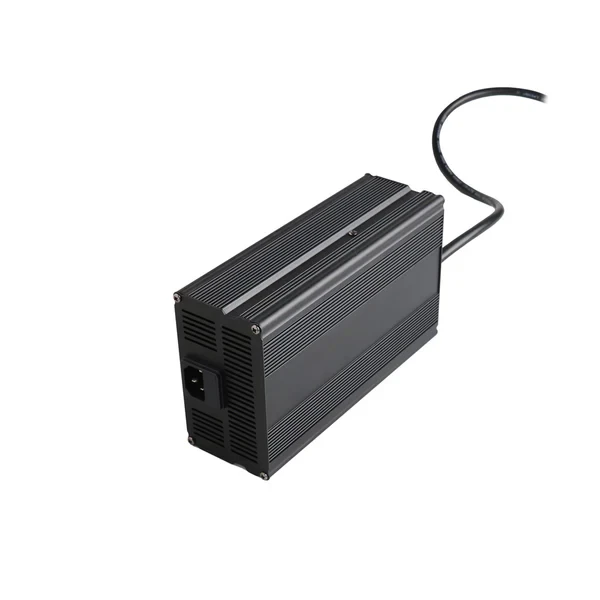
The choice of charger for LiFePO4 batteries is a critical factor that determines the battery's life, performance, and safety. LiFePO4 batteries are widely used in solar energy systems, electric vehicles, and portable power applications due to their stability, high cycle life, and low self-discharge rate. However, most chargers cannot charger for lifepo4 batteries at the same voltage, capacity, and chemistry as their corresponding battery, and therefore will not work well.
Key Factors
Voltage of the battery and the series arrangement.
The nominal voltages of each LiFePO4 cell are 3.2 volts. Batteries are stacked together to achieve the required operating voltage. There are usually four cells in series in a 12-volt battery. Before purchasing a charger, ensure that your battery pack has a total voltage rating that matches the charger's output voltage.
Capacity (Ah ) and charging current.
The ampere-hours are used as a measure of the battery capacity. A charger that provides excessively high current may reduce the battery life, whereas a charger that provides excessively low current will take too long and may fail to charge the pack completely.
Type of charger: constant current, constant Voltage, or both.
A majority of LiFePO4 chargers feature a constant current (CC) phase, which charges the cells with a fixed current until the top-end point is reached. Thereafter, the charger switches to a constant voltage (CV) phase, maintaining this until the current decreases to a low level.
Voltage cut-off and cut-in levels.
The charger must be capable of halting charge to the cells when they have reached the highest safe Voltage (typically 3.65 volts per cell). It must also prevent this from happening when the Voltage on the battery decreases below the lowest safe value (approximately 2.5 volts per cell).
Temperature compensation
LiFePO4 batteries exhibit varying behaviour with respect to charging at low temperatures. The cells will be safeguarded by a charger with a temperature sensor that slows the charging rate when the battery is cold.
Efficiency and energy loss
An efficient charger will be able to transform a higher percentage of the AC or DC power entering it into an applicable charge. Find a charge with an efficiency rating of 90% or higher.
Communication and monitoring
Specific chargers may be managed and monitored through a serial interface or through a mobile application. It may be helpful if you intend to integrate the charger into a domestic power system.
Charging Modes & Profile
Normal charge mode
In normal mode, the charger provides a fixed current up to the cut-off voltage. It is the quickest method of charging a battery.
Maintenance, or trickle charge mode
Once the battery is fully charged, you can use a small trickle current to maintain it. It comes in handy when the battery is not frequently used.
Fast charge mode
Other chargers even permit a higher charging rate temporarily. Fast charging should be used only when instructed by the battery manufacturer that their fast-charging technology is safe.
Smart charge mode
Emergency backup power measures the temperature and battery voltage and automatically changes the charging current. It is the best mode for long-term storage and high-power applications.
Sustainable and long-term performance
Charge cycle life
LiFePO4 batteries have a cycle life of thousands of cycles. Optimizing cycle life involves using a charger that operates within the recommended charge window (2.5 to 3.65 volts per cell).
Balancing cells
With a series pack, the individual cells can be slightly out of balance. A charger with a cell-balancing mode will equalize the Voltage of each cell and avoid a weak cell in a pack, thereby limiting the impact on the entire pack.
Storage temperature
When the battery has a long lifespan, use a charger that maintains the pack at a low, safe voltage (typically about half the full charge).
DC conversion efficiency
When the renewable energy source is a solar panel, select a charger that can accept the variable input voltage while maintaining a constant output to the battery.
Safety & Consideration
1. Check whether the charger matches the safety standards, e.g., UL 2054, IEC 62133, or other local regulations.
2. Make sure the charger has an attached input to guard against surges.
3. Ensure the enclosure of the charger is certified to be used in the type of environment in which you intend to use it, indoor, outdoor, damp, etc.
4. Secure the battery connection by using an appropriate disconnect or circuit breaker.
Selecting The Right Charger
1. Be aware of your battery pack's Voltage, capacity, and manufacturer specifications.
2. Adjust the Voltage of the charger to match the Voltage of the pack.
3. Select a charger, the maximum current of which is one-third to one-half of the battery capacity. For example, a 10Ah battery would be expected to charge at an average rate of 3.3 to 5 amps.
4. Make sure the charger is equipped with the necessary safety features - overvoltage, overcurrent, and temperature.
5. When you have a solar set of panels on which you are going to use the charger, make sure to purchase a charger with an extensive input voltage range and with MPPT (Maximum Power Point Tracking) capability.
6. Search to find a charger that can offer a long-term trickle or storage mode.
7. In case you require remote monitoring, choose a charger that has a communication package such as RS-232, Modbus, or Bluetooth.
8. Read the reviews and check the reputation of the brand for reliability.
9. Make price comparisons, but do not select the lowest-priced one that does not offer the required safety and performance features.
Final Thoughts
When it comes to lifepo4 100ah 12v, selecting an appropriate charger is not only about finding a device capable of providing the correct Voltage. It involves creating a safe, effective, and sustainable charging system. Firstly, pay attention to the first three: the battery voltage, capacity, and chemistry. Next, find a charger that provides the appropriate charge profile, that has strong protection, and can adjust to changes in temperature. If you plan to incorporate the charger into a renewable energy system, consider efficiency and tracking capabilities.