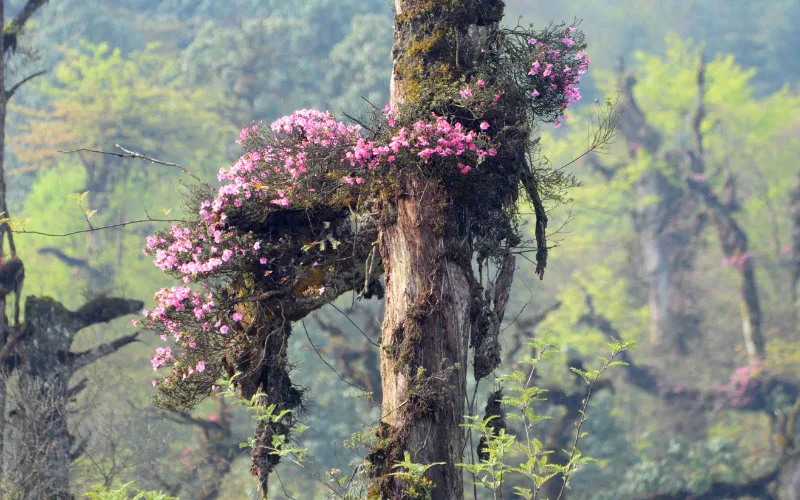
In China, the mountains and nature reserves provide excellent opportunities for photographers to capture images of rare and endemic flowers. The country's varied altitudes support an impressive array of flora, including forest orchids and rhododendrons, alongside primulas and alpine poppies.
If you are a photographer researching Wildflower Photography Locations China then you will discover some of the most rewarding locations in Sichuan Province and surrounding high - altitude areas. These sites provide spectacular mountain scenery, isolated valleys, colourful meadows, waterfalls, forests and wildlife habitats.
If you are a fan of close - up botanical photography, wide landscape compositions or wildlife and nature documentation, the following destinations offer great opportunities to photograph wildflowers in their natural settings.
1. Longcanggou Scenic Spot
Longcanggou Scenic Area is located between the Sichuan Basin and the Tibetan Plateau. It occurs in a rich transition zone where different climatic and ecological conditions meet.
The area is famous for its peaceful woods, foggy scenery, brooks and rich variety of plant species. The quietness of the neighbourhood is perfect for photographers looking for less - populated botanical locations.
Wildflowers and plants native to the area include :
• Tetracentron sinensis
• Monotropastrum humile
• appendiculatum Cremastra
• Phalaenopsis wilsonii
• Pleione bulbocodioides
• Paris polyphilla
• Wilson’s Oyama
• Syringa komarowii
• Thalictrum fargesii
• Galeola lindleyana
•Ribes laurifolium
• Rhododendron strigillosum.
Soft forest light and early morning mist can create atmospheric conditions for photographing flowers under the woodland canopy.
2. Wanglang Nature Reserve
The Wanglang Nature Reserve is in Pingwu County’s Minshan Mountains. The reserve is well - known for its biodiversity and is an important habitat for giant pandas, golden snub - nosed monkeys, takins and other wildlife.
Wanglang is also a great place to see animals and take photographs, and to look at alpine orchids, rhododendrons and native forest flowers. Photographers have the opportunity to record individual plants and the wider habitat in its mountain slopes, valleys and woodland environments.
Wanglang’s combination of wildlife and botanical diversity makes it a worthy destination for photographers interested in documenting full ecosystems and not just flowers.
Visitors are asked to respect reservation rules, stay on marked paths, and not disturb sensitive plants and animals.
3. Four Sisters Mountain
Siguniang Mountain is one of the most stunning alpine destinations in Sichuan Province. There are four main peaks in the range, the highest of which is Yaomei Peak at approximately 6,250 m above sea level.
The valleys, rocky slopes, forests and alpine meadows around here are rich with flowering plants. During warmer months, photographers can observe orchids and other rare and endemic species at various elevation zones.
It’s a particularly rewarding spot for wide - angle photography, with colourful flowers framing snow - covered peaks and expansive mountain scenery.
Siguniang Mountain is also popular with hikers and climbers. Photographers planning to shoot at higher elevations should prepare for cold weather, rapid weather changes and less oxygen.
4. Jiuzhaigou National Park
Jiuzhaigou National Park is in the northern Sichuan province's Aba Tibetan and Qiang Autonomous Prefecture. It is internationally famous for its colourful lakes, multi - level waterfalls, forested valleys and snow - capped mountains.
The park has multiple different ecosystems including temperate broadleaf and mixed forest. These habitats support rhododendrons, orchids, shrubs and many seasonal flowers.
Jiuzhaigou allows photographers to mix flower subjects with pictures of reflections, waterfalls, forest and mountain backgrounds. The light around lakes and wooded trails is always changing and can produce striking compositions at any time of day.
The park is a protected environment. Photographers should stay in designated visitor areas and should not step into fragile vegetation.
5. Wolong Natural Reserve
Wolong Nature Reserve is known as an important giant panda habitat, but the botanical diversity is just as impressive. The forests, valleys and mountain slopes are home to many rare and endemic plant species.
Possible notable floral subjects include :
• Cypripedium tibeticum
• Kingdonia uniflora.
• Pedicularis spp
• Primula species
The reserve provides opportunities for macro photography and environmental portraits of flowers growing in mountain habitats. Orchids and small alpine plants can be especially rewarding subjects, but may require patience and careful observation.
To improve the composition, photographers should avoid touching or moving flowers. A macro lens with a longer focal length can help to photograph delicate plants without disturbing them.
6. Huanglong National Nature Reserve
The Huanglong National Scenic Reserve is famous for its colourful limestone pools, forests, mountain valleys and alpine scenery. The turquoise water, pale mineral terraces, green vegetation and seasonal flowers contrast to make it one of the most visually distinctive destinations in the region.
The lower elevations support forests and many species of orchids, the higher elevations alpine meadows and cold adapted plants. The area is also home to important wildlife such as the Sichuan golden monkey.
Photographers can take close - ups of rare flowers or use the surrounding pools and mountains to create broader landscape compositions.
Visitors should walk slowly and stay hydrated due to high altitude and be prepared for sudden weather changes.
Tips For Taking Pictures of Wildflowers at High Altitudes
Technical preparation and responsible behaviour are both necessary for high altitude flower photography.
Some practical tips to keep in mind :
• Take the picture in the early morning or late afternoon when the light is softer.
• Bring a macro lens for close up botanical images.
• Use a wide - angle lens to photograph mountains and meadows.
• Lightweight tripod for low - light conditions in the forest.
• Keep camera equipment away from moisture and rain.
• Bring extra batteries; they deplete faster in cold weather.
• Do not pick, bend or move plants.
• Use established trails whenever possible.
• Before you go, check the weather and elevation.
• If looking for rare species, seek the assistance of a knowledgeable local guide.
Flowering times will depend upon altitude, rainfall, snowmelt and temperature. Travellers should therefore check the seasonal conditions before confirming their travel.
Final Thoughts
Top Wildflower Photography Locations China supplies in remote forests, alpine mountains, protected reserves and scenic national parks. Longcanggou is good for tranquil woodland photography, Wanglang mixes plants and wildlife, Siguniang offers dramatic mountain landscapes and Jiuzhaigou has colourful lakes and a variety of flowers. Wolong and Huanglong offer more chances to take photographs of rare plants within the protected natural environment.
If you want to visit these places, you can contact a seasoned specialist like WildFlora Tour to arrange your trips. A thoughtfully planned itinerary can direct visitors to appropriate places to see flowers, learn about local conditions and responsibly photograph China’s botanical bounty.