
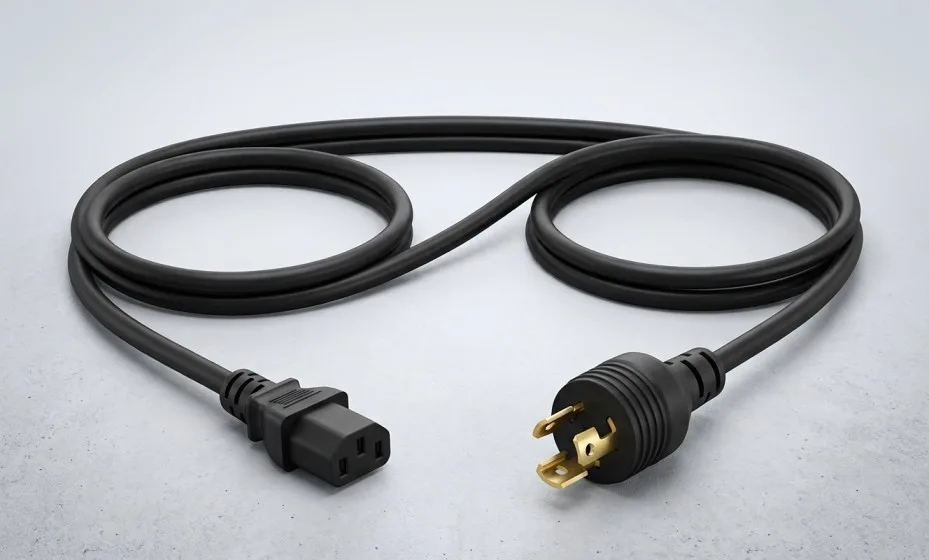
A power cord that slips out of its outlet at the wrong moment can interrupt a server, drop a UPS load, or shut down lab equipment in the middle of a task. Locking power cords solve that problem by twisting and locking into place. Choosing the right one, however, takes more than finding a plug that fits. Rating, wire gauge, and length all affect whether the cord is safe and dependable for your setup. This guide explains how a NEMA L5-15P locking plug works and how to choose a cord that matches your equipment, your outlet, and your space.
What Is a NEMA L5-15P Plug?
NEMA stands for the National Electrical Manufacturers Association, which sets the standards for plug and outlet shapes used across North America. The name NEMA L5-15P follows a simple code. The L means locking, the 5 identifies the configuration (125 volts, with a ground), the 15 is the amperage rating, and the P means plug. A matching outlet carries an R instead of a P, for receptacle.
A NEMA L5-15P has three curved blades. You push it into a matching L5-15R receptacle and give it a quarter turn. The curved blades lock behind contacts inside the outlet, so the cord will not pull free unless someone deliberately twists it back.
How It Differs From a Standard NEMA 5-15P Power Cord
Most people know the standard NEMA 5-15P power cord, the familiar plug with two flat blades and a round ground pin. It pushes straight into any standard household outlet and pulls straight out just as easily. That convenience is also its weakness in critical setups, because a bumped cable can disconnect it.
The locking version carries the same voltage and current rating, 125 volts and 15 amps, but uses a different blade shape. That means a NEMA L5-15P will not fit a standard outlet, and a standard NEMA 5-15P power cord will not fit a locking receptacle. This is deliberate. The shapes are designed so that only compatible parts can be joined. Before buying, always confirm which type of outlet you actually have.
When choosing a locking power cord, it is also important to understand how it differs from a NEMA 5-20 power cord. A standard 5-20P power cord uses a NEMA 5-20P plug designed for a compatible 20-amp, 125-volt receptacle, while a NEMA L5-15P locking cord uses a twist-lock connection rated for 15 amps at 125 volts. A 5-20P power cord is commonly used with compatible equipment that requires a higher current capacity, making it important to check the plug configuration, wire gauge, and overall cord rating before purchasing. Although a 20 amp power cord may be suitable for certain higher-power applications, it must match the equipment's requirements, the receptacle, and the circuit rating. Always verify these specifications to ensure a safe and reliable power connection.
Step One: Check the Rating
The rating is the first thing to confirm. A NEMA L5-15P plug is rated for 15 amps at 125 volts. But a cord has two ends, and the cord is only as capable as its weakest part. Many locking cords have a C13 connector on the equipment side. Depending on the design, the C13 end is often rated at 10 amps, though some North American cords are rated for 15 amps at 125 volts. Always read the label to see the rating for the whole cord, not just the plug.
To estimate your load, add up the wattage of the equipment and divide by the voltage. A device drawing 900 watts on a 120-volt supply pulls about 7.5 amps. As a rule of thumb, keep continuous loads to about 80 percent of the cord's rating. That leaves a safety margin for startup surges and warm rooms. Also remember that the outlet, the circuit, and any power distribution unit have their own limits, and the cord cannot exceed them.
Step Two: Understand Wire Gauge
Wire gauge describes the thickness of the copper conductors inside the cord, measured in American Wire Gauge, or AWG. The number works backward: a smaller number means a thicker wire. A 14 AWG cord is thicker than a 16 AWG cord, and a 16 AWG cord is thicker than an 18 AWG cord.
Thicker wire carries more current with less heat and less voltage drop. As a general guide for common flexible cords, 18 AWG is suited to loads up to about 10 amps, 16 AWG to about 13 amps, and 14 AWG to 15 amps. For light equipment such as a small network switch or monitor, 18 AWG is usually enough. For power-hungry equipment, or anything that runs around the clock, 16 or 14 AWG gives you extra margin.
Step Three: Pick the Right Length
Length affects both safety and tidiness. A longer cord has slightly more resistance, which means a bit more voltage drop and heat. On short runs the difference is small, but on long runs feeding demanding equipment, a heavier gauge becomes more important.
Measure the real path the cable will travel, including bends, vertical runs, and a little slack so that plugs are not pulled sideways. In a rack or cabinet, cords of one to three feet keep things neat and improve airflow. In a workshop or on a stage, six to ten feet is a common range.
Other Features Worth Checking
Once rating, gauge, and length are settled, look at build quality. The plug body should feel solid, with strain relief where the cable enters the plug. The jacket should suit the environment. A standard thermoplastic jacket works well indoors, while hot, oily, or high-traffic areas may need a tougher covering. Also look for a recognized safety certification mark from an independent testing laboratory. It shows that the cord has been tested for insulation, heat resistance, and mechanical strength. A cord with no visible markings is a warning sign.
Final Thoughts
A locking cord looks like a small upgrade, but the details decide whether it is truly safe and dependable. Understanding what a NEMA L5-15P is, how it differs from a standard NEMA 5-15P power cord, and how rating, gauge, and length work together will help you choose a cord that fits your equipment and keeps it powered. A few minutes of checking before you buy can prevent overheating, unexpected shutdowns, and costly replacements later.
Original Article :- https://instantguestpost.com/how-to-choose-the-right-nema-l5-15-locking-power-cord-rating-gauge-and-length