The Wrong Dark Store Location Will Fail Regardless of How Good Your App, Your Stock, or Your Team Is. Location Is Everything.
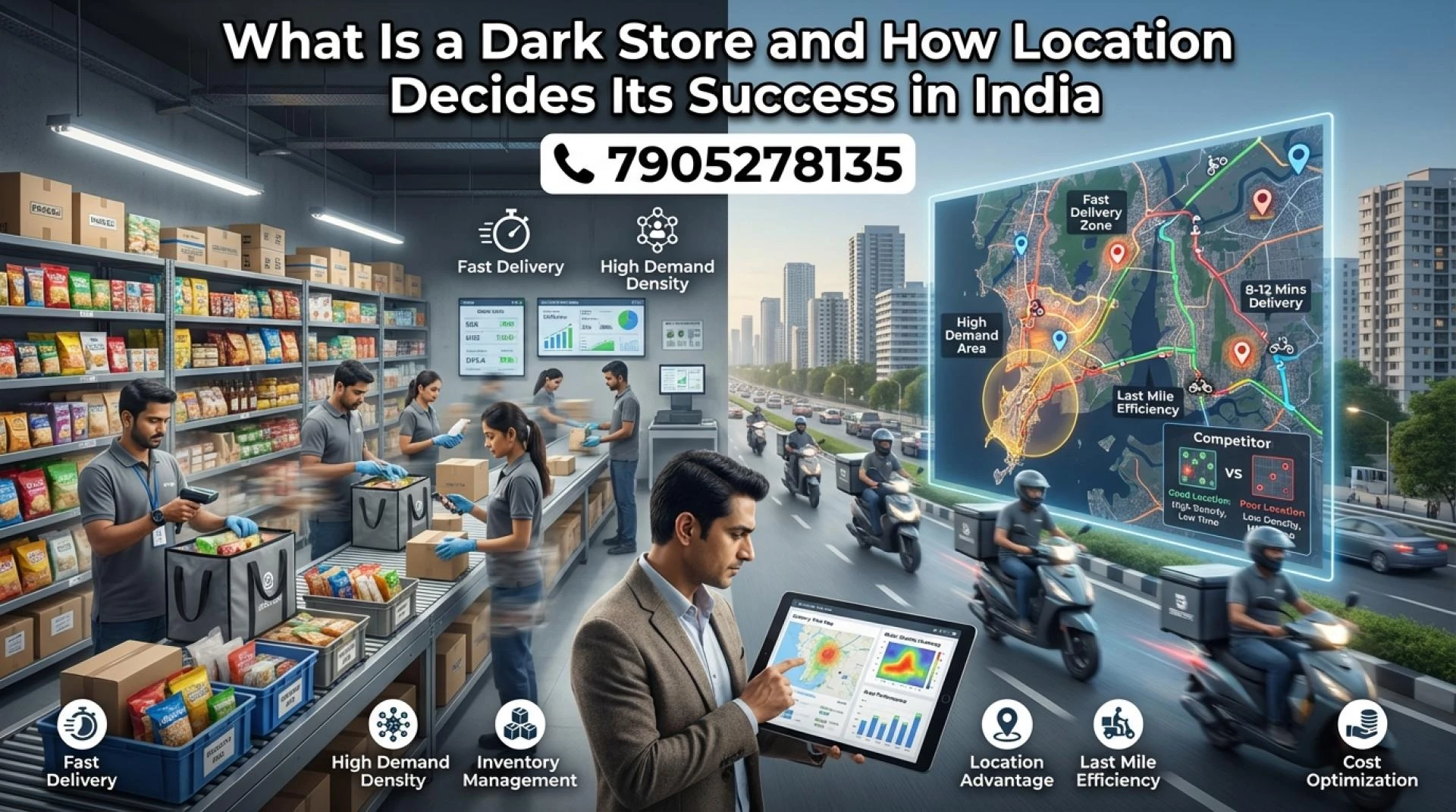
This is the most important truth about the dark store model. Blinkit, Zepto, and Swiggy Instamart have each shut down hundreds of dark store locations across India — not because the technology did not work or the staff were poor, but because the location did not generate sufficient order volume. A dark store in the right location fills itself with orders. A dark store in the wrong location is a money-burning exercise.
This guide gives you the systematic framework that professional quick commerce operators use to evaluate dark store locations in Indian cities. Whether you are evaluating a single dark store in one neighbourhood or planning a network of 10 across a city — the same framework applies.
The 5-Factor Dark Store Location Framework
Factor 1: Daytime and Evening Population Density
The primary metric for any dark store location evaluation. Use census data, Google Maps density indicators, or commercial data providers to estimate the number of households within 1, 2, and 3 km radii of the proposed location. Indian benchmarks for viable dark store density: minimum 15,000 households within a 2 km radius for a small 1,000 sq ft dark store; 30,000+ households within 3 km for a mid-size 3,000 sq ft operation with 600+ daily orders target.
Practical field test: visit the proposed location at 7 PM on a weekday evening. Count the residential buildings visible or within a 500-metre walk. A location surrounded by apartment towers and housing societies is promising. A location in a commercial-only zone or industrial area is not.
Factor 2: Competitive Coverage Gap Analysis
Before committing to any dark store location, map the existing dark stores of all quick commerce operators within a 4 km radius. If Blinkit, Zepto, and Instamart all have dark stores within 1.5 km — the area is well-served and highly competitive. If none exist within 3 km — there is an underserved opportunity. The practical way to check: open Blinkit, Zepto, and Instamart on your phone, type the proposed address, and see if they deliver there and how long the estimated time is. Very long estimated times (30 minutes+) or service unavailability often indicate a coverage gap.
Factor 3: Ground Floor Commercial Property Availability
Dark stores must be on the ground floor — riders cannot wait for elevators, and customer addresses are reached faster from ground level. In Indian cities, ground floor commercial space in residential-dense areas commands a significant premium. You are looking for: ground floor of mixed-use buildings (residential above, commercial below), standalone ground-floor commercial spaces in neighbourhood commercial markets, or purpose-built commercial blocks at the entry of residential colonies.
The rent range in Indian Tier-2 cities like Lucknow: ₹35 to ₹70 per sq ft per month for well-located ground floor commercial space in residential-dense areas. In Tier-1 metros: ₹80 to ₹200+ per sq ft. The higher rent is justified only if the order density supports it — this is why location analysis must precede any property commitment.
Factor 4: Rider Recruitment and Retention Potential
A dark store needs a consistent supply of delivery riders. Riders come from the community near the dark store — typically young men from working-class neighbourhoods adjacent to residential zones. The ideal dark store location has: easy rider access (near public transport or on a main road), proximity to areas where gig workers live, and good road connectivity for riders to reach all customer addresses within the service radius quickly.
Factor 5: Hub Warehouse Access for Replenishment
A dark store runs out of stock fast — popular items may need replenishment 2 to 4 times per day. The dark store location must be reachable from the central hub warehouse in under 30 to 45 minutes by road, with minimal traffic congestion on that route. In Lucknow, dark stores in central and north residential areas are ideally served by a hub warehouse on the NH-24 corridor — major roads connect the highway to city residential areas with manageable transit times.
🏭 ASHOKA WAREHOUSING — LUCKNOW
Affordable Warehouse / Dark Store Space for Rent on NH-24 Sitapur Road, Lucknow
💰 Rent: Only ₹18 per sq ft — minimum rent, maximum logistics value in Lucknow
📍 Location: Sitapur Road, NH-24 — Lucknow's top logistics corridor: warehouse near highway Lucknow
🏢 Space Type: Modern A-grade godown / commercial warehouse Lucknow — suits dark store, logistics space, storage facility, industrial shed operations
🚉 Connectivity: 20 min from Lucknow Junction | Daily courier pickup from all major platforms on NH-24 route
👥 Ideal For: Dark store operators · Q-commerce players · E-Commerce Fulfilment · FMCG distribution · Industrial shed for lease Lucknow · Bulk storage space Lucknow · Rent industrial property Lucknow
For dark store operators building or planning a Lucknow network, the hub warehouse location is as critical as the dark store locations. Ashoka Warehousing's facility on Sitapur Road, NH-24 provides the most logistics-efficient hub position in Lucknow for a dark store network operator. The NH-24 corridor connects to all major Lucknow residential areas via the city's arterial roads — making replenishment runs to dark stores across the city manageable within the required 30 to 45-minute windows. At ₹18 per sq ft, the hub warehouse cost stays competitive while the dark stores themselves absorb the higher per-sq-ft cost of their premium in-city locations. This hub-and-spoke economic model — efficient bulk storage at a competitive godown for rent on NH-24, with fast replenishment to city-located dark stores — is how the most cost-effective quick commerce operations in Indian Tier-2 cities structure their logistics space.
FAQs on Dark Store Location
Q: How large should a dark store be in India?
The optimal size of a dark store in India depends on the order volume target and SKU count. For a small neighbourhood dark store targeting 100 to 250 orders per day with 300 to 500 SKUs: 800 to 1,500 sq ft is sufficient with proper shelving. For a mid-size dark store targeting 250 to 600 orders per day with 500 to 1,500 SKUs: 1,500 to 3,000 sq ft. For a large urban dark store targeting 600 to 1,500+ orders per day with 1,500 to 3,000 SKUs: 3,000 to 6,000 sq ft. The general principle: a well-organised dark store with proper vertical shelving, a velocity-zoned layout, and an efficient packing station can handle more orders per sq ft than its size suggests. Blinkit and Zepto in India typically operate dark stores in the 1,500 to 4,000 sq ft range for most urban neighbourhoods. Sizing too large means paying premium city-centre rent for unused space — a critical economic mistake in the dark store model.