Temperature control is a critical part of modern manufacturing. Whether a production line involves plastics, packaging, pharmaceuticals, food processing, automotive components, batteries or industrial automation, maintaining the correct temperature can directly influence product quality, process consistency and equipment performance.
At the center of an effective thermal-control system is a reliable temperature sensor. The sensor provides the measurement that allows a controller to determine whether a process is operating within its required temperature range. If that measurement is inaccurate, unstable or poorly matched to the application, even a high-quality heating system may fail to deliver consistent results.
For this reason, choosing a temperature sensors manufacturer should be approached as an engineering decision rather than simply a procurement exercise.
What Are Industrial Temperature Sensors?
Industrial temperature sensors are measurement devices designed to detect temperature in machinery, equipment, processes or controlled environments.
Depending on the application, sensors can be designed to operate across different temperature ranges and under challenging conditions such as vibration, moisture, pressure, chemical exposure and continuous production cycles.
Two of the most widely used technologies are Resistance Temperature Detectors (RTDs) and thermocouples.
Although both measure temperature, their operating principles and characteristics are different. Selecting the appropriate technology requires an understanding of the process, required accuracy, response time, installation conditions and control-system requirements.
Why Temperature Measurement Is Important in Manufacturing
Temperature is often directly connected to process quality.
Consider a plastic-processing machine. Different heating zones may need to remain within defined temperature limits to ensure consistent material processing. A small measurement error can affect the actual thermal condition of the process.
Similarly, temperature measurement can be important during sealing and forming operations, pharmaceutical processing, food production and automated industrial machinery.
Reliable temperature measurement can help manufacturers achieve:
- More consistent process conditions
- Better product quality
- Improved heating control
- Reduced temperature fluctuations
- More predictable production cycles
- Better equipment protection
- Potential energy savings
- Easier process monitoring
However, these benefits depend on selecting and installing the appropriate sensor for the application.
RTD Sensors: When Accuracy and Stability Matter
RTD sensors measure temperature by monitoring changes in electrical resistance.
Platinum RTDs, including Pt100 sensors, are widely used for industrial temperature measurement where stable and repeatable measurements are important.
One reason engineers select RTDs is their suitability for applications where temperature measurement accuracy and repeatability are significant considerations.
An RTD Sensor manufacturer may provide different probe configurations, wiring arrangements, mounting options and protective constructions depending on the application.
When selecting an RTD, engineers should consider:
- Required temperature range
- Measurement accuracy
- Probe diameter
- Installation depth
- Wiring configuration
- Response time
- Environmental conditions
- Controller compatibility
The sensor should be specified according to the process rather than selected solely because it is a commonly used model.
Thermocouples: Flexible Temperature Measurement
Thermocouples use two dissimilar metals to generate a voltage related to temperature.
They are available in different types, each designed for particular temperature ranges and operating environments.
Thermocouples are frequently considered for applications where rapid response, compact construction or higher-temperature measurement is important.
A professional Thermocouple manufacturer should be able to help determine which thermocouple type and construction are appropriate for a specific application.
The choice may depend on:
- Maximum process temperature
- Required measurement range
- Response time
- Mechanical conditions
- Installation method
- Sensor sheath
- Cable requirements
- Controller input
Thermocouples can be highly practical, but selecting the correct type and construction remains essential for dependable measurement.
RTD vs Thermocouple: Which One Should You Choose?
There is no universal answer.
An RTD may be preferable when measurement stability and accuracy are major priorities within its suitable temperature range. A thermocouple may be more appropriate when rapid response, compact construction or higher-temperature measurement is required.
Why Custom Sensor Design Can Be Important
Standard sensors are convenient, but industrial machinery does not always follow standard dimensions.
A sensor may need to fit into a restricted space, connect to a specific controller, withstand vibration or reach a particular measurement point.
In these situations, customization can be valuable.
A custom sensor can be designed around requirements such as:
- Probe length
- Probe diameter
- Mounting arrangement
- Thread specifications
- Cable length
- Connector type
- Sheath material
- Sensing element
- Operating temperature
- Installation environment
Working with an experienced temperature sensor manufacturer can help engineering teams translate these requirements into a practical sensor configuration.
This is particularly relevant for OEMs and machinery manufacturers developing equipment for specialized industrial applications.
Temperature Sensors Should Be Considered With the Heating System
A temperature sensor does not operate independently.
In many industrial applications, the thermal system consists of three closely connected elements:
Heating element → Temperature sensor → Temperature controller
The heating element supplies thermal energy. The sensor measures the resulting temperature. The controller uses the sensor's signal to regulate the heating process.
If these components are poorly matched, the system may experience slow response, overshooting, unstable temperatures or inefficient operation.
For example, an application requiring localized heating may use a cartridge heater together with a suitably positioned temperature sensor.
Applications requiring different heating configurations may use coil heaters, tubular heaters or ceramic heating solutions.
The important consideration is not simply which heater is selected, but how the heater, sensor and controller function together.
The Importance of Sensor Placement
Even a high-quality sensor can provide poor process information if it is installed in the wrong location.
Sensor placement should reflect the actual temperature that needs to be measured.
For example, measuring temperature too close to a heating element may produce a reading that does not accurately represent the temperature of the material or process.
Engineers should consider:
- Heat distribution
- Distance from the heating source
- Material flow
- Thermal gradients
- Air movement
- Surface temperature
- Process response time
The installation position should be selected based on the purpose of the measurement.
Matching Sensors With Temperature Controllers
A temperature sensor produces a signal that must be correctly interpreted by the control system.
Therefore, compatibility between the sensor and temperature controller is essential.
The engineering team should verify:
- Sensor type
- Input signal
- Temperature range
- Wiring requirements
- Controller compatibility
- Control strategy
- Required accuracy
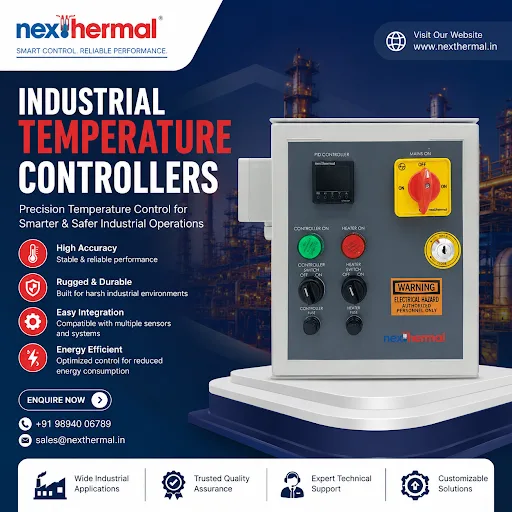
For industrial applications requiring coordinated temperature regulation, industrial temperature controller solutions can form part of a broader thermal-control system.
Larger systems may also require a dedicated temperature control panel to organize monitoring and control functions.
Industries That Use Industrial Temperature Sensors
The applications for industrial temperature sensors extend across many manufacturing sectors.
Plastics Processing
Temperature control is important in extrusion, molding and other polymer-processing operations. Sensors can monitor individual heating zones and support stable processing conditions.
Food Processing and Packaging
Temperature measurement can be used during heating, sealing, forming and other processes where thermal consistency affects product or package quality.
Pharmaceutical Manufacturing
Temperature monitoring is relevant to numerous pharmaceutical manufacturing and processing environments where controlled conditions are required.
Automotive Manufacturing
Industrial heating and temperature measurement can support manufacturing processes involving components, materials and automated production equipment.
Battery Manufacturing
Temperature monitoring is increasingly important across different stages of battery production. Sensor specifications need to reflect the particular process and environmental conditions.
Industrial Automation
Automated machinery depends on reliable feedback from sensors. Temperature information can be integrated into machine-control systems for monitoring and regulation.
What to Look for in Temperature Sensor Manufacturers in India
India has a growing manufacturing ecosystem, creating demand for locally available industrial sensing and thermal-engineering solutions.
When evaluating temperature sensor manufacturers in India, buyers should look beyond product catalogues.
Important considerations include:
Engineering Experience
Does the manufacturer understand industrial heating and temperature-control applications?
Customization Capability
Can the manufacturer modify sensor dimensions, cables, mounting arrangements and other specifications when required?
Manufacturing Quality
Are manufacturing processes documented and quality controlled?
Technical Support
Can engineers discuss application requirements and recommend a suitable configuration?
Integration Capability
Can the supplier understand the relationship between sensors, heating elements and controllers?
Industry Experience
Experience across multiple industries can provide useful insight into different operating conditions and application challenges.
Nexthermal, for example, positions itself around heating elements, temperature sensors, controls and thermal engineering solutions, allowing temperature measurement to be considered within a broader thermal-system context.
Questions to Ask Before Ordering a Temperature Sensor
Before contacting a supplier, it is useful to prepare a basic application specification.
Ask:
- What is the normal operating temperature?
- What is the maximum temperature?
- What accuracy is required?
- How quickly does the process temperature change?
- Where will the sensor be installed?
- What type of mounting is required?
- What environmental conditions will the sensor experience?
- Which controller or instrumentation system will receive the signal?
- Is a standard sensor suitable?
- Would a customized sensor provide a better installation?
Providing this information can make supplier discussions more productive and reduce the possibility of selecting an unsuitable configuration.
How Experienced Manufacturers Add Value
The role of a sensor manufacturer can extend beyond producing the sensing element.
An experienced supplier can help identify practical issues that may not be obvious during initial procurement.
For example, the engineering team may discover that the required probe diameter is too large for the installation location, the sensor cable needs additional protection, or the selected sensing technology is not optimal for the operating temperature.
Early technical discussion can prevent these issues from becoming expensive modifications after installation.
For organizations developing new machinery, working with a thermal engineering partner from the design stage can also help coordinate heating elements, sensors and controllers.
Nexthermal provides thermal engineering services alongside heating, sensing and control solutions, which can be relevant for manufacturers seeking a more integrated approach.
Future of Industrial Temperature Measurement
Manufacturing is becoming increasingly data-driven. Temperature sensors are no longer used only to display a temperature value; their measurements can become part of automated control, process monitoring and equipment-management systems.
As factories adopt greater automation, sensor reliability becomes increasingly important.
The future of industrial temperature measurement is likely to focus on better integration, faster response, improved repeatability, compact designs and application-specific sensing solutions.
For manufacturers, the practical lesson is straightforward: the sensor should be selected as part of the process-control strategy rather than as an isolated component.
Choosing the Right Partner for Your Application
Selecting a temperature sensor manufacturer is ultimately about finding the right balance between measurement requirements, installation conditions, reliability and system compatibility.
RTDs can be valuable where stable and accurate measurement is required, while thermocouples offer flexibility across a wide range of industrial applications. Custom configurations can provide additional advantages when standard products cannot meet machine-specific requirements.
For businesses comparing industrial temperature sensors or evaluating temperature sensor manufacturers in India, the best starting point is a clear application specification and a technical discussion with the manufacturer.
A well-designed temperature measurement system can contribute to more consistent manufacturing, better process control and more reliable equipment operation.
For application-specific requirements involving temperature sensors, heating elements and industrial controls, organizations can consult Nexthermal's temperature sensor solutions and discuss their requirements with its engineering team.
Book a Consultation: https://www.nexthermal.in/contact/
Visit website: https://www.nexthermal.in/
Visit Product Page: https://www.nexthermal.in/temperature-sensors/
Connect With Us
Electric Heating Elements manufacturer | cartridge heating element | coil heaters manufacturer | temperature sensors manufacturer | tubular heaters manufacturer | temperature controller manufacturers | Engineering services provider in india | Ceramic Infrared Heater manufacturer |Temperature Control Panel manufacturer | Heating Coil Element manufacturer | Tubular Heater manufacturer | Temperature Sensors manufacturer | Temperature Controller manufacturer