
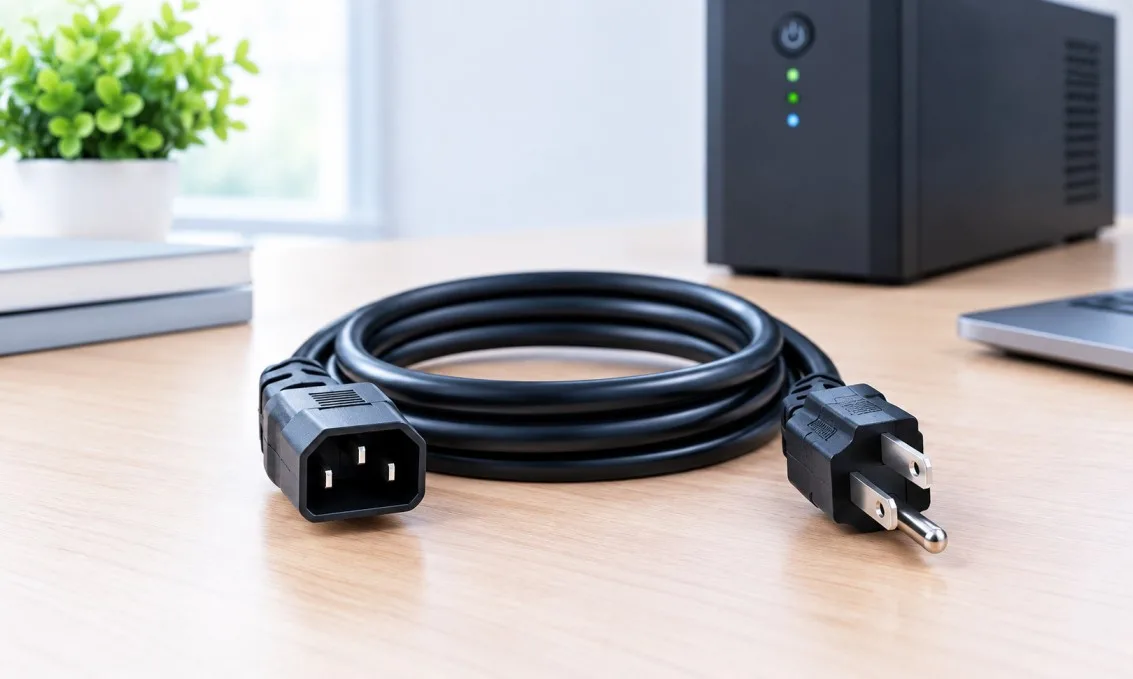
Power cords rarely get attention until a plug will not fit, a device loses power, or a cable feels warm to the touch. A C14 to NEMA 5-15 power cord is one of those unglamorous parts that quietly does an important job. It lets equipment with a standard North American plug draw power from a source that uses an IEC connector, such as an uninterruptible power supply (UPS), a power distribution unit (PDU), or the back of a desktop computer. Choosing the wrong one can mean overheated cable, unreliable power, or a setup that does not meet basic safety expectations. This guide covers the three factors that matter most: length, gauge, and rating.
What a C14 to NEMA 5-15 Power Cord Actually Is
A C14 to NEMA 5-15 cord has two very different ends. The C14 end is a male plug with three flat pins, designed to slide into a C13 outlet. The NEMA 5-15 end is a female receptacle, the familiar three-hole outlet found on walls across North America, built to accept a standard grounded plug. In effect, the cord turns a C13 outlet into a regular wall-style outlet.
A Quick Note on Naming: C14 to NEMA 5-15 vs. NEMA 5-15 to C14
You will see this cord described in different ways. Some listings and manuals say C14 to NEMA 5-15, while others say NEMA 5-15 to C14. Both usually point to the same product, but the word order can confuse buyers. What matters is the physical shape of each end: a C14 plug on one side and a NEMA 5-15R receptacle on the other.
Be cautious with anything that has a plug on both ends. A male-to-male cord can leave live voltage exposed on an open plug, which is a serious shock hazard. It is not a substitute for a properly made C14 to NEMA 5-15 power cord.
It is also important to distinguish a C14 to NEMA 5-15 cord from a NEMA 5-15 to C13 power cord. A NEMA 5-15 to C13 cord has a standard North American NEMA 5-15P plug on one end and an IEC C13 connector on the other, making it suitable for connecting equipment to a standard wall outlet or compatible power source. You may also see this cord described as NEMA 5-15P to IEC 320 C13, while a C13 power cord is a broader term often used for cords that connect an IEC C13 connector to a power source. Checking the connector type and plug orientation is important because these cords serve different purposes even though their names can look very similar.
Start With the Rating: Amps and Volts
Every power cord has a maximum current and voltage rating, and the cord is only as capable as its weakest part. A NEMA 5-15 receptacle is designed for up to 15 amps at 125 volts. The C14 connector, however, is typically rated for 10 amps, and many cords built with it are marked 10 amps at 125 or 250 volts. In practice, most C14 to NEMA 5-15 power cords should be treated as 10-amp cords, even though the outlet end looks like a 15-amp receptacle.
To check your load, add up the wattage of everything you plan to connect and divide by the voltage. A device drawing 600 watts on a 120-volt supply pulls about 5 amps, well within a 10-amp cord. As a habit, keep continuous loads to around 80 percent of the cord's rating. That leaves headroom for startup surges and warm environments.
Understanding Wire Gauge
Wire gauge describes the thickness of the copper conductors inside the cord, measured in American Wire Gauge (AWG). The detail that surprises beginners is that a smaller number means a thicker wire. A 14 AWG conductor is thicker than a 16 AWG conductor, which is thicker than an 18 AWG conductor.
Thicker wire carries more current with less heat and less voltage drop. As a general guide for common flexible cords, 18 AWG suits loads up to about 10 amps, 16 AWG handles about 13 amps, and 14 AWG is used for loads up to 15 amps. For monitors, networking gear, and small electronics, an 18 AWG or 16 AWG C14 to NEMA 5-15 cord is usually appropriate. If the connected device draws more power or runs around the clock, stepping up to 16 AWG gives you extra margin.
Choosing the Right Length
Length seems like the easiest choice, but it affects both safety and tidiness. Longer cords have more resistance, which causes a small voltage drop and a little extra heat. On short runs the difference is negligible, but on a long cord feeding a demanding device, a heavier gauge becomes more important.
Measure the real path the cable will take, not just the straight-line distance. Include vertical runs, bends around equipment, and a bit of slack so the plugs are not pulled sideways. In a server rack or under a desk, short cords of one to three feet reduce clutter and improve airflow. For general desk or workshop use, six feet is a common and flexible choice.
Jacket, Plug Quality, and Safety Certification
Beyond the big three, check the build quality. The outer jacket should suit the environment. A standard thermoplastic jacket is fine indoors, while hot, oily, or high-traffic areas may need something tougher. Look for molded plug ends with solid strain relief, since the point where the cable meets the connector is where most failures begin.
Look for a recognized safety certification mark from an independent testing laboratory, printed on the cord or its label. Certification shows the cord has been tested against established standards for insulation, heat resistance, and mechanical strength. Uncertified cords can look identical but may use undersized conductors or brittle insulation. If a cord does not list any markings, treat that as a warning sign.
Special Situations: Splitter Cords
Some C14 to NEMA 5-15 power cords have more than one outlet. With these, the combined load of every connected device counts against the cord's rating, not each device on its own. Two 6-amp devices already exceed the limit of a 10-amp splitter cord.
Final Thoughts
A C14 to NEMA 5-15 power cord looks simple, but small details decide whether it is safe and dependable. Understand the rating first, match the gauge to your load, pick a sensible length, and confirm the cord carries proper safety markings. Whether you are wiring a rack, powering a monitor from a UPS, or tidying a home office, spending a few minutes on these checks will save you from heat, failures, and replacement costs down the road.
Original Article :- https://thestarbiznews.com/how-to-choose-the-right-c14-to-nema-5-15-power-cord-length-gauge-and-rating/